
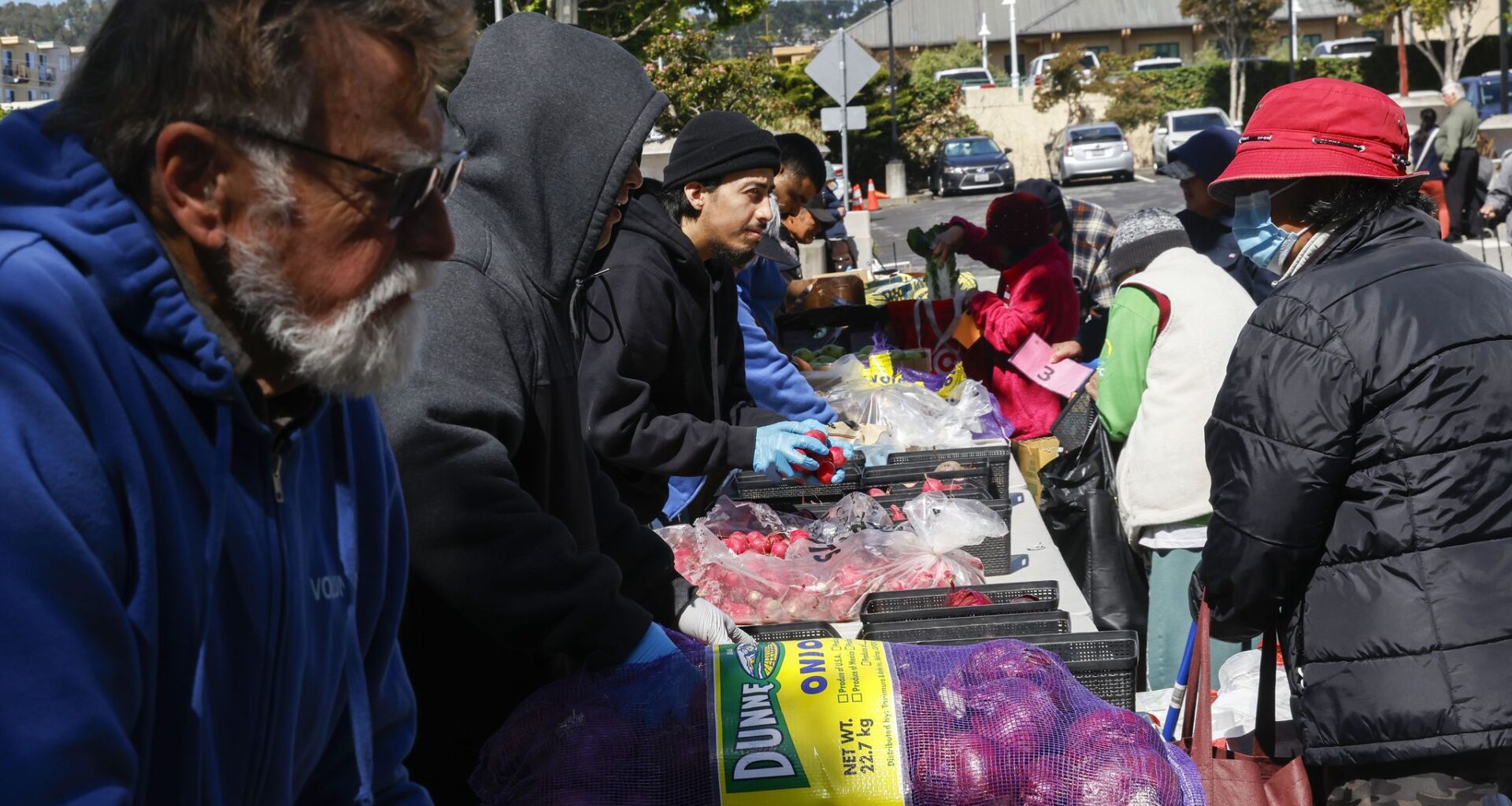
People line up to receive from the food bank at the Daly City Community Service Center on May 13. Some of the city’s services could be in jeopardy because of a little known funding agreement with the state.
Jessica Christian/S.F. Chronicle
As one of the poorest cities in California’s second richest county, Daly City is easy to overlook.
To the north is San Francisco with its $15 billion budget, it’s competing AI behemoths, its Michelin-starred restaurants and $5,000 apartments. To the south is the tech-studded suburbs: home to tech and biotech juggernauts ranging from Electronic Arts to Genentech to Meta. With an average income of $231,000, San Mateo is the second wealthiest county in California — only Marin County is richer — according to data provided by the county.
Daly City, a foggy working-class city of about 101,000 people known for its Filipino culture and mid-century tract housing, has the highest percentage of CalFresh recipients in the county. More than 20% of households qualify — which requires incomes of under $65,000 for a family of four. Daly City’s biggest employers are Recology, the waste management company, and Seton Medical Center.
Article continues below this ad
“We don’t have a YouTube. We don’t have a Google. We don’t have a Facebook,” said Mike Stancil, the executive director of the Daly City Partnership, which provides social services ranging from a food bank to diaper giveaways. “The tax base is not there.”
These days Stancil’s nonprofit is grappling with a fiscal nightmare that could decimate the barebones social network that already struggles to meet demand. Five years ago, the partnership’s three-times-a week food bank served about 300 week. Now it’s closer to 1,100.
Volunteer Yesenia Pleites helps a woman load a bag of food items while at the Daly City Community Service Center food bank.
Jessica Christian/S.F. Chronicle
Surrounded by boxes of pears and bok choy, crates of eggs and cartons of milk, she processes paperwork for new clients.
San Francisco Chronicle Logo
Make us a Preferred Source to get more of our news when you search.
Add Preferred Source
“It’s getting busier and busier — there is so much need,” said volunteer Renee Martinez, a retired title agent who lives on the border of San Francisco and Daly City. “Sometimes they just want a kind word, in addition to services. That is why we’re here.”
Article continues below this ad
But the program, along with social services programs across San Mateo County, is in jeopardy of losing funding because of an obscure 2004 formula regulating how counties get reimbursed for Vehicle Licensing Fees.
In 2004 the local governments across California agreed to give up their vehicle license fees in order to help the state close its budget deficit. Since that time the state has essentially made up for the lost revenue through an annual allocation called the “Vehicle License Fee Adjustment Amount.”
But the payments are tied to “non-basic aid” school district funding, with the money going to districts whose property taxes alone don’t cover minimum funding requirements. Because most school districts in San Mateo County are “basic aid” — meaning their local property tax revenues cover minimum requirements — the county is one of three in the state which doesn’t get adjustment payment.
Volunteer Brenda Hurt organizes bags of rice and beans for people in line at the Daly City Community Service Center food bank.
Jessica Christian/S.F. Chronicle
Between last year and this year, San Mateo has lost out on $157 million, about 18% of other general fund revenues, according to county administrator Mike Callagy, who said withholding the funds would have “devastating impacts.”
Article continues below this ad
“For the County of San Mateo itself, it is incredibly dire,” said Jackie Speier, a San Mateo County supervisor.
The fight over the funding comes three years after the county filed a lawsuit in 2025 seeking to recover the money. The state has disputed the claim, and the case has not yet been resolved in court. In a statement, the California Department of Finance said “the county doesn’t have a legal entitlement to these funds” and argues that the “state has provided them to the county in the past only on a discretionary basis.”
Stancil said Daly City is facing “an apocalyptic event.”
“The whole environment is slowly collapsing,” he said. “It’s all in jeopardy.”
People line up as early as 9 a.m. before the 10:30 a.m. opening of the food bank at the Daly City Community Service Center in Daly City, California Wednesday, May 13, 2026.
Jessica Christian/S.F. Chronicle
Danny Plascentia, director of community outreach for the partnership, said italso delivers to about 250 homebound seniors. Daly City has so few nonprofits that cuts to any of them will impact the whole city. Already the food bank is so busy that “we are running an hour late and running out of food,” he said.
Article continues below this ad
“If funding is cut from one it’s going to impact everyone tremendously,” Plascentia said. “With service numbers already increasing for everyone across the board I don’t know how another core agency would manage that influx.”
Given the wealth of San Mateo County, it’s hard to get sympathy from other California jurisdictions.
“There is this perception that San Mateo is so wealthy and all the cities have plenty of money,” he said. “Here we are talking about cuts that will force fire houses and libraries to shut down.