
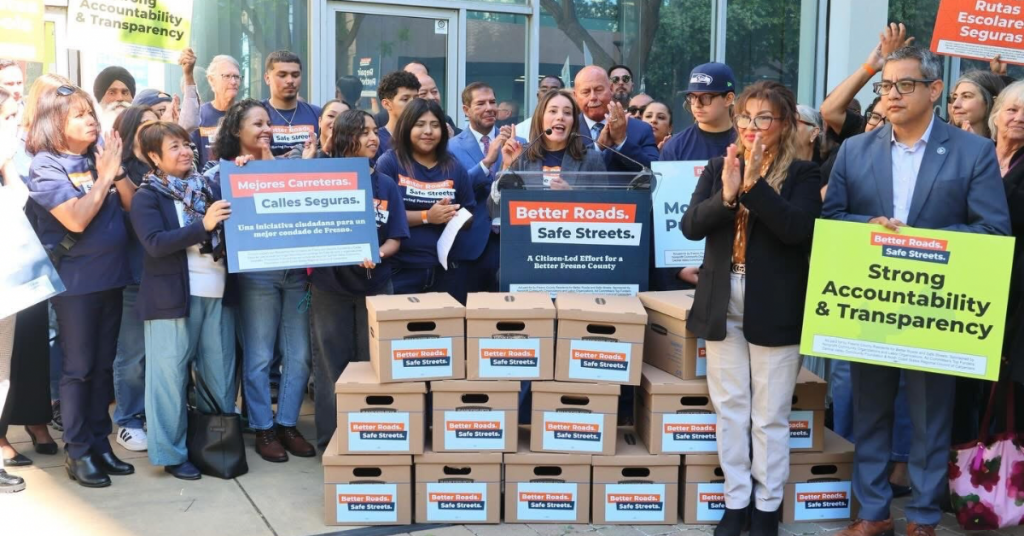
The social justice-backed proposal to succeed Measure C failed its random sampling test of the signatures submitted by backers.
Fresno County Clerk/Registrar of Voters James Kus told The Sun on Monday that the measure – branded the Better Roads, Safe Streets ballot measure – will now have to undergo a manual tally of all 32,000 signatures to qualify for the ballot.
The backstory: The Central Valley Community Foundation, Fresno Building Healthy Communities, Leadership Counsel for Justice and Accountability and the Northern California Carpenters Union spearheaded the citizens initiative to succeed Measure C after torpedoing a government-led effort.
The group took the same funding pots that the Measure C Steering Committee developed last year, allocating nearly 30% of all money raised by the half-cent sales tax to public transit.
Backers submitted more than 32,000 to Kus’s office in April. At the time, the measure could have been placed on the November ballot by the Fresno County Board of Supervisors in May or June, if the random signature sample was approved. The petition needed around 22,000 signatures to qualify for the ballot.
Behind the count: By law, Kus’ office is required to conduct a random sample of at least 500 signatures or 3% of signatures submitted, which ever figure is greater.
With an estimate of more than 32,000 signatures submitted, the Fresno County Clerk’s office took a random sample of 977 signatures.
In order for a ballot measure to qualify for the ballot based on its random sample, the validity rate of the sampled signatures must be high enough that – when multiplied by the total number of signatures submitted – the number of valid signatures exceeds 110% of the minimum threshold.
Kus informed GV Wire on Monday that the sample’s validity rate was too low, generating only 104% of the minimum threshold.
State of play: Because the transit measure failed to reach the 110% threshold, Kus told The Sun that the county will conduct a full count of the petition’s signatures.
His office has a deadline of Aug. 21 to finish its count, but the process could wrap up if the minimum number of valid signatures is identified sooner.
But the county elections office is in one of its busiest seasons, with the June primary coming up in two weeks and with the fact that the county is currently working with seven state propositions at a similar stage of signature review.
Meanwhile, Kus’ office took 34 calendar days to process the random sample of 977 signatures.
Big bucks come up short: The measure’s lead backers – the three nonprofits and Carpenters Union – generated more than $765,000 in campaign cash to fund their signature gathering efforts, spending more than $669,000 on signature gatherers and consultants through March 31, according to campaign filings.
Central Valley Community Foundation, led by former Fresno Mayor Ashley Swearengin, kicked in $500,000 in cash contributions to the effort.
The Northern California Carpenters Union donated $250,000 to the effort.
Fresno Building Healthy Communities, led by social justice executive and Assembly contender Sandra Celedon, donated more than $40,000 in polling and other services to the cause.
Time waits for no one: A major factor that will likely determine if Better Roads, Safe Streets makes it on the November ballot is if the county could somehow validate the signatures by July.
California’s Elections Code sets a statutory deadline of Aug. 7 for the Fresno County Board of Supervisors to place any measure on the November ballot.
Even if the elections office is able to verify the signatures by Aug. 7, the Board of Supervisors’ only regularly scheduled meeting immediately prior to that date is July 14.
Supervisors would need to have a certificate of sufficiency from Kus for the measure by July 10 for it to be agendized for the July 14 meeting, in accordance with Californa open meeting laws.
If the measure does not qualify in time for the November ballot, but nevertheless qualifies, the Board of Supervisors could call a special election for the measure, or it would have to wait for 2028.
Measure C, the half-cent sales tax that has funded Fresno County transportation projects since it was first approved in 1986, is set to expire in June 2027.