
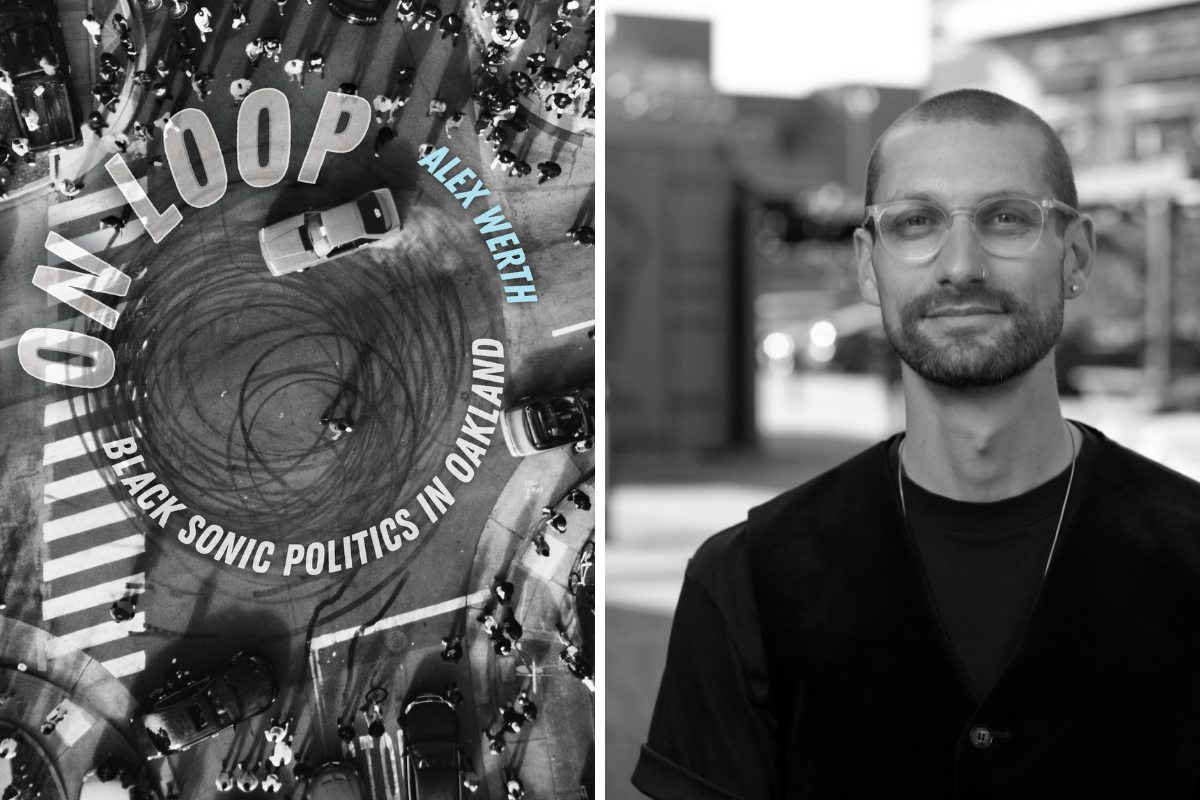
Author Alex Werth spent four years researching the ways police and lawmakers targeted Black music and culture in Oakland over decades. Werth, who has a doctorate from UC Berkeley, used his dissertation as the basis of his new book “On Loop: Black Sonic Politics in Oakland” (UC Press). The book explores the migration from the South and how it influenced the sounds of The Town, the rise of the Hyphy Movement and its effects on culture and nightlife, racially charged events like BBQ Becky, and other topics.
Werth moved out of Oakland a few years ago but is back in town this week to promote his book at various events around the Bay Area, culminating on Sunday, Nov. 2 at Chapter 510.
The Oaklandside recently caught up with Werth to talk about his book and wishes for the revival of Oakland nightlife.
This interview has been edited for clarity and length.
In the book you say Oakland has “a sound. It’s sparse, spacious, intense. Low in tone, high in tempo, it’s like a temple erected to the gods of the deep.” When you visit The Town now, does it sound the same?
My sense is that these sounds are so persistent, tenacious, held with pride and love. I think of a couple of things in particular like an artist like LaRusell. I think about how the spirit and sonics of the movement never went anywhere. It’s still such a touchstone for people growing up in the expanded East Bay. So that feels to me like it’s persistent. It’s held, it’s cherished. I think about community parties at the pergola at the lake.
Now, I do think that there seem to be these threads of continuity and persistence, and ultimately that comes back to just the way that’s found in the kind of lifeblood of expression for Oaklanders. Even with all the disruption, the displacement, the dread that exists in parts of The Town right now, I don’t see it going anywhere, not really.
Critics might say you shouldn’t be writing about Black sound and culture in Oakland because you’re a white guy who didn’t grow up here. How would you respond?
One of the things that felt unique to me about this project was trying to look at this issue of what I call “Black Sonic politics” from many different angles. There’s, of course, Black Oaklanders’ own experience of this. There’s a communal experience of this, and then there’s the way that it gets taken up and targeted from a perspective of governance and policing. I wanted to try to look at it from all of those angles, which meant that I wasn’t just talking to the nightclub owners, the promoters, musicians, DJs, people in the dance scene. I was also talking to people in the planning department, city attorney’s office, permitting division, and several people in OPD. I am a middle class white guy coming in to write this book. And one of the ways that I tried to leverage that positionality was by getting the city people to really go on record. I think they felt very comfortable talking to me about their own attitudes towards these kinds of spaces and practices, and I wanted to use that in order to be able to expose some of the racialized and racist logics that underpin the stories I tell in the book.
This work is the culmination of a 10-year project. It might feel like fly-by-night by somebody, but when I assure that whoever that somebody is, that it was not like that. I spent a long time trying to go as far down on some of these issues and historical moments as I possibly could, and part of it is that I’ve had the honor and pleasure of being able to be in dialog with many longtime Black residents about this work, and the perspective that I’ve gotten from them. And every Black Oaklander is, of course, entitled to their own opinion, but the perspective I’ve gotten from these kinds of relations of mine is, “Oh, I lived that. I kind of had a sense that it was happening over and over again.” They have thanked me for putting in the time in order to connect all those dots. And that’s what I hope is my contribution. There’s so many people who can tell these stories from a more intimate perspective than I can. What I’ve hoped to do is just be able to take the time and methodological tools of being a graduate student for all those years afforded me to connect these dots and try to tell this story in a structural way.
In chapter four, you go into detail about how in the late 1960s venues went from booking live bands to DJs, a practice that remained fairly popular in Oakland until the pandemic. Now, some venues are opting for karaoke nights over DJ nights. Why do you think this shift happened?
I can’t know for certain, but, I would want to know, was this a way of reducing their costs even further, in order to be able to deal with whatever’s happening in the commercial rent department and as well as maybe feeling like they’re getting fewer people in the door? As I talk about in the book, the DJ was more economical than a live band, but karaoke seems like it would be even more economical. So I wonder if it’s partially a response to that.
I wonder what’s happening in terms of both the culture as well as the politics of city politics in particular about dancing. Karaoke is more of an audience listening experience than here to “turn up” kind of experience. But then it’s also written into the city ordinances. This goes back so far with the history of the cabaret permit. It seems so old fashioned where the focus on dancing is what raises the kind of public health, safety, and welfare discourse. It shows you these persistent ideas about the way that dancing can spiral out into forms of social disorder that the city’s job to control.
What surprised you the most when you were researching the Hyphy Movement?
One of the things that I found initially surprising, is the way that the Oakland Police Department came to see hyphy as a proxy for danger and criminality. The way that they very explicitly used hyphy as a discourse and a reference point for who they were going to target.
This came through so clearly from the police officers that I interviewed saying things like “we were looking for people who had a hyphy look because we knew that they were going to be thizzing and going to sideshows.” It became the lens through which they were very explicitly targeting young people of color.
The youth as a demographic bracket comes up again and again over the course of this book, that if you really drill down into it, the people who were experiencing the brunt of the exclusion, the lack of opportunity, the over policing, what the scholar Victor Rios calls the “youth control complex.” This isn’t something I just got from doing the research, it is something I saw having spent a lot of time in Oakland with grassroots organizers, people working in the nonprofit sector.
I love how you described the Hyphy Movement as a “spirited form of affect and embodiment that was endemic to the cultural landscapes of Black youth.” How it “resonated with corporeal pleasure and catharsis rather than intellectual ideals; its party and its politics were indivisible.” To this day, so many of us who grew up and came of age during that time still go back to these sounds, no matter what type of music is popular. Why do you think we have kept the music alive all these years later?
I think about the way that popular music really animates people at a certain point in their coming of age trajectory. It’s the way that that music becomes not just a soundtrack, but an actual medium for particular experiences of sociality, of freedom, of self expression, of full joy and belonging, these profound human experiences that may become available as one enters into their extended youth, and then the music becomes fused with that.
I feel like a lot of people from a lot of different backgrounds and communities and places probably have that. For the hyphy generation, my sense is that’s part of the attachment.
I wrote about this in the book about the Hyphy Movement, almost to its own detriment, from a certain perspective, so focused on this place, and its own scene, its own community, deeply about a particular kind of subculture of the Bay Area, but also, really the East Bay. I wasn’t here for that. I didn’t grow up with that. But I can’t even imagine how exhilarating it would be to feel like they were people who were making this incredible music as a reflection of my own kind of subculture. Also the sense that nobody else gets hyphy outside of the Bay Area, which I think kind of comes along with it. It just feeds back into the pride and the attachment. Nobody else is going to uphold and cherish this music. It’s from us, it’s for us. We have to hold on to it. So I feel like there’s so many layers of emotional attachment there. I’m not surprised at all that it persists.
While working on the book, you found some interesting stats. From 2001 to 2016, for example, there was a surge in nightclubs, but Black ownership dropped 19 percentage points while white ownership grew 41 percentage points. The pandemic once again changed some of those stats and nightlife hasn’t quite recovered. How does Oakland move forward to once again become a thriving nightlife hub?
I don’t know if some of those places I remember have closed, or if those people have sold their businesses. I wonder if they’re just pulling their money out again as Oakland’s fortune takes a dive. It’s this predatory, cyclical thing of ‘we’re only invested when there’s money for us to be made there,’ not really about commitment to the place or the community.
I want to see there be a thriving nightlife in which not only the soundscapes and the dance floors are Black and brown, but also that the spaces are owned and managed by those folks as well, and also knowing the history, that it does not then come with inequitable regulation, suspicion, stigma from the part of the different agencies in the city government that are charged with overseeing nightlife.
I think the real progress is not just ownership, but also equitable treatment under the law, that feels important to me. And the other thing is, not just commercial club spaces but also places like the Malonga Center or grassroots community art spaces. One of the things that’s really special, in my opinion, about the cultural landscape in Oakland is that there is a lot of interconnection between these kind of smaller, underfunded, grassroots spaces, and some of the biggest artists who get a platform and come out of Oakland, and people move seamlessly between those things. It’s part of the ethics of the cultural landscape of the city.
I really worry that with Oakland entering another period of fiscal austerity, the arts and culture are always the first thing to go. So many things have already been chopped or on the chopping block right now. I’m really intrigued by the way that the current moment in Oakland seems to be a kind of looping back to what things were like in the ‘90s and 2000 and the question is, is the city going to do anything differently this time?
“*” indicates required fields