
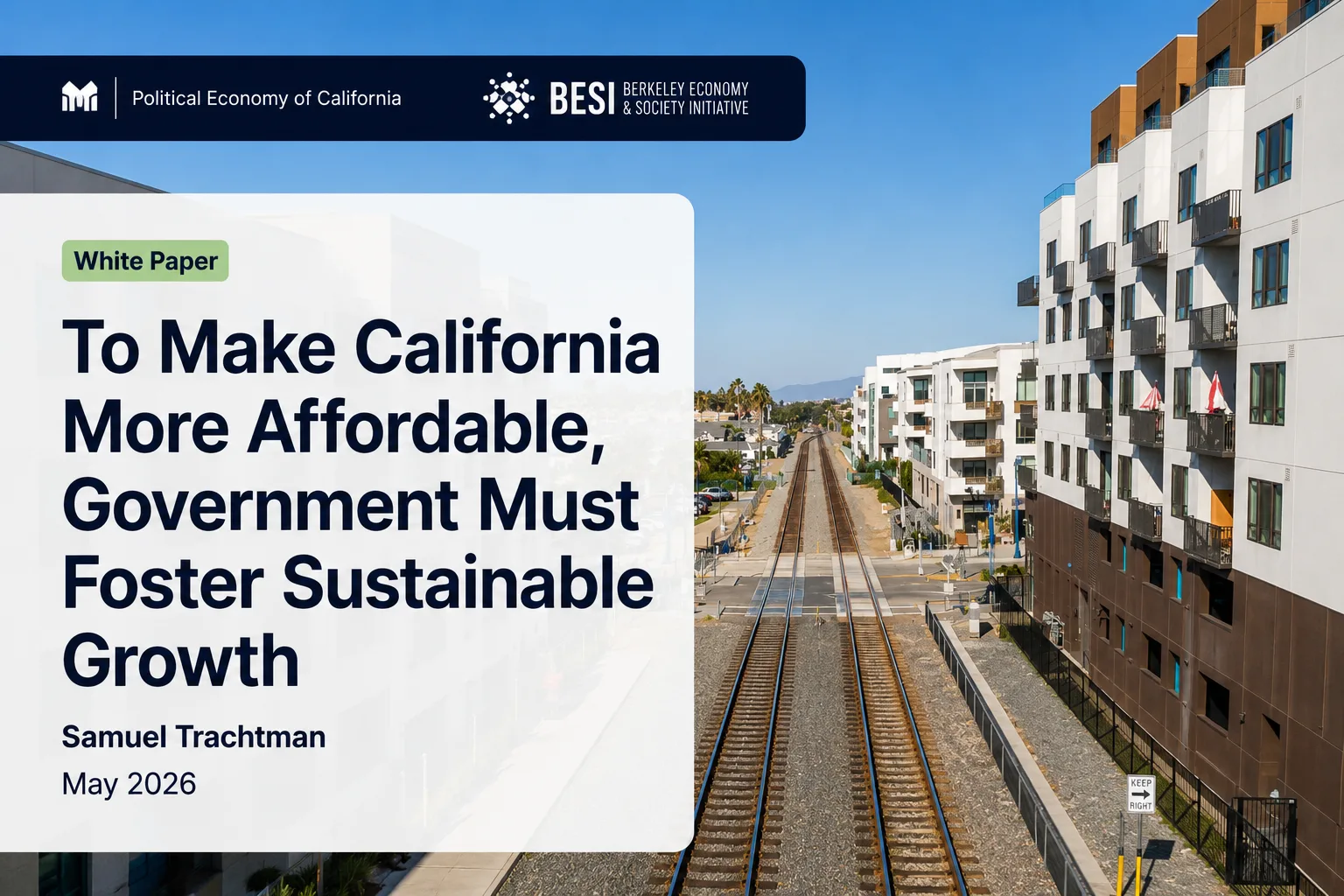
BERKELEY, Calif. — A new white paper released by the Berkeley Economy & Society Initiative argues that California’s affordability crisis is not simply the product of market forces or population growth, but the result of decades of policy decisions that made it increasingly difficult to build housing, transportation systems, energy infrastructure and other essentials needed to support a growing state.
The report, To Make California More Affordable, Government Must Foster Sustainable Growth, contends that the state’s high cost of living is now the central driver of poverty, housing insecurity and out-migration.
“The primary driver of California’s unaffordability and poverty is our high cost of living,” the report states. “As we discussed in the series’ first installment, California is the highest-cost state in the country.”
The paper continues, “California’s metro areas are systematically higher-cost than similarly affluent metro areas in other states. This leads to all sorts of problems, including poverty and out-migration.”
Authored by Samuel Trachtman through UC Berkeley’s Political Economy of California program, the report argues that the “foremost driver” of California’s high costs is a “policy regime that makes it difficult to build the physical infrastructure we need to deliver housing, energy, water, and other essentials.”
The report says, “Growth restrictions drive unaffordability primarily by reducing housing supply and increasing housing costs.” It adds that those restrictions “also contribute to high energy and transportation costs by increasing the price tag on critical public infrastructure — creating downstream costs for consumers.”
According to the white paper, California’s housing shortage is now the single biggest contributor to the state’s affordability crisis.
“High housing costs are the single-biggest driver of unaffordability in California,” the report states. “And the biggest driver of high housing costs is an acute shortage of housing.”
The report argues that stabilizing housing prices will require California to dramatically increase home production after decades of underbuilding.
The paper traces the origins of the crisis back to California’s postwar transformation. During much of the 20th century, the state aggressively embraced growth, investing heavily in highways, universities and water systems to accommodate a booming population.
“In his 1959 inaugural address, Governor Pat Brown characterized California’s explosive growth as ‘magnificent,’” the report notes.
But the report argues that mounting environmental concerns, congestion and backlash against rapid development in the 1960s and 1970s produced a political shift away from growth-oriented policies.
“In stark contrast to his father’s pro-growth 1959 inaugural address, in 1975 incoming Governor Jerry Brown claimed that California was entering ‘an era of limits,’” the report states.
The paper identifies three major policy developments that reshaped California’s housing landscape: restrictive zoning practices, expansion of environmental review under the California Environmental Quality Act and the passage of Proposition 13.
According to the report, zoning policies evolved from simple land-use separation tools into mechanisms that slowed growth and limited housing density.
“Cities started using zoning more aggressively to control the pace of growth,” the report states.
The paper notes that many California cities imposed caps on residential construction, reduced allowable densities and established urban growth boundaries designed to preserve open space and limit expansion.
The report also highlights CEQA as a pivotal turning point in California development policy. While the law was originally designed to ensure environmental review, the paper argues it gradually became a mechanism that enabled opponents to delay or block projects through litigation.
“Opponents of growth quickly recognized CEQA’s potential for blocking unwanted development,” the report states. “Even when they were a stretch, CEQA lawsuits were a vehicle for delay.”
The report argues those delays often impose enormous financial burdens on housing developers, making projects unprofitable and reducing overall housing production.
The paper also points to Proposition 13 as a major structural factor contributing to California’s housing shortage. By limiting property tax revenue growth, the report says the measure changed local government incentives and encouraged cities to discourage residential development while favoring commercial projects that generate sales tax revenue.
“Revenue-hungry cities began imposing ‘impact fees’ on new development,” the report states. “These fees add to the cost of producing new units, meaning fewer projects are profitable to build.”
The report argues California housing prices sharply diverged from the rest of the country beginning in the 1970s as these restrictions intensified.
“Today, California has the most expensive housing in the nation, and it’s not close,” the paper states.
The report cites federal data showing California housing costs were “58 percent higher than the national average and 18 percent more expensive than the next most expensive state, New Jersey.”
It also notes that many Californians can no longer afford to buy homes in the state.
“As of 2024, to qualify for a mortgage for a bottom-tier home a household would need an annual income of $136,000, about 33 percent higher than median household income,” the report states.
The white paper argues that restrictive land-use systems and discretionary approval processes have created a culture of delay and uncertainty that discourages development even in high-demand regions.
“Discretionary review in turn introduces an avenue for public opposition,” the report explains. “It also triggers CEQA review, which opens up a powerful legal avenue for project opponents to delay.”
According to the paper, labor unions, nonprofit groups and neighborhood opponents frequently use those processes to negotiate concessions or halt projects entirely.
The report further argues that California’s infrastructure challenges extend beyond housing into transportation and energy systems.
“Housing costs represent growth restrictions’ most pronounced contributions to California’s unaffordability problem,” the report states. “Yet by increasing the cost of building public infrastructure, growth restrictions also drive up the cost of other essentials like transportation and energy.”
The paper cites rail expansion projects and electricity transmission systems as examples where permitting delays, litigation and fragmented approvals significantly raise costs and extend project timelines.
The report argues California must adopt a “sustainable growth” strategy that lowers construction costs while increasing housing production and infrastructure investment.
“In short, California must foster sustainable growth,” the paper states.
The report calls for reforms that would reduce impact fees, streamline permitting, expand factory-built housing and establish innovative financing systems for affordable housing projects near transit corridors.
“California should adopt a holistic industrial policy to encourage the growth of factory-built housing in California,” the paper states. “Incorporating more manufacturing processes into homebuilding has great potential to reduce the cost to build.”
The report also advocates for new state financing tools.
“The California state government could capitalize revolving loan funds that subsidize the cost of capital for developments that address core state needs,” the paper states.
Politically, the paper argues California faces major obstacles because anti-growth coalitions have become deeply entrenched over decades.
“The legacy of growth restrictions has also empowered a set of organized interests that draw benefits from blocking growth,” the report states.
Still, the paper points to recent legislative reforms as signs of momentum toward pro-housing policy changes, particularly measures enacted in 2025 to reduce CEQA barriers for some infill housing projects.
The report credits Gov. Gavin Newsom with aggressively pushing those reforms through the Legislature.
“The governor refused to sign the budget unless it included AB 130 and SB 131,” the paper states.
Ultimately, the report concludes that California cannot solve its affordability crisis without substantially increasing growth and housing production while coordinating that growth with environmental planning goals.
“California can and should decide how to grow,” the paper states, “but choosing not to grow is a recipe for worsening unaffordability.”
Follow the Vanguard on Social Media – X, Instagram and Facebook. Subscribe the Vanguard News letters. To make a tax-deductible donation, please visit davisvanguard.org/donate or give directly through ActBlue. Your support will ensure that the vital work of the Vanguard continues.
Categories: Breaking News Housing State of California Tags: Berkeley Economy and Society Initiative California California Housing Crisis CEQA Reform Gov. Jerry Brown Governor Gavin Newsom Housing Affordability land use policy Sustainable Growth