

This story is part of our May 2026 issue. To read the print version, click here.
Like many other Capital Region residents, Kevin Wolf went to UC
Davis and “never left.” Since graduating with honors from the
University of California’s second-largest campus by enrollment in
1980, he has spent decades in the Capital Region, founded
sustainable energy company Wind Harvest and, perhaps most
importantly, remained an active member of the community.
“A lot of us want to stay,” he says, “because it is a great place
to live and grow families.”
Wolf founded Wind Harvest in 2005 and has grown the company with
community support in the form of several rounds of crowdfunded
investment. The company sells a vertical axis wind turbine that
can be positioned beneath traditional large turbines to increase
the amount of energy generated from the same surface area and
create synergies that will also increase the efficiency of the
larger turbines.
His path to growth, he says, is in part thanks to state
institutions that are based in California’s capital city as well
as supportive local government and utilities. He is part of a
growing group of CEOs, founders and investors who are choosing
the Capital Region over Silicon Valley as a place to launch their
businesses and careers, especially in fields such as clean energy
and agricultural technology. We spoke to a few to understand why.
Capital perks
Living near the state legislature gives unique benefits, Wolf
says. “Perhaps you find out the parent of the kid that goes to
school with your kid now is on the California Energy Commission.
… You have those kinds of connections that come from living near
the power players of the state. Even if they don’t affect what
you do, you certainly have access to information and advice
because you come to be friends with them.” The concentration of
expertise from lobbying and consulting firms based in the capital
city also means startups will often have a rich pool of potential
employees to choose from.

Kevin Wolf stands in front of a vertical axis wind turbine.
(Photo courtesy of Wind Harvest)
Local universities, such as UC Davis and
Sacramento State, also bring intelligent and inquisitive people
who want to stay and be around other such people, Wolf says. The
constant flow of new ideas and people, combined with a community
that nurtures growth and encourages new and different solutions
to problems, has allowed businesses in the region to succeed
whereas the more growth-first mindset of the Bay Area and its
investors might not.
SMUD has also been a huge boost to sustainable energy businesses
in the region, Wolf says. The community-owned utility closed the
Rancho Seco Nuclear Power Station in the 1980s following a vote
by ratepayers and now generates a large amount of its power from
hydroelectric, solar and wind. SMUD’s willingness to support
sustainable energy and infrastructure is something that several
CEOs in the region have highlighted as an important part of the
choice to start their businesses in the region and their decision
to remain here as their business grows.
Related: The
Future Of Electric Vehicles Is Taking Shape in Sacramento
“You don’t get many utilities like SMUD,” Wolf says. “They are a
huge plus for the region. … They are the leaders on everything
renewable, and they made a hugely successful movement away from
nuclear and into renewables.” SMUD’s use of renewables also means
that, at a basic level, most residents of the region have an
understanding of the viability of renewable power, Wolf adds.
Rick Spencer, managing partner at venture capital firm Growth
Factory, agrees. He says SMUD makes “a great partner, because
they’re big enough to have an impact on a startup, but they’re
small enough to navigate.”
SMUD is not the only pillar of the Capital Region clean tech
community. In 2005, the same year that Wolf founded Wind Harvest,
Gary Simon founded California Clean Start to give support and
resources to clean technology entrepreneurs. California Clean
Start has helped build an investment environment where people
understand that growth for clean tech companies can be less
spectacular than the ultra-high profit, fast growth firms that
Bay Area investors tend to look for, but that it is still
reliable and offers a net social benefit.
“We pitched at half a dozen events,” Wolf says, adding that it
would have been near impossible for his small startup to get in
front of so many experts and investors without the infrastructure
that Clean Start provides.

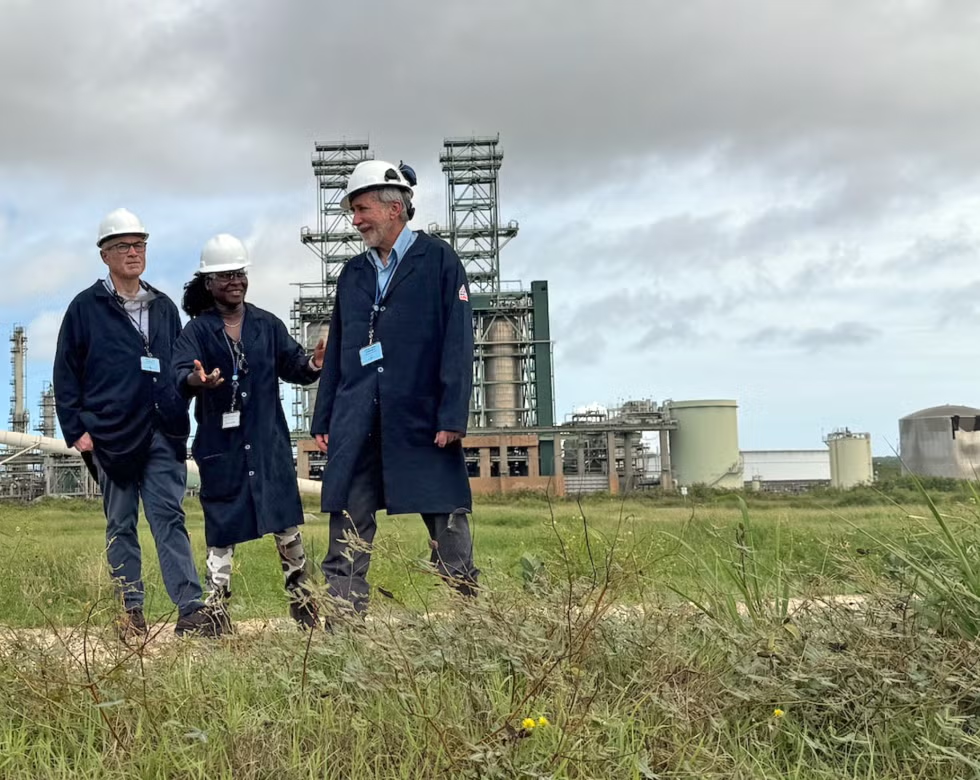
Wind Harvest engineers Olamide Ajala and Omar Garcia visit a
different model of turbine at a Texas testing site. (Photo
courtesy of Wind Harvest)
Outside of the public sector, the
Greater Sacramento Economic Council, a public-private
partnership, helps companies with site selection, staffing, and
local and state level incentives. The council says that both
startups and established firms are moving into the Capital
Region. This shift out of the Bay Area has seen both research and
development and manufacturing move eastward, bringing jobs and
investment to the region.
Samsung has established a small but growing facility in Folsom;
Hynix, a South Korean firm, invested $9 billion in solid state
memory development firm Solidigm, based in Rancho Cordova; and
Bosch has established a semiconductor facility in Roseville. With
tariffs on Chinese goods remaining a constant source of
uncertainty, the Capital Region is becoming a more attractive
site for well-paid manufacturing jobs for the tech industry.
Related: Companies Are
Racing to Fuel and Cool AI
Nonetheless, growth in the clean sector can also be challenging
because of the large amount of regulatory and testing hurdles
that a startup must overcome before it can begin selling
products. Startups “struggle to get capital to get through the
last steps of the commercialization process,” Wolf says.
“You are dealing with an industrial-scale technology in which you
have to go through third party certification. You have to make
two full-scale prototypes and eventually have enough of them in
the ground long enough for a bank to lend using those turbines as
collateral for the note,” he says. This has traditionally made
Venture Capital firms unwilling to invest, Wolf says.
A growing investment network
Ali Mackani, a general partner at Growth Factory Ventures who has
founded seven startups, says that capital was not always easy to
come by in Sacramento. “Early on,” he says, referring to his days
as an entrepreneur in the first decade of this century, “I never
saw Sacramento as a place where I could actually do a startup. …
I never was successful in raising capital in Sacramento.”
Mackani, and others, went to the Bay Area to seek investment and
found that “it was like night and day” compared to the Capital
Region. Today, in part thanks to Mackani and his partners at
Growth Factory, that is not the case. Capital is available to
take firms to a stage where they can grow large and successful
enough to attract investment from outside the region.

Ali Mackani, general partner, and Rick Spencer, managing partner
of Growth Factory Ventures, say that while it used to be
difficult for startups to raise capital in Sacramento, local
entrepreneurs now find support here thanks to the Growth Factory
and others. (Photo by Scott Sayles, courtesy of Growth Factory
Ventures)
“Can we use more capital here? Of course! And that’s our job,
right?” he says. Right now, though, he says Sacramento startups
have everything available in the region to get them to series A,
or their first round of significant venture capital funding.
Mackani says that even though investors in Sacramento are more
numerous than they once were, there is a different focus among
local investors. “In the Bay Area, they build for quick exits,”
he says. Sacramento founders and investors tend to have more
“longevity” in their build and their strategies often focus on
growth not just for their company, but for the community as a
whole.
In Silicon Valley, “You’re trying to change the world, right? So
the Bay Area will jump in and really get behind this, and they’ll
give you money just to see if something will happen,”
Mackani says. “I think in Sacramento, when you’re genuinely
trying to do something, there is a group of people in this city
that passionately care about uplifting the community.” Capital
Region founders and investors are “good people with good hearts,”
he adds, and tend to want to stay in the region they’re investing
in.
Meanwhile, “There’s a ton of transplants that come into the Bay
Area to build, which is great. That’s what makes that community
so vibrant,” Mackani says. But Sacramento often “changes the
mindset” of people who experience it for the first time. “I see
them wanting to do more and wanting to stay.”
‘Triple bottom line’
When Wolf began pitching investors in the Bay Area, “I was in
there explaining we could get a 30 percent margin and they just
dismissed me, saying, ‘If you can’t get 50 percent, we aren’t
interested,” he says, adding that the industry average for clean
energy tech is 20 percent. “At least in Sacramento people would
say, ‘Let me understand this a little bit more.’” He feels that
his business owes a lot to “a less arrogant and more inquisitive
or open place like Sacramento.”
Wolf adds that community support is especially important. “What
you want to have as a startup is patient investors, not those who
want their money back,” he says. Through crowdfunding, “We have
got 3,000 people who would never get a chance to invest in a
technology like ours.”
“I can’t tell you how many people we meet, and we share some of
the portfolio companies, and they’re like, ‘I had no idea these
types of companies were being built here in Sacramento.’”
— Rick Spencer, managing partner, Growth Factory
Mackani and Spencer of Growth Factory both believe that the
region has potential for much more growth. The issue is not that
there are too few people in Sacramento who are able to invest,
but that those people don’t see the Capital Region as a place
where their investments can grow.
“I can’t tell you how many people we meet, and we share some of
the portfolio companies, and they’re like, ‘I had no idea these
types of companies were being built here in Sacramento,’” Spencer
says.
The way he explains the value of investing in startups to local
investors is with the concept of a “triple bottom line.” This
means growth not only in the financial value of the investment,
but also growth in the community and growth in the human capital
in the region. Research published by the US Census Bureau shows
that a startup job creates more jobs than a job at an older
company.
Not only do startups increase human capital in the region, but
Wolf believes the less frantically growth-focused business
mindset and livable communities of the region also help retain
that talent. “We have a big pool of talented people,” he says,
“because they want to live here.”
–
Stay up to date on business in the Capital Region:
Subscribe to the Comstock’s newsletter
today.