
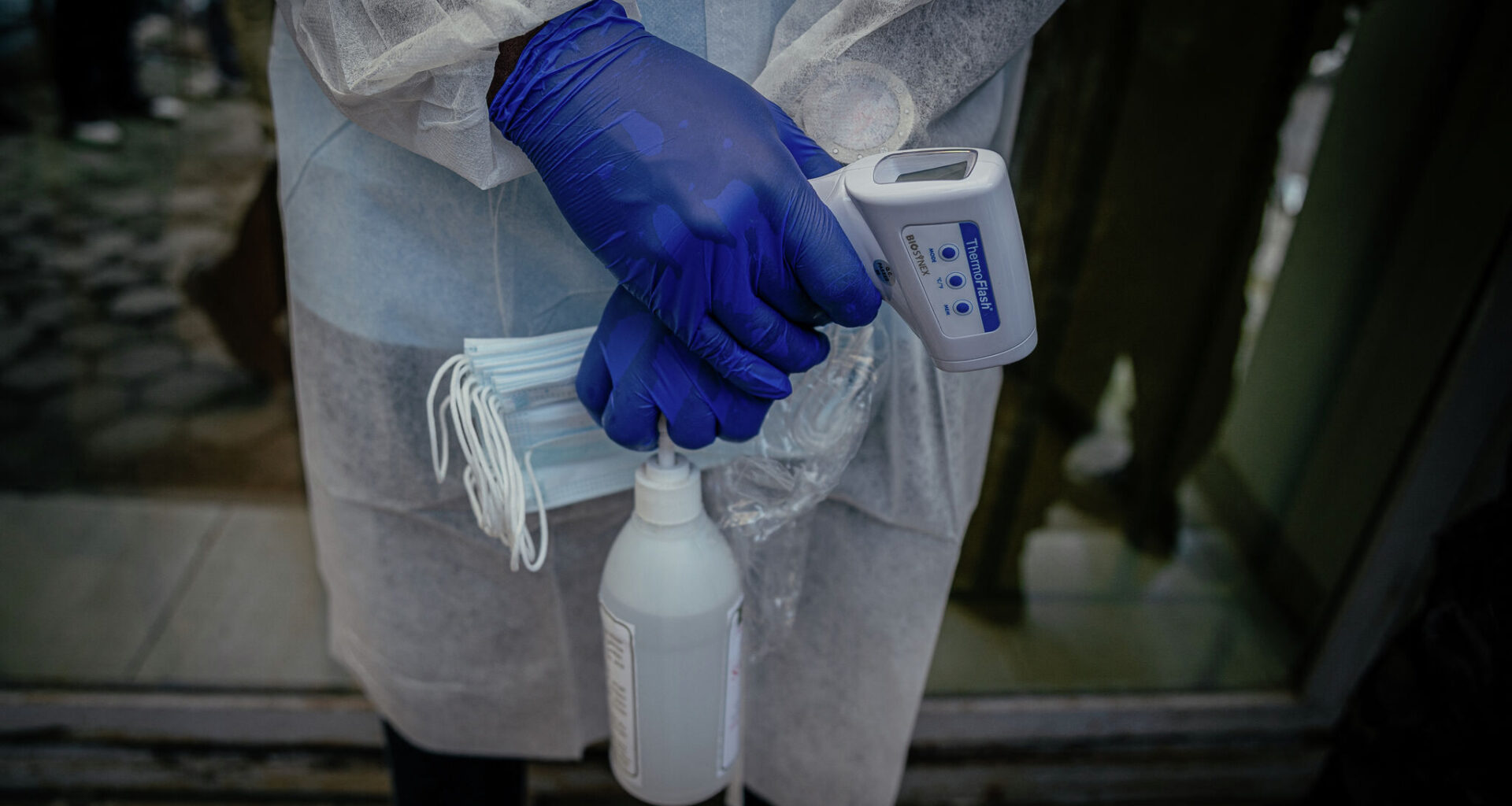
A health worker monitors visitors at a biomedical research institute in Goma, Democratic Republic of Congo, on Tuesday amid a growing Ebola outbreak that the World Health Organization has declared an international health emergency.
JOSPIN MWISHA/AFP via Getty Images
Infectious disease experts are concerned the Ebola outbreak in the Democratic Republic of Congo and Uganda is worsening — and while the risk to the U.S. public is low, they hope it doesn’t reach the devastating scale of the 2014 outbreak that originated in West Africa and killed more than 11,000 people, the largest Ebola outbreak since the virus was discovered half a century ago.
“This is bad,” said Dr. Art Reingold, a UC Berkeley epidemiologist who has helped train health care workers in Uganda on Ebola response efforts. “At the moment, it’s certainly not of the scale of the one in 2014, which was gigantic. On the other hand, this one is bad and unfortunately it appears the response has been substantially delayed.”
Ebola is a type of hemorrhagic fever spread by contact with bodily fluids. While rare, the disease is severe and often fatal.
Article continues below this ad
The current outbreak began in the Democratic Republic of Congo and is believed to have gone unrecognized for weeks, in part because some of the diagnostic tests did not detect the rare strain of Ebola, Bundibugyo. As of Tuesday, 536 suspected cases had been reported and 134 people died, mostly in the DRC, according to the Centers for Disease Control and Prevention.
One U.S. doctor who was working in the Congo as a medical missionary has tested positive for the virus after he was exposed while treating patients, according to Serge, the Christian missions organization he works for.
San Francisco Chronicle Logo
Make us a Preferred Source to get more of our news when you search.
Add Preferred Source
Federal agencies on Monday issued an emergency public health order prohibiting non-U.S. citizens who’ve recently been to three African nations where the Ebola outbreak is spreading — Congo, Uganda and South Sudan — from entering the United States.
The order, signed by the head of the CDC, came a day after the World Health Organization declared the outbreak a “public health emergency of international concern.”
Article continues below this ad
The travel restriction is in effect for the next 30 days. The CDC is also enhancing health screenings at airports for people arriving from areas affected by the Ebola outbreak — the 17th to be reported since the virus was identified in 1976.
Here’s what else to know about the current situation:
People offload a shipment of more than 15 tons of supplies donated by UNICEF as part of the response to the Ebola virus outbreak at Bunia National Airport in Congo on Tuesday.
Moses Sawasawa/Associated Press
Unique challenges to containment
Congo is under-resourced, and the outbreak appears to have originated in rural areas that are difficult to access, making it hard to do contact tracing and medical treatment. Political instability in the region is also hampering public health efforts.
Article continues below this ad
“This is occurring in one of the poorest countries in the world, with incredibly poor infrastructure, bad roads, and roads that become almost impossible when they’re muddy and there’s rain,” Reingold said. “It couldn’t be happening in a worse place in terms of infrastructure and ability to respond.”
There is no vaccine or treatment for this strain of Ebola. A vaccine and monoclonal antibody treatment exist for the Zaire strain, the more common type that caused the 2014 outbreak; however, they’re not effective against the current Bundibugyo strain.
“What that means is the response is going to be things like isolation, quarantine, restricting travel and being more conscious about the burial of bodies,” Reingold said.
Ebola spreads through body fluids like blood, sweat and saliva, and is transmissible to family members and healthcare workers who are changing bedding and clothing for ill people.
Moreover, the Trump administration has dismantled USAID, the federal agency that administered civilian foreign aid and development assistance, which normally would be on the front lines in an outbreak like this.
Article continues below this ad
“We’re in a different post-COVID world now,” said UCSF infectious diseases specialist Dr. Peter Chin-Hong. “There’s less funding for global health overall, the U.S. has pulled out of the WHO, USAID is decimated and the CDC is weakened. That’s the main difference between 2014 and now, we don’t have as much coordinated information-sharing as we’ve had in previous outbreaks that might impact the U.S.”
Aid workers set up an Ebola treatment center in Bunia, Democratic Republic of Congo, on Tuesday, as officials work to contain a growing outbreak.
Dirole Lotsima Dieudonne/Associated Press
What the outbreak means for Californians
Infectious disease experts say the likelihood of Ebola spreading to the U.S is low. Ebola is not an airborne virus, except in very rare cases where sick patients having medical procedures performed on them can cause the virus to get into the air, said Dr. Michele Barry, director of the Center for Innovation in Global Health at Stanford.
“People in the Bay Area should follow the outbreak with interest, but there is very low risk of infection and spread in the U.S.,” Barry said.
Article continues below this ad
During the 2014 outbreak, 11 people were treated for Ebola in the U.S., but most acquired the virus outside the U.S. and were medically evacuated to the U.S. for treatment or entered the country as a regular airline passenger. Two of those people died of the disease, according to the CDC.
People who have plans to travel to the currently affected region or nearby countries should consider postponing.
“I’m not worried as a Bay Area resident, at the moment, that I’m at risk of getting Ebola from someone traveling from the area and infecting me in the Bay Area,” Reingold said. “But I think it’d be wise to postpone travel to (the region), assuming the government would even let you travel, until after the situation is stabilized.”
Outbreak will likely worsen before it gets better
Because the outbreak likely went undetected for weeks, there were potentially many more people exposed who may soon develop symptoms, which include sudden high fever, fatigue, weakness, muscle pain, vomiting, severe diarrhea, rash, and unexplained bleeding or bruising.
The incubation period is up to three weeks.
“I’m sorry to say this is going to get worse before it gets better,” Reingold said. “I think we’re going to be seeing a lot more cases in the coming week or two — some of it recognition of people who were already sick, and some of it people coming down with illness, having been exposed recently.”