
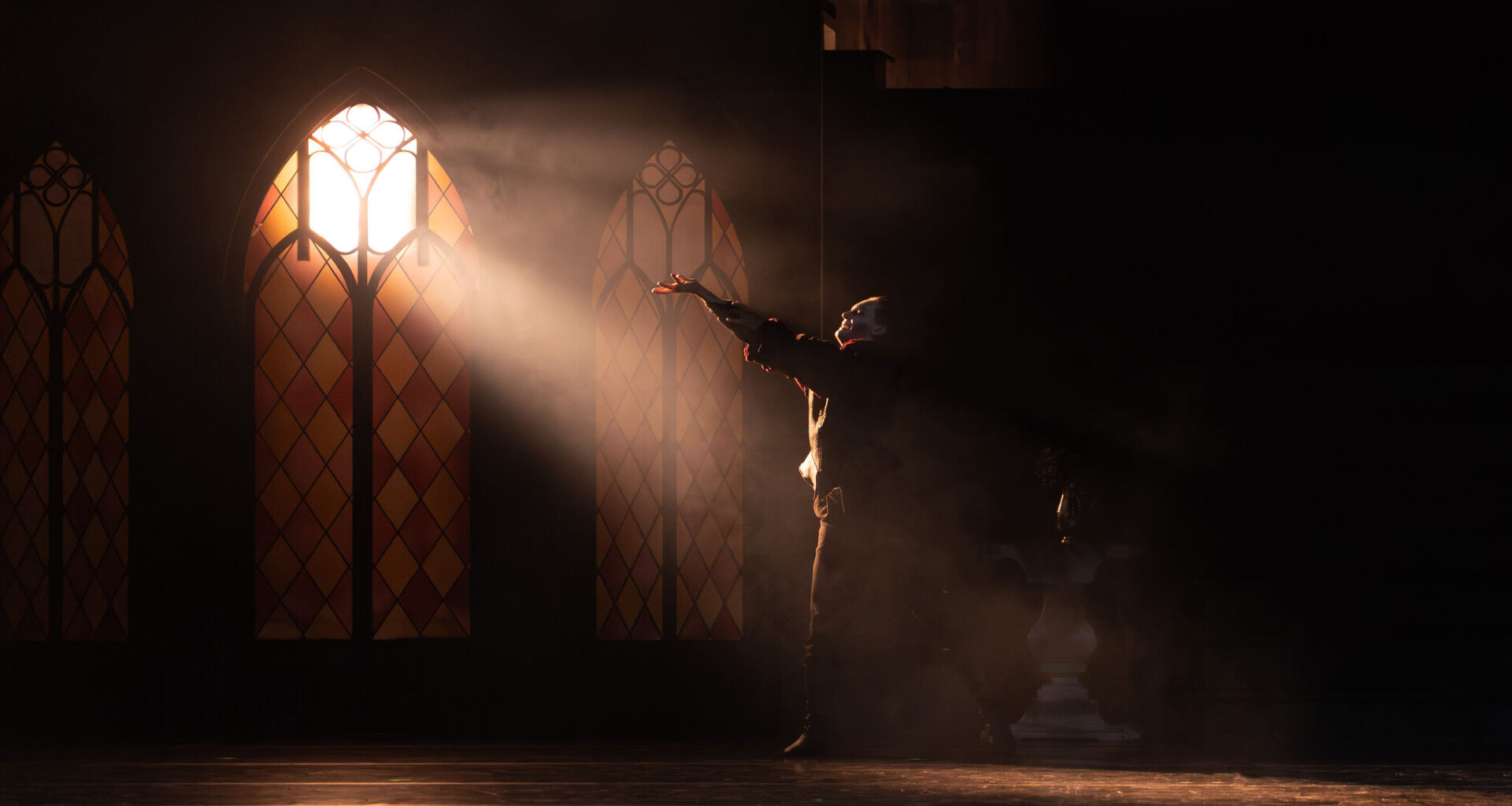
BIG Live’s ballet version of “Dracula” tours to ATG San Francisco’s Orpheum Theatre.
ATG San Francisco
Susi Damilano, left, and Johnny Moreno rehearse San Francisco Playhouse’s “Dracula: A Feminist Revenge Fantasy, Really.”
Charisse Loriaux/San Francisco Playhouse
Director Becca Wolff gives feedback during rehearsal of “Weightless” at Z Space on Feb. 14, 2018, in San Francisco.
Amy Osborne/Special To The Chronicle
If you need a symbol for facism, economic precarity or rapid technological advancement, try “Dracula.”
Renee Fox, an associate professor of literature at UC Santa Cruz and a co-director of the school’s Center for Monster Studies, sees a throughline in the eras when vampire stories peak — the 1920s, the interwar years, the ‘90s, our own. They’re all dominated by uncertainty amid great change.
“There’s not a moment when they fall out of fashion,” Fox said, “because we’re always f—d up.”
Article continues below this ad
Still, with the Bay Area poised to see four adaptations of “Dracula” this year, maybe there’s something special about 2026.
As Becca Wolff, one of the productions’ directors, put it, with a wry laugh, “I don’t know about you, but do you feel like something is just like sucking the life out of you all the time?”
BIG Live’s ballet version of “Dracula” tours to ATG San Francisco’s Orpheum Theatre.
ATG San Francisco
The spate kicks off with San Francisco Playhouse’s production of Kate Hamill’s “Dracula: A Feminist Revenge Fantasy, Really,” which runs through June 27. BIG Live’s ballet version tours to ATG San Francisco’s Orpheum Theatre July 3-12. TheatreWorks Silicon Valley mounts Steven Dietz’s adaptation Oct. 7-Nov. 1, around the same time as Gordon Greenberg and Steve Rosen’s “Dracula: A Comedy of Terrors” gets a Center Repertory Company production.
“Dracula: A Feminist Revenge Fantasy, Really”: Adapted from Bram Stoker by Kate Hamill. Directed by Bill English. Through June 27. $52-$145. San Francisco Playhouse, 450 Post St., S.F. 415-677-9596. www.sfplayhouse.org
“Dracula”: Choreographed by Joel Burke. Performances begin July 3. Through July 12. $59.78-$231.80. Orpheum Theatre, 1192 Market St., S.F. 888-746-1799. https://us.atgtickets.com/whats-on/san-francisco
“Dracula”: Adapted from Bram Stoker by Steven Dietz. Directed by Giovanna Sardelli. Performances begin Oct. 7. Through Nov. 1. Mountain View Center for the Performing Arts, 500 Castro St., Mountain View. 877-662-8978. https://theatreworks.org
“Dracula: A Comedy of Terrors”: Written by Gordon Greenberg and Steve Rosen. Directed by Becca Wolff. Performances begin Oct. 25. Through Nov. 15. Lesher Center for the Arts, 1601 Civic Drive, Walnut Creek. 925-943-7469. www.centerrep.org
The vampire cluster isn’t limited to the Bay, either. Cynthia Erivo is starring in a one-woman “Dracula” in London through the end of May. On Broadway, “The Lost Boys,” adapting the 1987 Kiefer Sutherland vampire film of the same name, recently landed a whopping 12 Tony Award nominations. That follows the hype around “Sinners,” which won four Academy Awards this year, including one for Oakland filmmaker Ryan Coogler.
Article continues below this ad
San Francisco Chronicle Logo
Make us a Preferred Source to get more of our news when you search.
Add Preferred Source
Different artists posit different theories for the current spike.
Bill English, who’s directing San Francisco Playhouse’s production, theorized that “Dracula” helps us investigate the rise of “the toxic male” in 2026. In Hamill’s version, he explained, Dracula “doesn’t have fangs. He doesn’t sleep in a coffin. He looks just like us.”
Susi Damilano as Doctor Van Helsing in San Francisco Playhouse’s “Dracula: A Feminist Revenge Fantasy, Really.”
Jessica Palopoli/San Francisco Playhouse
That insidiousness might tap into another of the monster’s qualities that feels all too relevant. Actor Susi Damilano described her character in the show, Doctor Van Helsing, as a Cassandra figure warning against evil. “No matter how many people speak out, it isn’t changing,” she said.
Article continues below this ad
Wolff, who directs Center Rep’s production, suggested the rise of artificial intelligence might figure in. Like Dracula, robots try to blend in with humans before extracting something from us — if not our blood, our attention or what Wolff calls our “life force.”
Our own Dracula, she said, is “this thing that exists out there that we can connect with instead of connecting with humans.”
Tech overlords themselves might be another factor. We live in an era when tech CEO Bryan Johnson tried to reverse the aging process via blood transfusions from his 17-year-old son and when others, including Peter Thiel, are planning for cryonic resurrection.
BIG Live’s ballet version of “Dracula” tours to ATG San Francisco’s Orpheum Theatre.
ATG San Francisco
In Bram Stoker’s epistolary and diaristic 1897 novel, still another, more banal quality resembles life in 2026: Everyone’s so anxious and drained all the time, and they’re not always sure why. Flip open any random page, and you’re likely to see a reference to it.
Article continues below this ad
“Cannot eat, cannot rest,” goes one section. “I have a sort of empty feeling.”
Later, Stoker writes, “Was this desolation but another link in the chain of doom which seemed drawing tight around us?” Elsewhere, characters keep “looking over their shoulders at every sound and every new shadow, just as I felt myself doing.”
“Dracula,” for all its genuine fright, also comforts. Stoker implies there’s a reason for all that dread and exhaustion. It’s not the digital age or authoritarianism or a vanishing American Dream. It’s a single discrete monster, and it’s vanquishable.
“‘Dracula’ is the story of good, decent people overcoming evil,” said Giovanna Sardelli, who directs TheatreWorks’ production.
Miller (Elizabeth Cowperthwaite, left) guards Renfield (Stacy Ross) in San Francisco Playhouse’s “Dracula: A Feminist Revenge Fantasy, Really.”
Jessica Palopoli/San Francisco Playhouse
Stacy Ross, who plays insane asylum patient Renfield at San Francisco Playhouse, even calls it “aspirational.”
Article continues below this ad
“Could we stake other things as well?” Ross asked. “Is this a cultural response to a regime? And can we, in fact, remove the bad guy who’s bleeding us dry?”
The usual way a monster story works, Fox explained, is as a safe release valve for a culture’s broader fears. “Maybe it elicits certain feelings in you that you don’t necessarily want to acknowledge, but it’s between the pages of a book, and when the book ends that monster is gone.”
But Fox argues that “Dracula” complicates that formula. Even after Stoker kills off the monster, he implies there’s a way his blood might still carry on.
“I come out at the end of ‘Dracula’ knowing that I get to experience it again — that it’s not over, that Dracula is immortal; it doesn’t matter how many times you kill him,” she said.
Part of the forbidden thrill of “Dracula” is the pleasure in pain, the way victims desire the vampire even as they fear him. Fox said one draw is “the idea of being consumed.” Vampires, she said, “literalize” a metaphor for sexual ecstasy.
But for an enervated, fearful populace, the notion of being consumed might have another appeal. Maybe, when you’re consumed by a vampire — or just that engrossed in a story about one — all your other worries skitter away for a little while.