
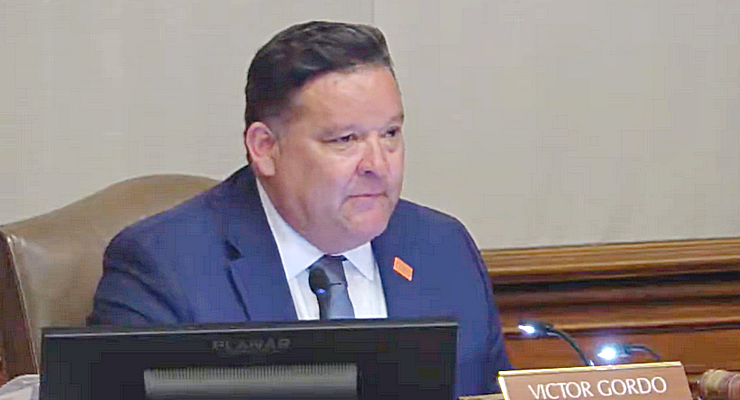
Moments after the City Council voted unanimously on Monday, May 18, to approve a contested 133-unit affordable housing development at 600 North Rosemead Boulevard, Mayor Victor Gordo delivered a sweeping rebuke of California’s housing laws, telling colleagues that Sacramento has “completely taken” land-use decisions away from local elected bodies and is pitting “good people on one side of the housing issue” against “good people on the neighborhood side.”
The mayor’s remarks drew a pointed response from Councilmember Rick Cole, who, after an intervening exchange in which Councilmember Jason Lyon defended the council’s obligation to follow state law and Gordo expanded his critique, said Pasadena’s history of racially restrictive housing covenants — and its alignment with cities that have resisted affordable housing mandates — has eroded the city’s credibility in the state capital.
The exchange came at the end of a public hearing on an appeal of the Design Commission’s approval of the Rosemead Boulevard project, which combines a new five-story, 82-unit multifamily building with the adaptive reuse of an existing two-story office building into 51 dwelling units. Of the 133 total units, 131 are designated affordable and two are manager units.
Councilmember Gene Masuda, who represents the district in which the project will be built, moved to deny the appeal and approve the application. The motion passed 8-0, with Cole, Tyron Hampton, Justin Jones, Jason Lyon, Steve Madison, Masuda, Vice Mayor Jess Rivas and Gordo all voting yes.
Gordo opened his remarks after the roll call by saying he wanted to address “the state’s actions and the mess that it’s causing not just in our city and every other city.”
“One of the reasons we have people on both sides of the issue who are good people who want housing, who support responsible development, but the state has completely taken that out of our hands,” Gordo said. “And we’re going to see more and more of these frustrating hearings where the local elected body essentially has little to no discretion or little to no say, and that’s wrong. That’s wrong.”
He continued: “I think the real culprits in pitting, again, good people on one side of the housing issue and good people on the neighborhood side against one another, is Sacramento’s action.”
Councilmember Jason Lyon followed the mayor, defending the council’s posture as a matter of legal duty and pushing back on public commenters who had urged the council to defy state law.
Resisting state law, Lyon said, “would be nothing but a dereliction of our fiduciary duty to the city and a violation of our oath to follow the laws in the constitution of this state.”
“If people have a problem with state law, the place to take that up is with their state representatives,” Lyon said. “Our job is to make it work as best we can while it is the law, and that’s what we’re doing.”
Gordo then returned to his Sacramento critique, arguing that Pasadena has been “carefully curated” and is “the model for affordable housing,” asserting that the city has developed more affordable housing than most cities its size.
Gordo said the city’s own plan to concentrate density downtown had been “gutted and ripped apart by Sacramento.”
“Sacramento is taking action that loses the confidence of residents because it dictates from Sacramento to their local elected officials on how to do things,” he said. “And I wouldn’t suggest to you that Sacramento’s the best model on how to do much of anything.”
Cole responded that while he agreed Sacramento was “not the best agency to plan our city’s future,” the mayor’s characterization of Pasadena as “carefully curated” was incomplete.
“This is a city where 40% of the single family homes had legal restrictions that no one that was not 100% of the Caucasian race could live there,” Cole said. “So the curation goes both ways. We have to look at the bright side of careful planning that you and others have worked on for literally decades, but also the dark side of the history of this, where affordable housing is concentrated in certain parts of our city and largely absent in other parts of our city.”
Cole said Pasadena loses leverage in Sacramento by aligning with cities that have refused affordable housing.
“When we stand with Huntington Beach, when we stand with … cities that refuse affordable housing, then we have very little credibility in Sacramento,” Cole said. “When we go to Sacramento and say, ‘We don’t stand with those racist exclusionary cities, we would like special consideration’ — and this is where you and I do agree, we should have special consideration — but we have consistently stood against, we’ve stood with the League of California Cities, which has resisted any impingement on what they call ‘local control.’ I think our best argument with our local legislators and with the rest of the legislators is treat Pasadena differently when we do things differently.”
Gordo pushed back, saying the city was “not standing with any one city” but “standing on the principle of our city.” He said Pasadena has “done things right” and is being “penalized” by the state rather than recognized.
Cole, conceding the floor, told Gordo: “You’re the mayor and I’m going to give you the last word.”
Councilmember Steve Madison then raised what he called a “point of order,” objecting to the back-and-forth.
“One councilmember is giving you the last word, mayor, in a debate that is bilateral between the two of you and this all started after we decided a matter and should have moved on on the agenda,” Madison said. “The rest of us feel compelled to either not participate, and then I suppose be accused of not caring as much as you and Mr. Cole, or jumping in.”
Madison said he agreed Sacramento’s housing efforts were “ham-handed” but added he yields “to nobody in my pride for the way Pasadena’s responded to these challenges,” and urged the council to move on.
The Rosemead Boulevard project will use state density bonus law concessions and is located in the East Pasadena Specific Plan area. The council’s action denied the appeal, approved the Consolidated Design Review, approved a private tree removal request involving seven protected trees, and approved density bonus concessions, all subject to staff-reviewed conditions.
Following the exchange, the council took up a related Tax Equity and Fiscal Responsibility Act, or TEFRA, hearing and adopted a resolution approving a plan of finance under which the California Municipal Finance Authority would issue up to $60 million in exempt facility bonds for the benefit of 600 North Rosemead, LP, the project’s borrower. City staff noted the bonds will be the sole responsibility of the borrower, with the city carrying no financial or legal obligation for repayment.
The mayor’s Sacramento remarks landed against the backdrop of a separate set of items that had been listed on Monday’s agenda dealing with the Abundant and Affordable Homes Near Transit Act, or Senate Bill 79, the state housing law set to take effect July 1. Those items — an interim urgency ordinance and a delayed effectuation ordinance that would temporarily exempt certain historic and lower-density sites within Pasadena’s Transit Oriented Development zones from the law — were pulled from Monday’s agenda by the City Attorney before the Rosemead hearing began, due to potential conflicts of interest under review, and are anticipated to return to the council on June 8. At the close of the meeting, the chair confirmed that “all the other business has been deferred.”
The 600 North Rosemead Boulevard project drew heavy public comment. The city clerk reported that 88 postcards were mailed on May 4 and that the clerk’s office received 29 letters in opposition to the project and/or in support of the appeal, 49 letters in support of the project and/or advocating denial of the appeal, one letter from the applicant responding to the appellant’s concerns, and one email containing 119 copies of a form letter in support of the project.
Public testimony stretched across dozens of speakers, with opponents focused on parking, traffic, ambient noise, distance to the nearest major transit stop, and neighborhood compatibility, and supporters arguing the project would deliver critically needed affordable units in East Pasadena.
 Get our daily Pasadena newspaper in your email box. Free.
Get all the latest Pasadena news, more than 10 fresh stories daily, 7 days a week at 7 a.m.