
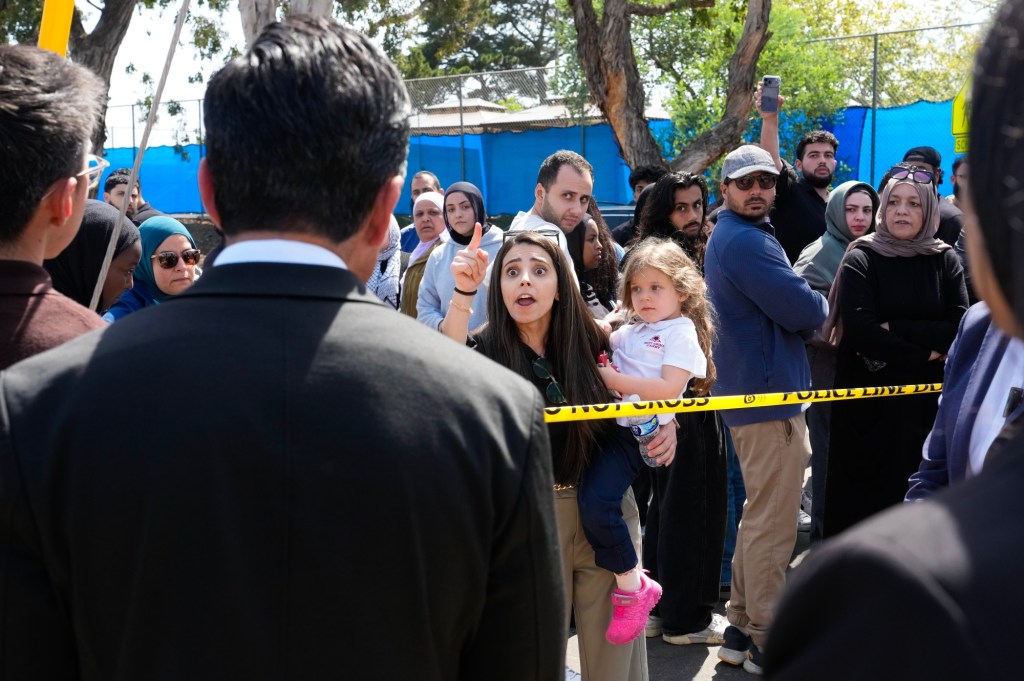
In the wake of the horrific, heartbreaking shooting at the Islamic Center of San Diego, our city stands at a profound and painful crossroads. The raw emotion, grief and subsequent demands from community members for city leadership to step away — vividly captured during the May 18 press conference outside the mosque — should not be dismissed as isolated anger. When a heckler stood up and told Mayor Todd Gloria, “This is a direct result of your leadership. … You have to listen to them,” she was giving voice to a deep, systemic betrayal.
This moment must be recognized for what it truly is: the breaking point of a long-standing pattern of civic exclusion, and an unavoidable demand to completely overhaul how City Hall engages with its Muslim constituents.
To truly understand why the heartbreak outside the mosque quickly turned to anger, city leaders must look past political optics and grasp a foundational concept in Islam, which also parallels the monotheism tradition: the absolute oneness of our community. The Quran states: “Indeed this community of yours is one community, and I am your Lord: So worship Me alone” (21:92).
This spiritual blueprint of unity is further crystallized in the famous teaching of the Prophet Muhammad (peace be upon him), who taught: “The believers in their mutual kindness, compassion and sympathy are just like one body. When one of the limbs suffers, the whole body responds to it with wakefulness and fever.”
This concept is precisely why the devastating genocide in Gaza is not a distant, abstract foreign policy issue to San Diego Muslims. It is an open, bleeding wound felt acutely by our community here at home. Yet when community members packed city chambers to plead for a moral stance and a ceasefire resolution, our local leadership flatly refused to listen.
Compounding this alienation, the mayor and City Council recently rushed through a restrictive definition of antisemitism — one that weaponizes legitimate protections against bigotry to chill constitutionally protected free speech and criminalize Palestinian advocacy. By shutting the door on our grief over Gaza and actively suppressing our right to speak out, local leadership signaled to the Muslim community that our safety, our voices and our pain do not carry equal weight in America’s finest city.
When a hateful rampage takes the lives of three people at our county’s largest mosque, including our heroic security guard Amin Abdullah, it lands on a community that is already exhausted, grieving and hyper-vigilant. The “fever” our community is experiencing right now is a collective response to both a localized physical threat and the political silencing we have endured for months.
Therefore, when leadership was told outside the center that this tragedy is a reflection of their failures, it was a reminder that you cannot ignore a community’s warnings about rising Islamophobia and then expect open arms during a tragedy.
We do not need symbolic photo-ops or boilerplate statements that “hate has no home here” in the immediate aftermath of a tragedy. We need a structural shift in how policy is made. If Gloria and the City Council truly wish to heal this city, they must face the discomfort, sit down with the community and directly address the specific policy decisions that have fractured our trust. True safety cannot be achieved while our free speech is chilled and our collective grief is ignored.
Our theological mandate is to stand together as one body. But as San Diegans, we are also vital limbs of this city’s civic body. The door to dialogue remains open, but City Hall must finally start listening.
Qadan is acting president of the American-Arab Anti-Discrimination Committee’s San Diego chapter and lives in San Marcos.