
La Jolla Traffic & Transportation Board member Mike McCormack has long been a staunch advocate of reduced speed limits. With a California law that went into effect two years ago, he hopes the city of San Diego will be able to better enforce limits.
McCormack led a discussion at the T&T Board’s May 19 meeting that keyed on Assembly Bill 645, which was signed into law in October 2023 and became effective in January 2024. It allows cities to adopt a five-year pilot program for automated speed cameras in safety corridors, school zones and areas prone to speeding to help spot and impose fines on drivers who exceed the posted speed limit.
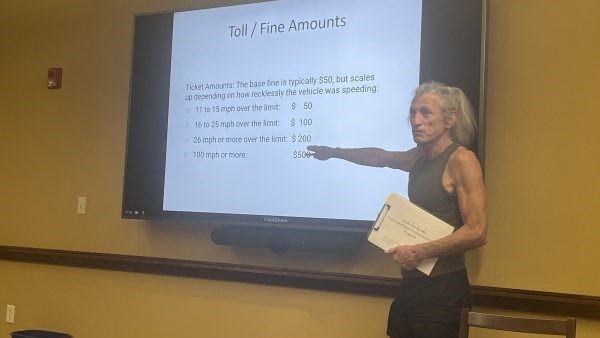
Fines start at $50 and increase depending on how much drivers exceed the limit. The highest fine is $500 for driving above 100 mph. Violations will not go on people’s driving records.
Six California cities — Los Angeles, Long Beach, Oakland, San Jose, Glendale and San Francisco — have adopted the program. Malibu installed speed cameras on a 21-mile stretch of Pacific Coast Highway through Senate Bill 1297.
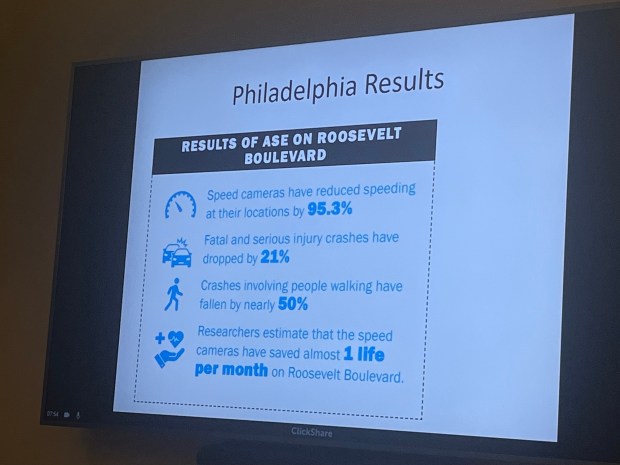 An automated speeding enforcement program on Roosevelt Boulevard in Philadelphia reduced speeding and crashes involving pedestrians and fatal or serious injuries, according to a presentation at the May 19 La Jolla Traffic & Transportation Board meeting. (Noah Lyons)
McCormack said joining those cities would offer San Diego a much-needed deterrent to speeding and help improve safety for pedestrians, cyclists and others.
“The reason we’re passionate about it is the police force doesn’t have the resources to do the kind of enforcement we need to slow speeds down,” McCormack said. “They’re not there. They need help. And this provides a tool to do that.”
Some of the key corridors he said could benefit from speed cameras are Prestwick Drive, La Jolla Boulevard, Nautilus Street, La Jolla Scenic Drive South and Torrey Pines Road.
McCormack, who lives in La Jolla Shores, said his neighborhood speed limit of 25 mph already seems too fast and that driving 30 or 40 mph poses significant danger.
McCormack elicited positive reactions from other board members and the public. The item was for discussion only, and trustee John Bauer recommended that it return as an action item at a future meeting.
Trustee Ross Rudolph called the idea “an absolute no-brainer that should be done,” saying it would reduce the need for police to enforce speed limits and would generate revenue for the city and deter people from speeding.
Fellow board member Tom Brady agreed, saying “I really think it’s an obligation we have to the community of La Jolla and San Diego to have this and discuss and see if we can start putting pressure on the City Council members — all of them — to have them get up to speed.”
The proposal does face a roadblock, however. San Diego’s Transparent and Responsible Use of Surveillance Technology, or TRUST, ordinance states that “while surveillance technology is critical to managing and providing city services and protecting public safety, it can also be used to infringe upon the civil rights and civil liberties of the public.”
Also, T&T member Patrick Ryan pointed out what he sees as a “fatal flaw” in the program: Since violations wouldn’t go on driving records, it might not deter some people enough.
“La Jolla is one of the wealthiest ZIP codes in the United States, and what you could end up with … is a pay to speed program, just like a pay to go in the toll lane program,” Ryan said.
McCormack argued the bill does not remove the ability of police to enforce against excessive speed, which would go on the driver’s record.
Bauer urged the board to take action on speeding.
“Anything is better than where we are today,” he said. “So I’ll take this.”
In March, the City Council approved a comprehensive speed management plan using another state law, AB 43, to reduce speed limits on about 20% of city streets, prioritizing school zones, business districts and areas deemed dangerous because of their history of crashes or other risk factors.
The list of affected streets includes more than 75 segments in La Jolla. ♦