
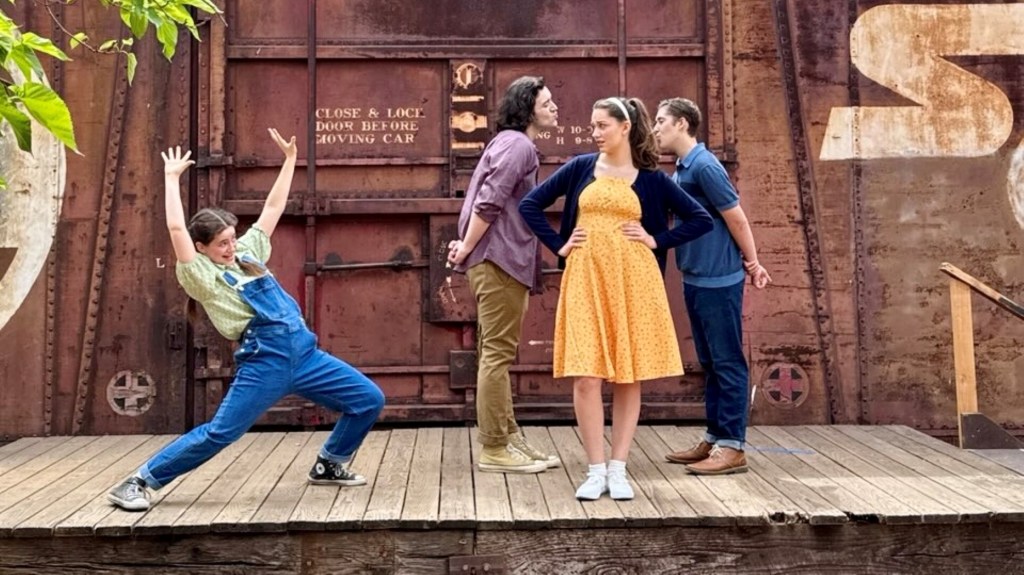
It’s been a long time since a new theater company launched in San Diego.
There’s no money to be made in theater, and the industry has been challenged in recent years with rising production expenses, the loss of federal, state and regional grant funding, and a softening of ticket sales.
But that hasn’t discouraged Poway residents Jacquelyn Ritz and Julia Giolzetti, who this month launched Poway Shakespeare, a new professional theater company dedicated to educating the public on the works of William Shakespeare and presenting the Bard’s plays in outdoor environments.
The nonprofit company’s kickoff production is “Bards with Blades,” a high-energy hourlong show that combines Shakespeare wordplay mixed with high-energy swordplay.
The company made its debut last weekend at the San Diego International Fringe Festival, which concludes its 10-day run on Sunday.
“Bards with Blades” still has two more performances on Friday and Saturday evenings in Old Poway Park. Tickets at sdfringe.org.
READ MORE: Poway Shakespeare, a new professional theater company, to debut this week
READ MORE: San Diego International Fringe Festival returning for 14th year, expanding into Baja California
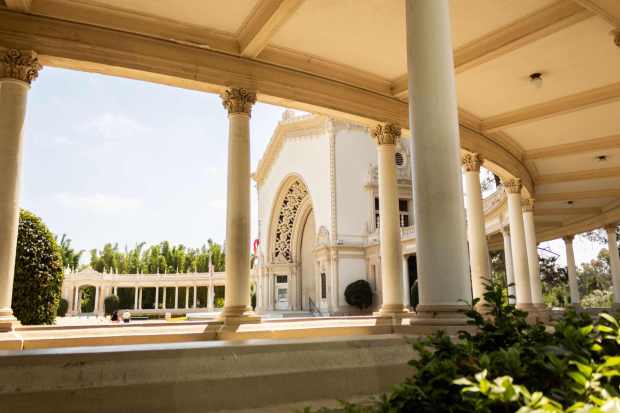 The Spreckels Organ Pavillion on Thursday, Aug. 08, at Balboa Park in San Diego, CA. (Brittany Cruz-Fejeran / The San Diego Union-Tribune)
Music
It’s nearly summer, which means that cities and park organizations all over San Diego County are rolling out their free summer concert lineups.
Unlike many other American cities, where summer afternoons and evenings can mean extreme heat, humidity and hungry mosquitoes at dusk, San Diego summer evenings are usually cool and mostly bug-free.
This makes the free concerts offered in Balboa Park, El Cajon, Coronado, Poway, Point Loma and many more local communities among the region’s most popular community offerings.
U-T staff writer Carlos Rico rounded up all this summer’s free concert series in one story, linked below.
READ MORE: San Diego County’s ultimate guide to free summer community concerts
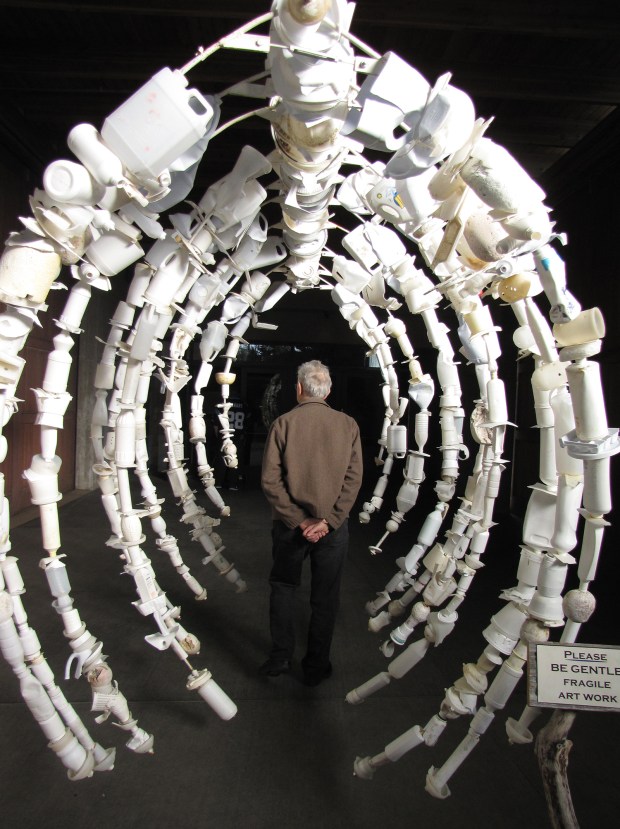 A man walks through a whale’s rib cage sculpture created entirely from ocean debris in “Washed Ashore: Art to Save the Sea,” opening today at the San Diego Natural History Museum. (Washed Ashore Project)
Visual art
To bring attention to the growing catastrophe of manmade ocean pollution, the San Diego Natural History Museum in Balboa Park will open on Friday the exhibition “Washed Ashore: Art to Save the Sea.”
Created by Oregon’s Washed Ashore Project, the exhibit features more than 25 marine creatures — each one constructed entirely from plastic waste collected along coastlines. Marine scientists say that there are 75 to 199 million tons of plastic currently choking our oceans.
At the exhibit, visitors can wander among suspended jellyfish blooms, walk through an 18-foot whale “rib cage,” meet Dexter the Dungeness crab and more.
All of these art assemblages were crafted from ocean debris like plastic bottles and caps, flip flops, sand toys, lighters, nylon rope, and even toothbrushes.
The exhibit is located in the museum’s second-floor art gallery. Details at sdnhm.org.
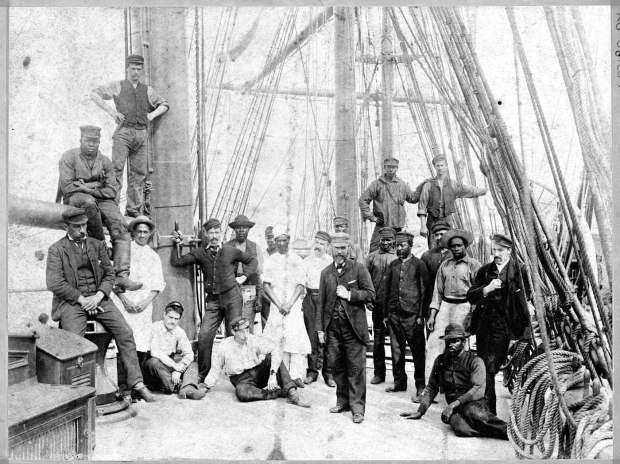 Black and white sailors pose for a photo aboard The Rathburn, a late 19th-century British sailing ship, when it docked in San Francisco in 1892. The photograph is featured in the Maritime Museum of San Diego’s new exhibition “Take Me to the Water: Histories of the Black Pacific.” (Maritime Museum of San Diego)
Nautical history
The Maritime Museum of San Diego will open an historical exhibition Saturday that explores the Black maritime history of the Pacific Ocean.
“Take Me to the Water: Histories of the Black Pacific” was created in collaboration with curator Caroline Collins, an assistant professor of social and spatial justice in the Department of Urban Studies and Planning at UC San Diego.
According to museum President and CEO Christina Connett Brophy, the exhibit will spolight the essential role that Black Americans played in the maritime industry. Although white seafarers disproportionately populated most accounts of the United States’ maritime enterprises, from the 16th to the 20th century, Black whalers, commercial mariners, fishers, explorers, soldiers and sailors traveled along the Pacific coast and across the Pacific Ocean.