
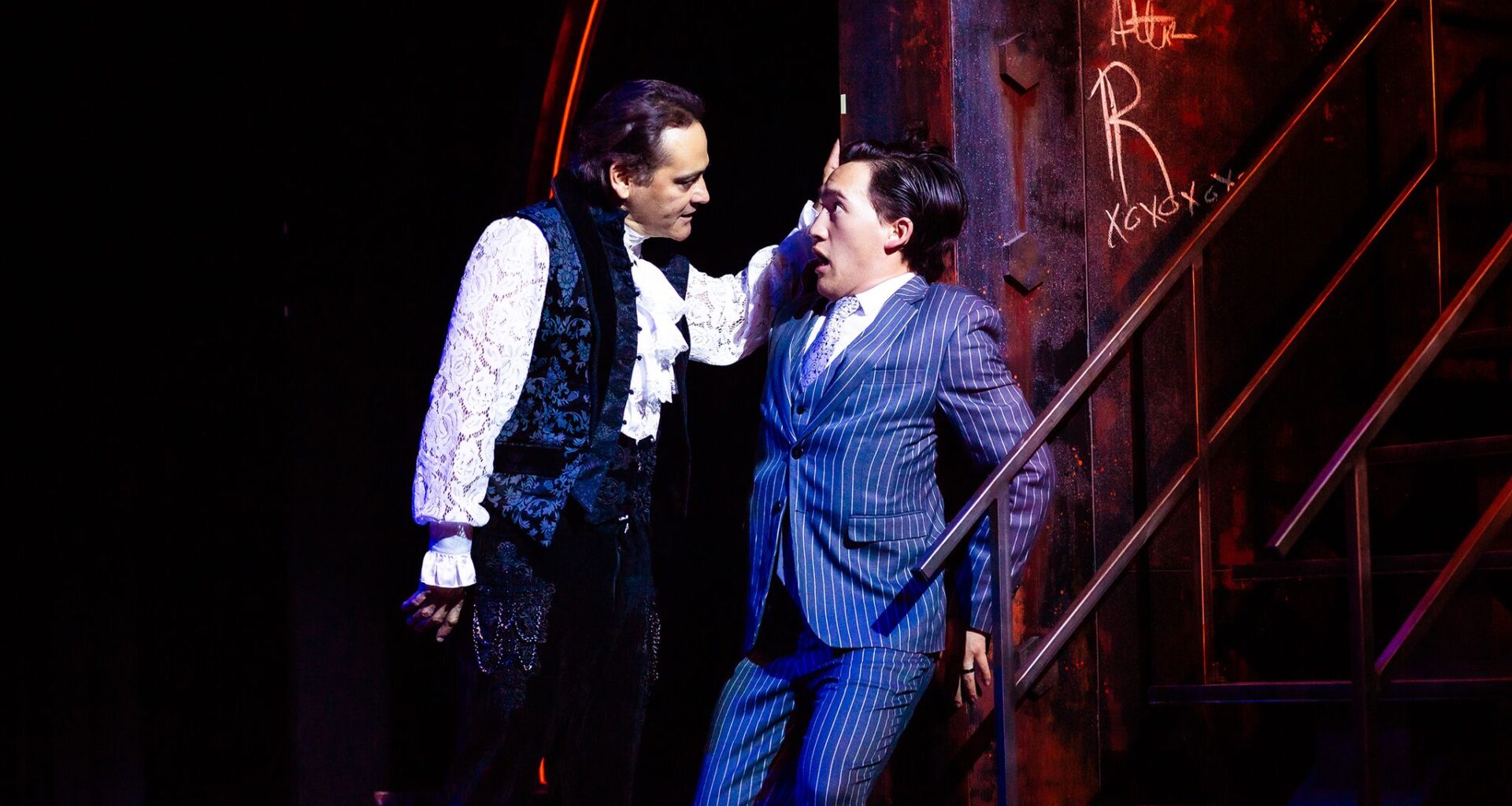
Dracula (Johnny Moreno, left) menaces Jonathan (James Aaron Oh) in San Francisco Playhouse’s “Dracula: A Feminist Revenge Fantasy, Really.”
Jessica Palopoli/San Francisco Playhouse
It’s time to end bumper-sticker feminism in Bay Area theater.
You know the kind. It tells men to stop mansplaining and hepeating. Stop talking over women, and start listening. It says wives don’t exist to obey their husbands and can have their own agendas and pursuits. It urges women to drop ignorant, docile façades and be themselves, and it points out that not everything worth knowing comes from men’s historical and scientific records.

“Dracula: A Feminist Revenge Fantasy, Really”: Adapted from Bram Stoker by Kate Hamill. Directed by Bill English. Through June 27. Two hours, 40 minutes. $52-$145. San Francisco Playhouse, 450 Post St., S.F. 415-677-9596. www.sfplayhouse.org
It’s not that there aren’t still plenty of men who need to learn these things. But preaching such bromides just doesn’t make for interesting plays. In fact, it looks downright retrograde — as if the fight for gender equality is won once you can yell, “Girl power!”
Article continues below this ad
The latest sloganeer to masquerade as art is “Dracula: A Feminist Revenge Fantasy, Really,” which opened Wednesday, May 20, at San Francisco Playhouse. Kate Hamill’s riff on Bram Stoker’s 1897 novel has an intriguing premise: The allure and threat of a bite from Dracula (Johnny Moreno) is, for women, a way out of the confines of marriage.
Lucy (Nemma Adeni) is rebuffed by Van Helsing (Susi Damilano) in “Dracula: A Feminist Revenge Fantasy, Really.”
Jessica Palopoli/San Francisco Playhouse
Of course, it’s a false promise. Dracula’s victims don’t get to gallivant on adventures but become his “brides,” slaves to his bidding, dependent on him for food, aka blood.
San Francisco Chronicle Logo
Make us a Preferred Source to get more of our news when you search.
Add Preferred Source
The monster and the hysteria he inspires could prove a rich stand-in for heterosexual male fragility.
Article continues below this ad
“She chose to leave me?” one of the play’s arrogant men, Doctor George Seward (Josh Schell), says in disbelief after his fiancée, Lucy (Nemma Adeni), falls prey. “To go to this — other man?”
But the play simply stays too shallow.
“Our whole destinies are wrapped up in men,” Lucy laments at one point. “Once we are wed we are little better than their chattel, according to the law.”
Mina (Sharon Shao) approaches danger lurking in the shadows in “Dracula: A Feminist Revenge Fantasy, Really.”
Jessica Palopoli/San Francisco Playhouse
In another world, such a baldly expository line could be amped up for laughs. Hamill’s ludicrous-on-purpose adaptation of “Pride and Prejudice” at Santa Cruz Shakespeare in 2019 went that route to delightful effect. But here, Adeni plays it straight — as if there’s a good reason to establish with her confidante Mina (Sharon Shao) something she and we both have heard a zillion times before.
Article continues below this ad
Similar storytelling gaffes bedevil both the script and the production, which Bill English directs.
A flurry of quick-cut, barely-there scenes resembles more storyboard than story. Exposition so pads the plot that by the time real action rolls around, you barely care any more.
At the same time, crucial rules remain unestablished. If Dracula is omnipresent and omnipotent, why doesn’t he just suck the blood of everyone onstage and end the whole play in about 90 seconds?
When characters realize they’re in the hands of a vampire or see their spouses for the first time in eons, actors barely react. Rather than being in tune with each other, it’s as if the cast members are sealing themselves in individual bubbles, steeling themselves against the scenario they’re in.
Still, a couple performances rise above. Charisse Loriaux, in two small roles, slurps up every syllable as if to speak is to stay alive a moment longer. Shao, as Mina, transforms from streetfighter to mouse in an instant, all while showing how both modes are of a piece. Too many actors underplay, though, as if it’s still rehearsal and they haven’t quite owned their roles yet.
Article continues below this ad
Drusilla (Elizabeth Cowperthwaite, from left), Marilla (Charisse Loriaux), and Dracula (Johnny Moreno) are eager to feed on Jonathan (James Aaron Oh) in “Dracula: A Feminist Revenge Fantasy, Really.”
Jessica Palopoli/San Francisco Playhouse
Special effects give brief jolts of life. Sound designer James Ard’s cue for the neck bites is somehow crunchy, thuddy and squelchy at the same time — even if elsewhere the show overrelies on hard rock electric guitar to try to juice up a lack of tension.
Thanks to “blood specialist” Tristan Fabiunke, blood actually seems to flow through a tube for a transfusion. It globs down the clavicles of Dracula’s slave-wives (Loriaux and Elizabeth Cowperthwaite). At one point, Moreno’s Dracula seems to be able to open a gash in his own bare chest just by tracing a fingertip over it.
But overall, fights are clumsy. In multiple instances on opening night, actors struggled to remove weapons from pockets at the necessary time. Imagine one of those climactic scenes with a James Bond villain, where he could just kill his adversaries instantly but draws it out for suspense. Now take away the restraints or any of the reasons that prevent Bond from fighting back. What you have now is actors awkwardly drifting around, waiting for the script’s arbitrary declaration they can finally do something.
Article continues below this ad
To vanquish Dracula — and sexism — American theater needs more sophisticated tools.