
The choice for voters in the 7th Congressional District has been referred to as a “battle of the ages,” as longtime incumbent Congresswoman Doris Matsui is facing a challenge from a fellow Democrat who’s half her age. The leading Republican candidate is even younger. At 25 years old, he just meets the Constitutional age requirement to serve in the U.S. Congress. While the 7th Congressional District has long centered around the city of Sacramento, under voter-approved Proposition 50 the boundaries shifted and expanded to include some rural and urban areas in El Dorado and San Joaquin Counties. The district now includes parts of Sacramento along with Elk Grove, Lodi, Placerville, Galt and El Dorado Hills. The top two candidates from the June Primary will advance to the General Election in November, and the winner will serve the next two-year term that starts in January. We interviewed the three leading candidates in the race. In alphabetical order: Democrat Doris Matsui has served in the U.S. Congress for 21 years. She’s best known for securing billions of federal dollars for regional flood control and her work to expand access to health care and broadband. Democrat Mai Vang has served on the Sacramento City Council for six years. She teaches in the Department of Ethnic Studies at California State University, Sacramento, and she’s a co-founder of the group “Hmong Innovating Politics.” Republican Zachariah Wooden is a member of the Woodbridge Municipal Advisory Committee. He works at a Stockton nonprofit that focuses on affordable housing, and he’s a political science major at California State University, Sacramento. He is endorsed by Central Valley Impact Republicans and the Sacramento County Republican Party.On the issue of using federal funding to help the parts of the 7th Congressional District with the worst air quality:Mai Vang, Democrat Vang views this as an equity issue, focusing on neighborhoods and rural areas that have traditionally been left out of federal investments. “I know what our rural families are facing. I live in South Sacramento,” Vang explained. “It is much hotter in South Sac than it is in downtown or in Land Park. And a big part of that is because of heat islands that we have, because we don’t have that many trees.” She says she will fight for climate investments in the urban areas with fewer trees. Her plan also extends to rural areas, with work to strengthen wildfire protection. Vang supports legislation that’s often characterized as part of the “Green New Deal,” focused on shifting the economy to clean energy projects and industries. She says her personal experience shaped her views on the importance of targeting neighborhoods with heat islands and poor air quality. “I would be a strong advocate, especially for someone who grew up in an underserved community that has neighborhoods that have been left behind. Communities that have left behind. These are the communities that I’m going to be fighting for,” Vang explained.Zachariah Wooden, Republican Wooden pointed out that parts of San Joaquin County have some of the worst air quality in the state. “It is a recurring issue and that’s partially just because of transportation corridors running through the area. And I’m sure that that also applies to other parts of the district as well,” said Wooden. He would promote regional transportation networks, including public transportation networks, throughout the 7th Congressional District. He envisions the networks connecting Sacramento with San Joaquin and El Dorado Counties, and extending to the Bay Area. That includes improving the traffic flow on I-5 and Highway 99. He said he would also promote energy efficiency, using incentives to encourage adoption. Wooden believes part of the solution is looking at how cities grow and expand, and especially protecting agricultural land from urban sprawl and development. “Cities are increasingly hotter than the areas that they’re surrounded by. And can we densify? Can we densify so that sprawl isn’t so prohibitive with regards to affecting the climate and affecting the environment around it?” Wooden explained.Doris Matsui, Democrat Matsui says instead of giving federal grants to a city or county, she would be more intentional about directing those investments to certain areas. She cited the Sacramento Municipal Utility District (SMUD) as an organization that does a good job using clean energy grants to focus on the areas with the highest needs. She also pointed out that a problem like climate change needs larger scale solutions. “The climate is changing, and the fact is, we aren’t going to be able to live this way, in the way it’s going now,” said Matsui. “So what we want to do right now is be … as focused as possible on how we look at our region.” Matsui said that includes wildfire prevention, since large fires create unhealthy air quality. “We can do this. It takes a little bit more — be more intentional about what we do, being more prescriptive,” explained Matsui.On the issue of making groceries more affordable and/or making food accessible to more people:Zachariah Wooden, (R) Wooden says the price of groceries starts with some of the foundational costs and limitations for farmers, including the water supply. He would like to see more federal investments in water infrastructure for the 7th Congressional District, from flood control to water delivery. “Specifically for food prices, lowering food prices by increasing the water available for production, specifically for farmers in District 7,” explained Wooden. He also cites the increasing cost of transporting food, and said his plan for regional transportation networks is part of the solution that can bring down prices. “We have to look at the middle of how that gets there and how that’s grown. So that includes investment in infrastructure that would increase the capacity for more food to be brought to the market to be sold,” said Wooden.Doris Matsui, (D) Matsui blames President Trump’s tariffs for some of the rising food prices, from the high cost of fertilizer for farmers to the gas prices that make transporting food more expensive. She also wants to restore funding to the federal Supplemental Nutrition Assistance Program (SNAP), which was cut under H.R.1, also known as the “One Big Beautiful Bill Act.” “This is the richest country in the world. We should be able to feed everyone,” said Matsui. Matsui also looks at technology, including developments created at UC Davis, that can increase food production. “Let’s try to build something for small farmers so they can actually be able to make some money,” explained Matsui. “Have farming that is more, accessible, maybe regenerative farming, and be able to use some of the technology in order to maybe, increase the production and things like that.”Mai Vang, (D) Vang points to her work on the Sacramento City Council to support local farmers markets. “Making sure that we have culturally relevant food for our families is really important, making sure that we invest in our local economy and our farmers as well,” said Vang. She pointed out that Sacramento is known as the “Farm to Fork Capitol” of the state, and yet many families in the region have a hard time getting enough food. Among her priorities is restoring the funding to the federal Supplemental Nutrition Assistance Program (SNAP). Those benefits were among the social safety nets that faced deep cuts under H.R.1, also known as the “One Big Beautiful Bill Act”. “As someone who grew up in Sacramento, I am a product of our food stamps, of Medicaid, and had it not been for these programs, I wouldn’t be here today. And right now, these programs are threatened under this administration,” Vang explained.On the generational divides among the leading candidates in this race:Doris Matsui, (D) Matsui said anyone should be able to run for office, but her level of experience makes her the best candidate. “Judge me on my work and not my birth certificate,” Matsui explained. “When we have so much chaos, I think you really need experienced leadership.” At 81 years old, she says she has the experience, effectiveness and energy to hit the ground running if she’s elected to a 12th term. She said she plans to use her experience to rein in actions by the Trump administration. “When we take back the House, from day one to move ahead,” said Matsui. “We cannot sit around and try to figure out what’s going to be going on. I really feel that at this moment, when we have the highest risk ever in this country, we need to have experienced, effective leadership to take this on.”Mai Vang, (D) As a Democrat challenging a prominent local member of her own party, Vang is careful to acknowledge Matsui’s decades of service. “I often share a story of how my mother actually has a photo of the Matsui family on her desk,” said Vang. “As a daughter of a Hmong refugee from the Asian American community, I have deep gratitude and respect for the service and the work that she’s done for our region.” She said she decided to challenge Matsui because she believes more members of Congress need to understand the day-to-day struggles of working families. At 41 years old, Vang is half the age of the woman she’s challenging, but she says her candidacy doesn’t represent a generational divide as much as a socio-economic issue. “The congresswoman is a multi-millionaire, married to a billionaire, and she doesn’t understand the day-to-day struggles of our working families. And we need fighters in the halls of Congress that knows what it means to fill up your gas tank, knows the struggle of being able to pay your mortgage and your rent,” said Vang.Zachariah Wooden, (R) If elected, Wooden would become California’s youngest-ever congressional representative. At 25 years old, he just meets the minimum age to serve in the U.S. Congress. “Why I’m running isn’t because of my age. I don’t think age is a proxy of credibility, but I’m running because there’s a distinct lack, a distinct decrease in opportunity for this country,” explained Wooden. He said his generation is finding home ownership out of reach, along with other benchmarks that are seen as part of the American dream. “Congress can act to reverse a lot of the issues that have generated these circumstances, that have generated the issues that people like me, not just my age, but people like me in general who are working to make ends meet,” said Wooden.Also on the ballot in the 7th Congressional District: Democrat Robby Morin, small business ownerDemocrat Enayat Nazhat, tech entrepreneurRepublican Ralph Nwobi, attorney-at-lawYou can learn more about the candidates on their campaign websites:Doris Matsui Robby Morin Enayat Nazhat Mai Vang Ralph Nwobi and Zachariah Wooden *They do not have active campaign websites as of the time of this report.See more coverage of top California stories here | Download our app | Subscribe to our morning newsletter | Find us on YouTube here and subscribe to our channel
The choice for voters in the 7th Congressional District has been referred to as a “battle of the ages,” as longtime incumbent Congresswoman Doris Matsui is facing a challenge from a fellow Democrat who’s half her age.
The leading Republican candidate is even younger. At 25 years old, he just meets the Constitutional age requirement to serve in the U.S. Congress.
While the 7th Congressional District has long centered around the city of Sacramento, under voter-approved Proposition 50 the boundaries shifted and expanded to include some rural and urban areas in El Dorado and San Joaquin Counties. The district now includes parts of Sacramento along with Elk Grove, Lodi, Placerville, Galt and El Dorado Hills.
The top two candidates from the June Primary will advance to the General Election in November, and the winner will serve the next two-year term that starts in January.
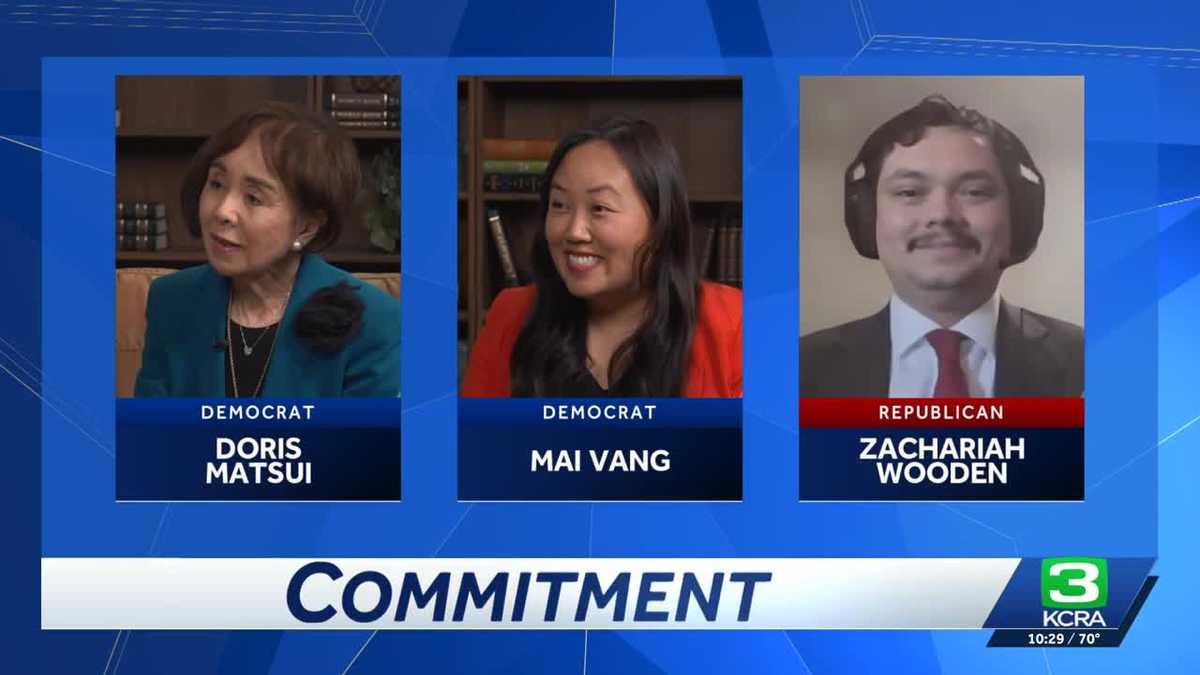
We interviewed the three leading candidates in the race. In alphabetical order:
Democrat Doris Matsui has served in the U.S. Congress for 21 years. She’s best known for securing billions of federal dollars for regional flood control and her work to expand access to health care and broadband.
Democrat Mai Vang has served on the Sacramento City Council for six years. She teaches in the Department of Ethnic Studies at California State University, Sacramento, and she’s a co-founder of the group “Hmong Innovating Politics.”
Republican Zachariah Wooden is a member of the Woodbridge Municipal Advisory Committee. He works at a Stockton nonprofit that focuses on affordable housing, and he’s a political science major at California State University, Sacramento. He is endorsed by Central Valley Impact Republicans and the Sacramento County Republican Party.
On the issue of using federal funding to help the parts of the 7th Congressional District with the worst air quality:
Mai Vang, Democrat
Vang views this as an equity issue, focusing on neighborhoods and rural areas that have traditionally been left out of federal investments.
“I know what our rural families are facing. I live in South Sacramento,” Vang explained. “It is much hotter in South Sac than it is in downtown or in Land Park. And a big part of that is because of heat islands that we have, because we don’t have that many trees.”
She says she will fight for climate investments in the urban areas with fewer trees. Her plan also extends to rural areas, with work to strengthen wildfire protection.
Vang supports legislation that’s often characterized as part of the “Green New Deal,” focused on shifting the economy to clean energy projects and industries.
She says her personal experience shaped her views on the importance of targeting neighborhoods with heat islands and poor air quality. “I would be a strong advocate, especially for someone who grew up in an underserved community that has neighborhoods that have been left behind. Communities that have left behind. These are the communities that I’m going to be fighting for,” Vang explained.
Zachariah Wooden, Republican
Wooden pointed out that parts of San Joaquin County have some of the worst air quality in the state.
“It is a recurring issue and that’s partially just because of transportation corridors running through the area. And I’m sure that that also applies to other parts of the district as well,” said Wooden.
He would promote regional transportation networks, including public transportation networks, throughout the 7th Congressional District. He envisions the networks connecting Sacramento with San Joaquin and El Dorado Counties, and extending to the Bay Area. That includes improving the traffic flow on I-5 and Highway 99.
He said he would also promote energy efficiency, using incentives to encourage adoption.
Wooden believes part of the solution is looking at how cities grow and expand, and especially protecting agricultural land from urban sprawl and development.
“Cities are increasingly hotter than the areas that they’re surrounded by. And can we densify? Can we densify so that sprawl isn’t so prohibitive with regards to affecting the climate and affecting the environment around it?” Wooden explained.
Doris Matsui, Democrat
Matsui says instead of giving federal grants to a city or county, she would be more intentional about directing those investments to certain areas. She cited the Sacramento Municipal Utility District (SMUD) as an organization that does a good job using clean energy grants to focus on the areas with the highest needs. She also pointed out that a problem like climate change needs larger scale solutions.
“The climate is changing, and the fact is, we aren’t going to be able to live this way, in the way it’s going now,” said Matsui. “So what we want to do right now is be … as focused as possible on how we look at our region.”
Matsui said that includes wildfire prevention, since large fires create unhealthy air quality.
“We can do this. It takes a little bit more — be more intentional about what we do, being more prescriptive,” explained Matsui.
On the issue of making groceries more affordable and/or making food accessible to more people:
Zachariah Wooden, (R)
Wooden says the price of groceries starts with some of the foundational costs and limitations for farmers, including the water supply. He would like to see more federal investments in water infrastructure for the 7th Congressional District, from flood control to water delivery.
“Specifically for food prices, lowering food prices by increasing the water available for production, specifically for farmers in District 7,” explained Wooden.
He also cites the increasing cost of transporting food, and said his plan for regional transportation networks is part of the solution that can bring down prices.
“We have to look at the middle of how that gets there and how that’s grown. So that includes investment in infrastructure that would increase the capacity for more food to be brought to the market to be sold,” said Wooden.
Doris Matsui, (D)
Matsui blames President Trump’s tariffs for some of the rising food prices, from the high cost of fertilizer for farmers to the gas prices that make transporting food more expensive.
She also wants to restore funding to the federal Supplemental Nutrition Assistance Program (SNAP), which was cut under H.R.1, also known as the “One Big Beautiful Bill Act.”
“This is the richest country in the world. We should be able to feed everyone,” said Matsui.
Matsui also looks at technology, including developments created at UC Davis, that can increase food production.
“Let’s try to build something for small farmers so they can actually be able to make some money,” explained Matsui. “Have farming that is more, accessible, maybe regenerative farming, and be able to use some of the technology in order to maybe, increase the production and things like that.”
Mai Vang, (D)
Vang points to her work on the Sacramento City Council to support local farmers markets.
“Making sure that we have culturally relevant food for our families is really important, making sure that we invest in our local economy and our farmers as well,” said Vang.
She pointed out that Sacramento is known as the “Farm to Fork Capitol” of the state, and yet many families in the region have a hard time getting enough food.
Among her priorities is restoring the funding to the federal Supplemental Nutrition Assistance Program (SNAP). Those benefits were among the social safety nets that faced deep cuts under H.R.1, also known as the “One Big Beautiful Bill Act”.
“As someone who grew up in Sacramento, I am a product of our food stamps, of Medicaid, and had it not been for these programs, I wouldn’t be here today. And right now, these programs are threatened under this administration,” Vang explained.
On the generational divides among the leading candidates in this race:
Doris Matsui, (D)
Matsui said anyone should be able to run for office, but her level of experience makes her the best candidate.
“Judge me on my work and not my birth certificate,” Matsui explained. “When we have so much chaos, I think you really need experienced leadership.”
At 81 years old, she says she has the experience, effectiveness and energy to hit the ground running if she’s elected to a 12th term. She said she plans to use her experience to rein in actions by the Trump administration.
“When we take back the House, from day one to move ahead,” said Matsui. “We cannot sit around and try to figure out what’s going to be going on. I really feel that at this moment, when we have the highest risk ever in this country, we need to have experienced, effective leadership to take this on.”
Mai Vang, (D)
As a Democrat challenging a prominent local member of her own party, Vang is careful to acknowledge Matsui’s decades of service.
“I often share a story of how my mother actually has a photo of the Matsui family on her desk,” said Vang. “As a daughter of a Hmong refugee from the Asian American community, I have deep gratitude and respect for the service and the work that she’s done for our region.”
She said she decided to challenge Matsui because she believes more members of Congress need to understand the day-to-day struggles of working families.
At 41 years old, Vang is half the age of the woman she’s challenging, but she says her candidacy doesn’t represent a generational divide as much as a socio-economic issue.
“The congresswoman is a multi-millionaire, married to a billionaire, and she doesn’t understand the day-to-day struggles of our working families. And we need fighters in the halls of Congress that knows what it means to fill up your gas tank, knows the struggle of being able to pay your mortgage and your rent,” said Vang.
Zachariah Wooden, (R)
If elected, Wooden would become California’s youngest-ever congressional representative. At 25 years old, he just meets the minimum age to serve in the U.S. Congress.
“Why I’m running isn’t because of my age. I don’t think age is a proxy of credibility, but I’m running because there’s a distinct lack, a distinct decrease in opportunity for this country,” explained Wooden.
He said his generation is finding home ownership out of reach, along with other benchmarks that are seen as part of the American dream.
“Congress can act to reverse a lot of the issues that have generated these circumstances, that have generated the issues that people like me, not just my age, but people like me in general who are working to make ends meet,” said Wooden.
Also on the ballot in the 7th Congressional District: Democrat Robby Morin, small business ownerDemocrat Enayat Nazhat, tech entrepreneurRepublican Ralph Nwobi, attorney-at-law
You can learn more about the candidates on their campaign websites:
See more coverage of top California stories here | Download our app | Subscribe to our morning newsletter | Find us on YouTube here and subscribe to our channel