
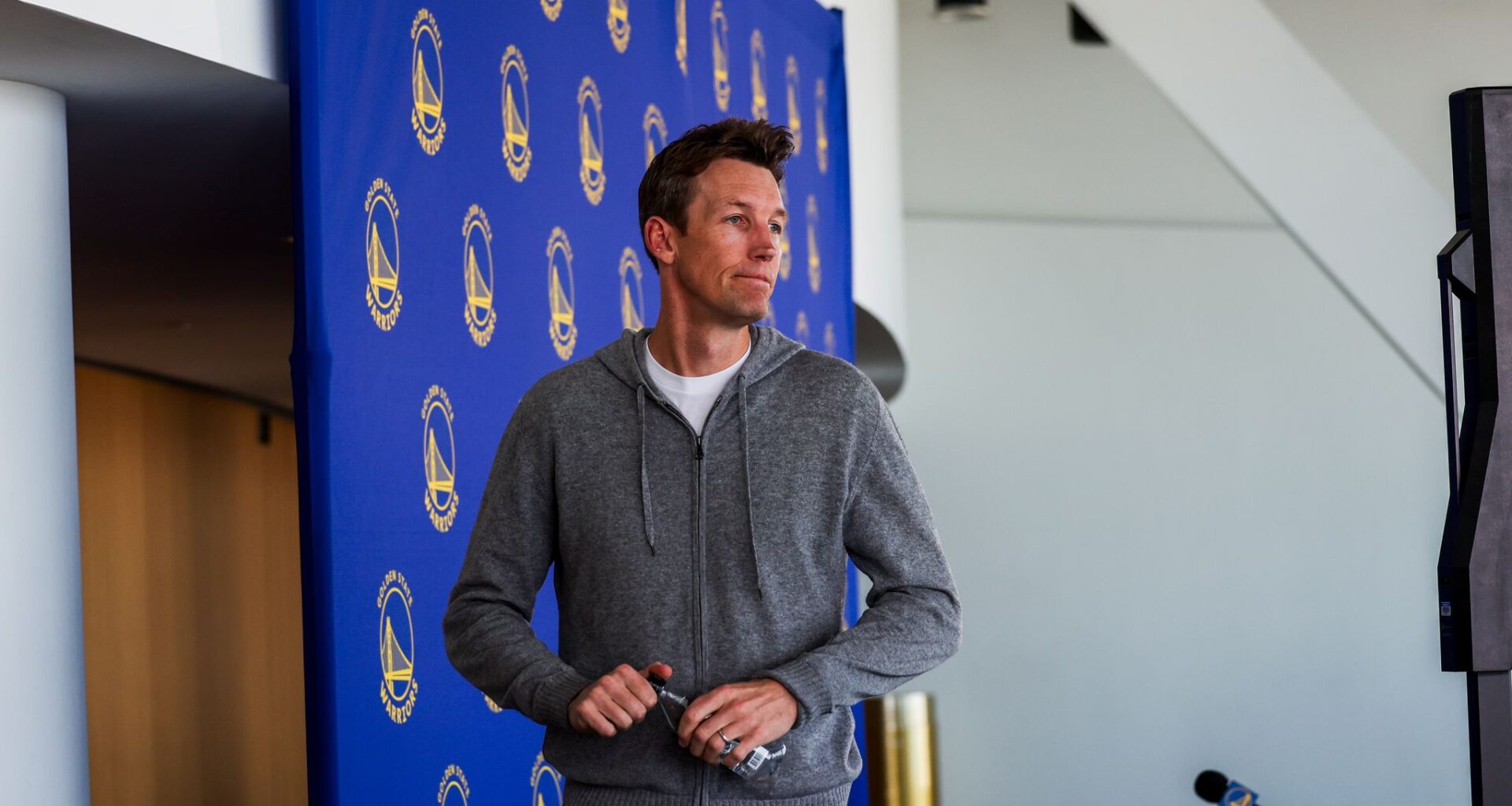
Warriors general manager Mike Dunleavy exits a news conference after addressing the media regarding the return of head coach Steve Kerr at Chase Center on May 15.
Yalonda M. James/S.F. Chronicle
If Golden State Warriors general manager Mike Dunleavy watched the first two games of the Western Conference finals, he probably found himself rethinking a striking statement he made in his news conference last week.
Dunleavy was responding to a question about the conversations leading to Steve Kerr’s return as head coach. How much did they talk about the roster? Does Dunleavy think they can make big improvements this summer?
“This just isn’t about the roster, frankly,” he said. “This year I don’t think we came up short because of the talent on the roster. It was injuries and things we could control. Do we need to get better roster-wise? I think so, but we didn’t get to a point where we played a team where their roster is better than ours.”
Article continues below this ad
Not to be a contrarian — but, yes, this is about the roster.
Dunleavy is smart and savvy, so in retrospect he probably realizes his answer veered from plausible defense of his players to borderline preposterous. Of course the Warriors faced (several) teams with better rosters. That’s patently obvious.
It’s also obvious the Warriors missed the playoffs, in part, because of injuries. Jimmy Butler was sidelined for the season’s final 38 games (and both play-in tournament games) with a torn ACL. Stephen Curry also missed 27 games in the second half, with his own lingering knee injury.
San Francisco Chronicle Logo
Make us a Preferred Source to get more of our news when you search.
Add Preferred Source
Injuries were a factor and so was a roster short on skilled, two-way, long-armed wing players. Both things can be true.
Article continues below this ad
For vivid evidence of the need for those types of players, consider this week’s riveting start to the Western Conference finals between Oklahoma City and San Antonio. Victor Wembanyama has played like a generational basketball alien, but we already knew that about him.
Rookie Dylan Harper announced his arrival on the postseason stage with a transcendent Game 1 performance (24 points, 11 rebounds, seven steals, six assists and only one turnover). Harper joins Stephon Castle, Devin Vassell and Julian Champagnie in giving the Spurs a deep collection of multi-dimensional wings to complement Wembanyama and point guard De’Aaron Fox, who missed the first two games with an injury.
That core matches up well with the Thunder’s similar supply of two-way players, most notably back-to-back MVP Shai Gilgeous-Alexander, Jalen Williams (when healthy), Cason Wallace and Alex Caruso. They give OKC a swarming, relentless pack around 7-foot-1 Chet Holmgren.
Both teams flood the floor with long players who impact the game on both offense and defense. They evoke memories of the position-less Warriors of a decade ago: young Draymond Green, Klay Thompson, Kevin Durant (and Harrison Barnes before him), Andre Iguodala and Shaun Livingston, all causing havoc around Curry.
Those Warriors built this model. Other franchises followed suit.
Article continues below this ad
This past season’s Golden State team mostly featured specialists who needed Curry and Butler to prosper. And, as Kerr noted last week, the Warriors had too many players limited by age and/or injury issues, restricted from competing on back-to-back nights, an inescapable reality in the NBA. That’s the risk of an older roster.
“We need some younger legs, for sure,” Kerr said.
This brings us back to the vital summer ahead for Dunleavy and the Warriors. Deep down, he must know he has to upgrade his roster. He knows Golden State needs younger, fresher, more complete players to achieve Curry’s goal of playing “meaningful basketball” in the final years of his incomparable career.
That doesn’t mean Dunleavy should resist the temptation to check on the cost of a landscape-shifting trade for Giannis Antetokounmpo. He’s one of the top five players in the world, a unique talent, and he’s only 31 years old. Kick the tires on Giannis, absolutely.
But set aside dreams of LeBron James (age 41) and Kawhi Leonard (soon to turn 35). That feels like a reach, too much like sacrificing the future for one last desperate shot at glory.
Article continues below this ad
The more you contemplate the Warriors’ situation, the more it becomes evident their clearest path to improving the roster is by using, not trading, the first-round pick in next month’s draft.
Milwaukee most likely will find a better offer for Antetokounmpo elsewhere, anyway. Then the Warriors will turn their attention to the No. 11 choice in a deep draft, a prime opportunity to address their shortcomings — especially important with Butler and Moses Moody to miss at least the first half of next season.
Dunleavy should be able to find a high-level starter at No. 11, possibly a franchise cornerstone. That’s where the Warriors got Thompson 15 years ago. The Spurs took Vassell (no Thompson but a key player) 11th in 2020. Last year’s No. 11 pick, Memphis’ Cedric Coward, earned first-team all-rookie honors this season.
Also worth remembering: Gilgeous-Alexander was the 11th pick in 2018.
This is not to suggest Dunleavy needs to identify a future, two-time MVP at No. 11. But he can add a multi-skilled player with size and length, to contribute on offense and defense, to step into the rotation sooner rather than later.
Article continues below this ad
Dunleavy cannot afford to miss on his first swing at a lottery pick.