
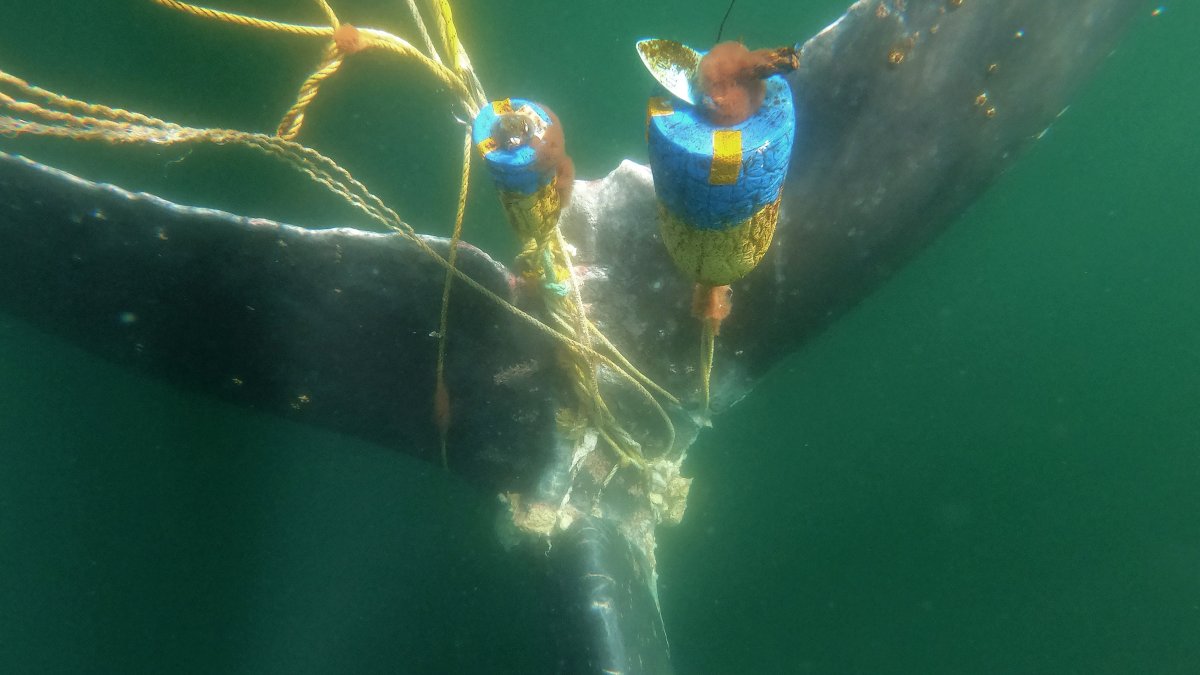
Thousands of fishing traps lost at sea are damaging ocean ecosystems and threatening marine life, including whales, sharks, turtles, and seabirds, according to wildlife experts.
“It’s a really massive problem that requires interesting and scalable solutions,” said Neil Nathan, a marine scientist and researcher at The Benioff Ocean Science Laboratory at UC Santa Barbara. “It does pose a huge risk and threat to a wide variety of marine life here in California.”
California crab fishermen are turning to a high-tech alternative to ensure their gear doesn’t entangle marine life, including endangered whales. Senior Investigative Reporter Bigad Shaban travels off the coast to learn more about the technology and its potential impact on fishermen and marine life.
It’s a really massive problem that requires interesting and scalable solutions.
Neil Nathan, a marine scientist
Conventional fishing traps – aimed at catching lobster, crabs, and shrimp – are set on the seafloor and are attached to rope and buoys so fishermen can locate and retrieve them later. Crab and shrimp fishermen can leave their traps out for up to four days, lobster traps can remain out at sea for up to seven days.
Those dangling ropes attached to the traps can sometimes stretch hundreds of feet long and because the traps can be left out at sea for days at a time, vulnerable wildlife can get ensnared, including threatened and even endangered whales.
Crab traps off the California coast can sit hundreds of feet below the surface, leaving lines of rope dangling in the middle of the ocean that can unintentionally entangle whales. Senior Investigative Reporter Bigad Shaban talks with Raj Mathai about emerging technology called pop-up gear, which is allowing fisherman to remain on the water even after the close of crab season since the equipment doesn’t require ropes to be left out at sea for days on end.
Roughly 500 whales entangled by fishing gear
Fishing gear has entangled close to 500 whales off the west coast over the past two decades, leaving some dead, according to records from NOAA obtained and analyzed by the NBC Bay Area Investigative Unit. So far this year, 1 orca and 9 humpback whales were found entangled. Certain humpback whale populations are so vulnerable that NOAA scientists estimate as few as four whale deaths per year could threaten their long-term recovery.
“All it takes is one spin and [the gear] becomes attached to the whale,” said Brand Little, a California fisherman of more than 20 years. “We can’t seem to keep our gear off the whales.”
Little says while entanglements have been detrimental to wildlife, they’ve also been devastating for fishermen, who’ve watched their crabbing seasons get cut shorter and shorter each year in an effort to protect those majestic mammals.
“We’ve given up months in the beginning of the season, while the whales are still here before they migrate south,” Little said. “We’ve given up months on the end of the season to get the gear out of the water before the whales come back.”
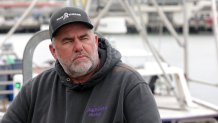
Brand Little is a California fisherman of more than 20 years.
Shorter crab seasons squeeze fishermen
In California, Dungeness crab season is a lucrative one for the state, averaging about $45 million a year, according to the California Dept. of Fish and Wildlife. While the season used to last roughly eight months, in recent years, it has been reduced to sometimes less than three.
Now, for the first time, California is giving Bay Area fishermen the chance to keep fishing after the close of the regular crab season if they use a new type of equipment known as pop-up gear. Unlike standard traps, pop-up gear allows the cages to be set without leaving dangling rope behind. Fishermen use GPS coordinates to find the traps once it’s time to retrieve them and then send out an acoustic signal that triggers the traps to release a buoy and rope back to the surface so the gear can be reeled in. The rope shoots up in seconds But the new technology for the old cages costs about $1,200 per device.
Several traps can be grouped together to share one of the new pop-ups, but depending on how many traps you have, some fishermen could still need upwards of 20 of those new devices.
“It’s a big investment. It’s $20,000, but that buys us the ability to go fishing,” said Little, who was one of the first fishermen to begin experimenting with the gear in 2023 and now uses the gear to catch crab and shrimp. “Eventually, the writing’s on the wall.”
It’s a big investment. It’s $20,000, but that buys us the ability to go fishing.
Brand Little, describing his decision to use pop-up gear to catch crab and shrimp
Just this month, the California Dept. of Fish and Wildlife officially authorized the use of pop-up gear for fishermen targeting Dungeness crab off the coast of the San Francisco Bay Area. The equipment received approval for use in more southern parts of California, along Monterey and Morro Bay, in April.
Of California’s roughly 350 active crab fishermen, about one in five is already using the new pop-up gear, according to the California Dept. of Fish and Wildlife. The state also recently approved the new technology for shrimping, but regulators haven’t gotten any bites from crews wanting to use the gear to catch lobster. However, with this being the equipment’s inaugural season for crab and shrimp, it may not be long before pop-up gear manages to reel in even more fishermen.
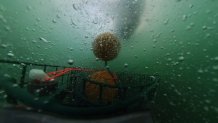
Sub Sea Sonics | Guardian RopelessSub Sea Sonics | Guardian Ropeless
Pop-up gear offers fisherman a high-tech alternative to traditional crab traps, which have historically been tied to lengthy ropes left dangling out at sea for days at a time. Pop-up gear, however, allows traps to sit on the sea floor without that dangling rope. Once it’s time to retrieve the traps, fishermen use GPS to locate the cages and then send out an acoustic signal to trigger the pop-up gear to release a buoy tied to rope that floats to the surface so fishermen can reel in the trap.
Lost at sea
The aim of the gear is to dramatically reduce the amount of time those ropes attached to traps are left dangling out at sea, where they could unintentionally entangle wildlife or get severed by oncoming boats or storms.
“The weather is super rough…and when a boat drives across, the buoy gets cut off,” Little said. “And you’re like, where is it? It’s gone.”
Historically, California fishermen lose more than 6,000 crab and lobster traps each year, according to government records the Investigative Unit obtained from the California Dept. of Fish and Wildlife.
These so-called “ghost traps” can remain lost at sea for years, inadvertently capturing and killing all sorts of marine life, including sharks and seabirds.
“Essentially every trap that is down there has the potential to be killing marine life,” Nathan said. “All these animals can get stuck and trapped in these traps and die.”

Senior Investigative Reporter Bigad Shaban joined marine scientists and researchers on a boating expedition to recover lost fishing traps off the coast of Santa Barbara.
All aboard
Nathan and his team invited Senior Investigative Reporter Bigad Shaban to join them on one of their expeditions to recover lost traps about 20 miles off the coast of Santa Barbara.
Going off tips from local divers, researchers believed ghost traps could be down below. But along the seafloor, visibility was often murky.
“It’s almost like being on a scavenger hunt down there,” Nathan said. “It’s dark, there’s algae, there’s kelp, there are rocks covering things. It can be a bit challenging to find them.”

Neil Nathan, a marine scientist and researcher with UC Santa Barbara’s Marine Science Institute, is working to find and recover fishing traps lost at sea.
Training artificial intelligence how to fish for ghost traps
Which is why scientists are now working to train artificial intelligence to analyze sonar technology to spot the ghost traps autonomously and then provide the exact coordinates to researchers.
“It’ll make us a lot more efficient in finding these traps when underwater,” Nathan said. “These traps have a very unique signature on sonar, given that they are rectangularly shaped and made of metal.”
When scientists started reeling in the abandoned fishing gear, they found many filled with marine life, including lobster, which the traps are actually designed to catch. Yet, with no one coming to collect them, they would just die in the traps and become bait for the next lobster.
Impacts to one specific species can trickle down and have impacts on the rest of the ecosystem.
Neil Nathan, speaking about the potential harm caused by abandoned fishing gear known as ‘ghost traps’
The cycle could, unfortunately, repeat itself for years, at the detriment of fishermen and the environment.
“Impacts to one specific species can trickle down and have impacts on the rest of the ecosystem,” Nathan said. “[Ghost traps] are presenting a clear and ever-present risk to the marine life.”
Scientists retrieved a dozen ghost traps during the trip off the coast, but thousands more will likely be added to the ocean floor by the end of the year. Thus, however many traps researchers are able to recover, they will likely only represent a small fraction of what remains out at sea.
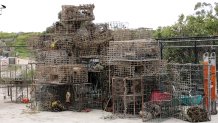
Researchers and scientists at UC Santa Barbara recovered more than 30 ghost lobster traps over the course of a five-day search effort out at sea.
The escape hatch
California law requires the metal cages be outfitted with trap doors that eventually disintegrate to give sea life an exit if the trap is lost.
“Each trap destruct device shall create an unobstructed escape opening in the top or upper half of the trap of at least five inches in diameter,” state California regulations.
Nathan and his team, however, have found traps still in one piece months or even years after they were originally set.
“This trap is still sealed shut,” Nathan points out while providing a tour of the recently recovered ghost traps. “The hinges — they’re keeping this door attached — they should be degrading faster.”
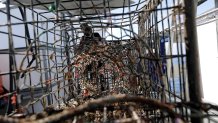
California law requires fishing traps to partially disintegrate when lost at sea in order to prevent marine sea from being unintentionally caught and killed. Marine scientists, however, argue those materials don’t always break down, leaving some traps fully intact, without an escape hatch, months or even years after they were set.
California law requires the metal cages be outfitted with trap doors that eventually disintegrate to give sea life an exit if the trap is lost.
In hopes of creating fishing cages that better comply with state regulations, researchers at UC Santa Barbara have been working on a new kind of biodegradable material for fishing gear.
“We’ve been trying to think of ways to replace those petroleum-based plastics with other materials,” said Alyson Santoro, a microbial oceanographer who has been leading the research.
“By some estimates, there may be more plastic than fish in the ocean by the year 2050, so finding different types of materials to use in the ocean is really, really important.”

Alyson Santoro (left) is an oceanographer and UC Santa Barbara professor who specializes in microorganisms. Her research is focusing on how to construct certain types of fishing equipment out of biodegradable materials, in part, to reduce the amount of plastic pollution in the ocean.
Preventing ghost traps
In addition to potentially reducing the amount of plastic pollution in the ocean, the research could ultimately lead to creating a new type of trap door that more reliably disintegrates when the trap is lost at sea.
“When you are having potentially thousands and thousands of traps lost every year and accumulating in these ecosystems, it’s too large of a challenge to solve with cleanup alone,” Nathan said. “We really need to invest more time and energy in solutions to how we prevent trap loss in the first place.”
Some of the largest and most vulnerable species just may depend on it. At stake is a huge environmental cost and an economic one, according to Brand Little.
The entire commercial fishing industry is at stake.
Brand Little, California fisherman
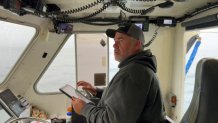
Brand Little prepares to use summon his fishing traps by sending out an acoustic signal that triggers the traps to release a rope and buoy to the surface.
“It’s a lot of opportunity lost,” Little said. “The entire commercial fishing industry is at stake.”
Little says it’s not just about the price of replacing missing gear. He says he’s also lost out on the ability to catch more seafood. When a trap goes missing, fishermen aren’t allowed to set additional traps until the next season.
“It’s literally cut our crab business in half,” he said.
Little says the losses can add up to tens of thousands of dollars. But ever since he started using the pop-up gear, he tells us he hasn’t lost a single trap.
“I don’t want to have to pay to use it, but I’m going to sink without it –so you adapt or die,” Little said. “It gives us a lifeline and it may be the only thing that saves the industry.”
The lead imagery at the top of this story were provided courtesy of Pieter Folkens (NOAA Permit #18786).
Contact The Investigative Unit
submit tips | 1-888-996-TIPS | e-mail Bigad