
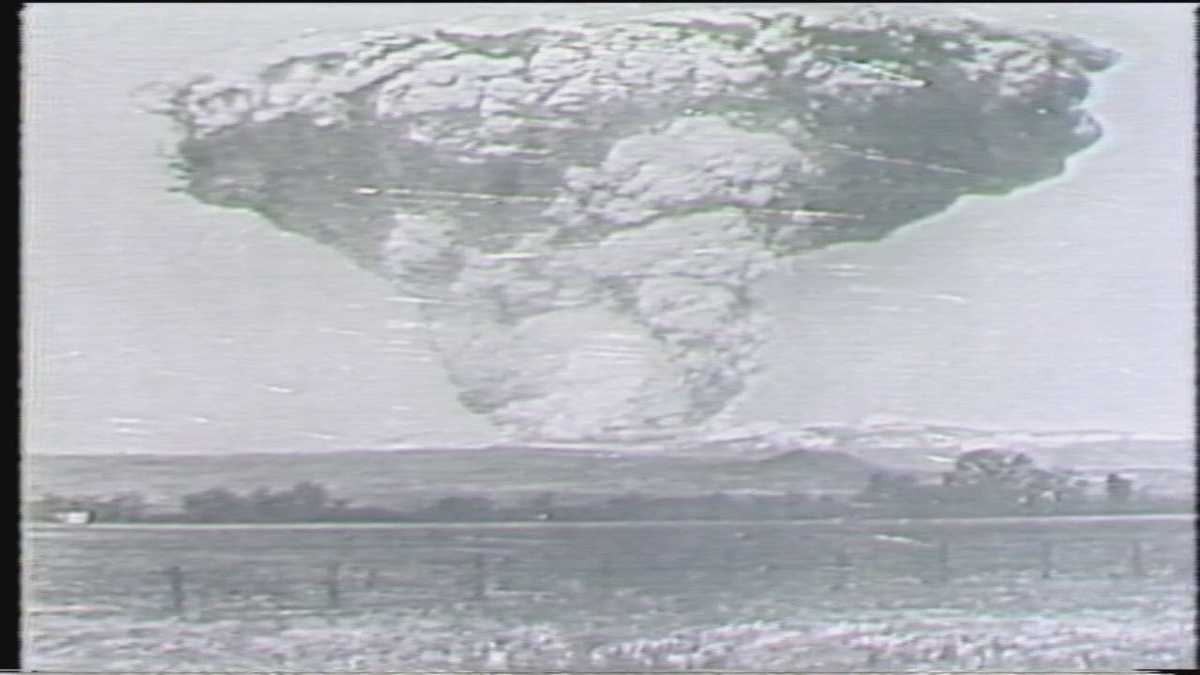
The great hot blast of May 1915 roared down the northeast face of Lassen Peak carrying mud and debris 150 miles an hour for *** distance of 3 miles and left *** layer of mud on ranch land 25 miles away. Though nature is rebuilding now, the location still deserves its name, the devastated area. Here at Lassen National Park, scientists are able to study several. Lassen Peak is *** plug dome volcano, the name because lava pushes up through the top of *** crater, cools, and forms *** dome plugging the opening. Lassen Peak is one type of volcano. Behind me is another. That’s Hat Mountain. *** cinder cone volcano. The cinder cone volcano gets its name from the material it vents in an eruption, *** material highly charged with gas. Just beyond Lassen to the northeast, *** shield volcano that history tells us erupts with *** very liquid lava. All these volcanoes are quiet now, but park officials say Lassen still has the potential for another huge blast, not necessarily from the. Peak, but from spots like this one on the east side, what you’re seeing is volcanic activity. Bumpus Hell is *** thermal area that vents steam, carbon dioxide, and other gasses with *** water temperature inside of 198 °F. Geologists generally agree that another California volcano is likely to erupt again before Lassen. It’s Mount Shasta to the north. According to the research, Shasta is due to erupt sometime within the next 400 years. While we watch with fascination news reports of Mount Saint Helens now, the only man alive today who survived the 1915 Lassen Peak eruption has earned *** wisdom few will know. The way I feel about it is *** human family with their little minds, uh, just cannot grasp the awesome power that *** volcano has. It takes it must be millions of Of pounds per square inch to move the amount of rock that is necessary when, when that, uh, big eruption happened in Saint Helens. And that’s something we don’t have on on Earth. You have *** sense of it though. Oh yes, we, I had *** little, little experience, not much, an experience I don’t want to repeat. Over Lassen Peak in northern California, Sue Pearson for Channel 3 reports. I’m standing in the path of the fast moving mud flow of May 19, 1915. Now May 22nd, the great hot blast, the same volcanic event that just occurred at Mount Saint Helens. Hot gasses and cinder pouring down from the top. This is what the great hot blast looked like from Anderson, 50 miles away. The mushroom cloud rose 40,000 ft in the air and was visible as far south as Sacramento. Bill Whitt was 17 in May of 1915. He stood on the west face of Lassen Peak as the east face blew out. Two months later, he and *** friend went back to the mountain to try and get some photographs. What followed became *** nightmare. I remember, still remember, I was scared. Another fellow and I were there. And we had We’d gone to the top of the peak. There was *** little smoke coming out of the crater, but uh nothing to get excited about. And um We’d walked out on *** little point that’s kind of stuck out over the edge of the crater. And I took *** couple of pictures down at the crater which didn’t amount to anything. We walked around the crater at the other side and while we roll on the other side, that whole point broke off and fell in the, fell in the crater. So we decided we’d better get out of there, so we took off down the west side of the mountain. And they I guess we’re maybe 500 yards down the side of the mountain when Another eruption took off and we turned around and looked up there and the air was full of smoke and dirt and rocks and some of the rocks came down and. And, uh, most of them came back down at the crater, but some of them made it over the side and came cartwheeling down the mountain. My partner looked at me and he said, this is no place for *** Sunday school boy. Let’s go. So we went. Lassen Peak erupted off and on for six more years. It’s been sleeping since 1921, but there is still volcanic activity here. Tomorrow we’ll take *** look and find out what it may mean for the future. In Live Copter 3 at Lassen Peak, Sue Pearson for Channel 3 reports.
On this day in 1915, Lassen Peak in California erupted
111 years ago today, Lassen Peak had its most powerful explosion in a series of eruptions that occurred between 1914 and 1917.

Updated: 10:53 AM PDT May 22, 2026
On May 22, 1925, Lassen Peak in California had its most powerful eruption in a series of eruptions that occurred in the Cascade Range between 1914 and 1917.That eruption, which occurred 111 years ago and is often referred to as “The Great Hot Blast,” caused devastation to nearby areas. With a vertical column of ash reaching altitudes of 30,000 feet, the Lassen Pean eruption “rained volcanic ash as far away as 200 miles to the east,” according to the National Park Service and the U.S. Geological Survey. Lassen Peak, a plug dome volcano that is sometimes referred to as Mount Lassen, is the southernmost active volcano in the Cascade Range, and is the largest volcanic dome in the world, according to NPS. It is located about 55 miles east of Redding, California, and is one of the numerous volcanoes that are part of the Lassen Volcanic National Park. When it erupted in May 1925, a fast-moving pyroclastic flow occurred and caused devastation to an area as far as 3.7 miles northeast of the summit, according to USGS. Over a century later, that area, which is part of Lassen Volcanic Park, is known as the “Devastated Area.” While it was once barren, forests now cover much of the Devastated Area. Lassen Peak is considered to be active by the USGS. The 111th anniversary of the blast at Lassen Peak comes just days after the 46th anniversary of the Mount St. Helens eruption. The series of eruptions from 1914 to 1917 was the last to occur in the Cascades before Mt. St. Helens erupted on May 18, 1980, killing 57 people in the aftermath. Mount St. Helens, which is located in Washington state and is part of the Cascade Range, erupted at 8:32 a.m. on May 18, 1980.Today, Washington state observes Volcano Awareness Month in May and offers a variety of events and opportunities for people to learn about preparedness and the threats posed by volcanoes. In the wake of the blast at Mount St. Helens, USGS beefed up its monitoring of volcanoes that are active – and potentially active – in the Cascades. “Monitoring of the Lassen area includes periodic measurements of ground deformation and volcanic gas emissions and continuous transmission of data from a local network of nine seismometers to USGS offices in Menlo Park, California,” NPS’s website for Lassen Volcanic National Park states. Following the eruption of Mount St. Helens, sister station KCRA looked back on the eruption at Lassen Peak and spoke with a man who was 17 years old at the time and was in the area when the Great Hot Blast occurred.See that coverage and hear from him in the video player at the top.
On May 22, 1925, Lassen Peak in California had its most powerful eruption in a series of eruptions that occurred in the Cascade Range between 1914 and 1917.
That eruption, which occurred 111 years ago and is often referred to as “The Great Hot Blast,” caused devastation to nearby areas. With a vertical column of ash reaching altitudes of 30,000 feet, the Lassen Pean eruption “rained volcanic ash as far away as 200 miles to the east,” according to the National Park Service and the U.S. Geological Survey.
Lassen Peak, a plug dome volcano that is sometimes referred to as Mount Lassen, is the southernmost active volcano in the Cascade Range, and is the largest volcanic dome in the world, according to NPS. It is located about 55 miles east of Redding, California, and is one of the numerous volcanoes that are part of the Lassen Volcanic National Park.
When it erupted in May 1925, a fast-moving pyroclastic flow occurred and caused devastation to an area as far as 3.7 miles northeast of the summit, according to USGS. Over a century later, that area, which is part of Lassen Volcanic Park, is known as the “Devastated Area.” While it was once barren, forests now cover much of the Devastated Area.
Lassen Peak is considered to be active by the USGS.
The 111th anniversary of the blast at Lassen Peak comes just days after the 46th anniversary of the Mount St. Helens eruption. The series of eruptions from 1914 to 1917 was the last to occur in the Cascades before Mt. St. Helens erupted on May 18, 1980, killing 57 people in the aftermath. Mount St. Helens, which is located in Washington state and is part of the Cascade Range, erupted at 8:32 a.m. on May 18, 1980.
Today, Washington state observes Volcano Awareness Month in May and offers a variety of events and opportunities for people to learn about preparedness and the threats posed by volcanoes.
In the wake of the blast at Mount St. Helens, USGS beefed up its monitoring of volcanoes that are active – and potentially active – in the Cascades.
“Monitoring of the Lassen area includes periodic measurements of ground deformation and volcanic gas emissions and continuous transmission of data from a local network of nine seismometers to USGS offices in Menlo Park, California,” NPS’s website for Lassen Volcanic National Park states.
Following the eruption of Mount St. Helens, sister station KCRA looked back on the eruption at Lassen Peak and spoke with a man who was 17 years old at the time and was in the area when the Great Hot Blast occurred.
See that coverage and hear from him in the video player at the top.