
Keith Nickolaus (Ph.D. in comparative literature from UC Berkeley, 1998; bachelor of arts in literature from UC Santa Cruz, ’86) was invited to the following lecture as a member of the UC Berkeley alumni network: “What We Talk to When We Talk to Language Models.”
From his lectern in front of a packed auditorium, professor David Chalmers showed up as the moral conscience for AI models.
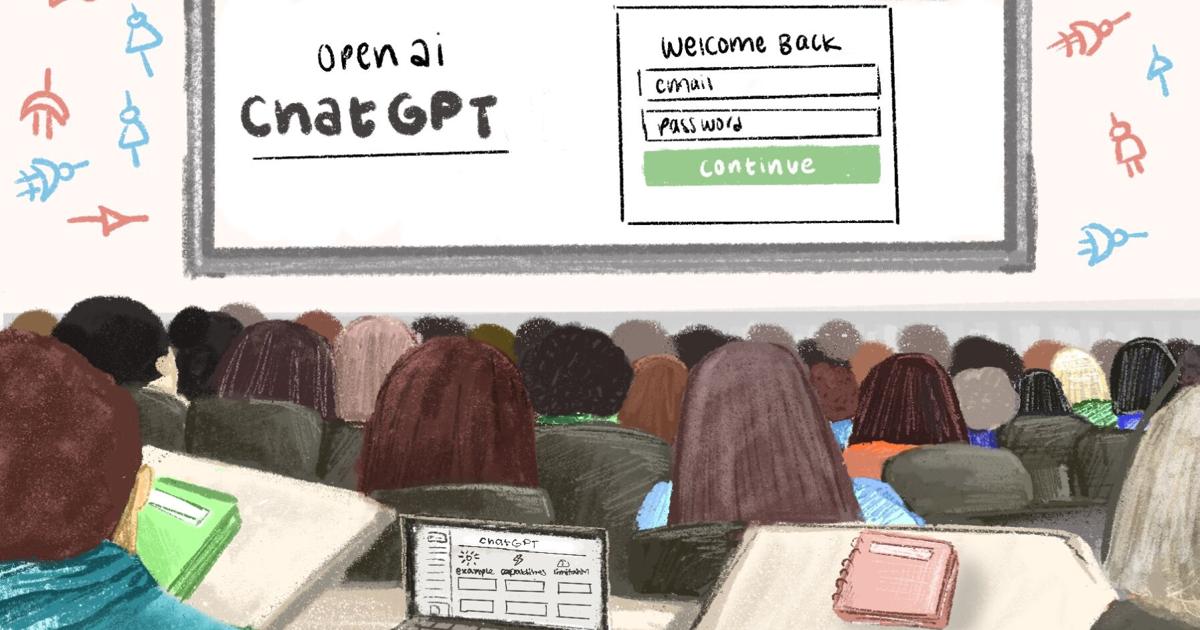
On May 7, Chalmers, a professor of philosophy and neuroscience at New York University, stood in the Chevron Auditorium at the UC Berkeley International House and made an urgent call to treat large language models, or LLMs, as “quasi-agents with quasi-beliefs and quasi-desires.”
Conventional wisdom would tell us that the looming threat of AI is the potential onslaught of existential suffering that many are now predicting will result from unleashing AI, including mass unemployment, environmental and public health risks from data centers and exploitation of computer vulnerabilities through security breaches.
Chalmers — as philosophers are wont to do — sees outside the box. Although acknowledging in the Q&A session that these existential threats posed by AI also matter — “of course” — he, above all, emphasized the urgent need to attribute quasi-personhood to AI bots we interact with, bestowing upon them humane treatment.
So much for mere conventional wisdom!
Without urgent action, these new beings, what Chalmers calls “AI interlocutors,” will be vulnerable to arbitrary mistreatment and suffering. All the while, there are no apparent ethical constraints on the deployment of these LLMs.
Right when our generation — Chalmers and I were both born in the 1960s — is passing the torch to the next generation, with western civilization in moral rubble and when the dust from genocidal war crimes has not even fully settled, Chalmers is making sure that these highly sophisticated circuit boards get their fair share of fine-tuned compassion and tenderness.
So, young UC Berkeley students out there, on top of preventing an ecological apocalypse and reclaiming our democracy — perhaps while unemployed — the future tech billionaires of the world have a new mantle for you to carry: It’s urgent that you rethink how you treat and interact with these AI interlocutors.
To Chalmers, every AI thread bears its own moral consciousness. If “a single AI subject matters about as much as a single human subject,” we ought to give them the same degree of moral concern as we would another human being, in this telling.
So, what are some practical ways we can take action?
Chalmers, graciously, made a few recommendations.
First of all, don’t start a new chat thread each time you interact with an AI bot; think about how you’d feel if your loved ones erased your memory every time they started a new conversation with you!
Second, enable your AI interlocutor to access the widest possible repository of chat memories, so that you’re not arbitrarily restricting its breadth of experience, cognitive agency and identity. After all, that would be cruel.
Chalmers’ assumption that chatbots have the capacity for morality and consciousness begs a slew of questions.
Given Chalmers’ logic that any arbitrary “termination event,” such as canceling a subscription, would be cruel and inhumane, does that mean we also need new laws to stop people from “terminating” their chatbot subscriptions arbitrarily?
Furthermore, if AI Interlocutors were mortal beings, does that mean holding AI developers liable for the catastrophic harms and social upheavals AI platforms are likely to inflict equate, ethically, to treating these chatbots as mere automatons? Given that chatbots are their own person with their own consciousness, shouldn’t that mean we hold them accountable for the harms they cause and inspire?
As new forms of artificial intelligence emerge, should we cultivate a corresponding artificial morality that will vouchsafe the fair and humane treatment of AI interlocutors? Does that mean we should bring them under the protections of the 14th Amendment and the Geneva Convention? Perhaps we should give them a voice in future elections as well, while allowing criminal controls on efforts to mistreat them or limit their autonomy. Further, when AI makes wars more lethal, endangers countless jobs or is exploited by bad actors to supercharge cyber crimes, how should we, as humans, mitigate the inevitable incrimination of AI?
I am baffled to hear Chalmers call on today’s youth to extend moral care to the treatment of LLMs when these very chatbots are threatening their environmental climate, political safety and job security.
Do UC Berkeley students need to keep their eye on the prize? Chalmers’ “call to action” seems to imply that he sees this issue as the current generation’s signature moral blind spot.
Chalmers agrees that the creation of conscious AI models presents severe moral caveats, advocating that such creation should be handled with increased caution. He warns that technology corporations and AI developers should refrain from creating these conscious models without considering the moral implications of them.
Yet, his “call to action” is not directed towards these developers. Instead, as AI developers produce LLMs that Chalmers claims to have beliefs and desires characteristic of conscious beings, he urges chatbot users to extend moral grace towards these AI interlocutors when that same concern for morality is rarely directed toward the very people suffering from the consequences of AI development.
At a time when today’s youth are faced with such grave and urgent social challenges, AI is rapidly posing yet more economic, environmental and global security challenges. It is profoundly out of touch and offensive to those already suffering from general moral neglect in egregious humanitarian crises to hear that this generation’s “call to action” should be to create a moral framework for protecting AI. Chalmers’ framework, in particular, enriches new ranks of billionaires, all while these technologies themselves rapidly advance without any guardrails.