
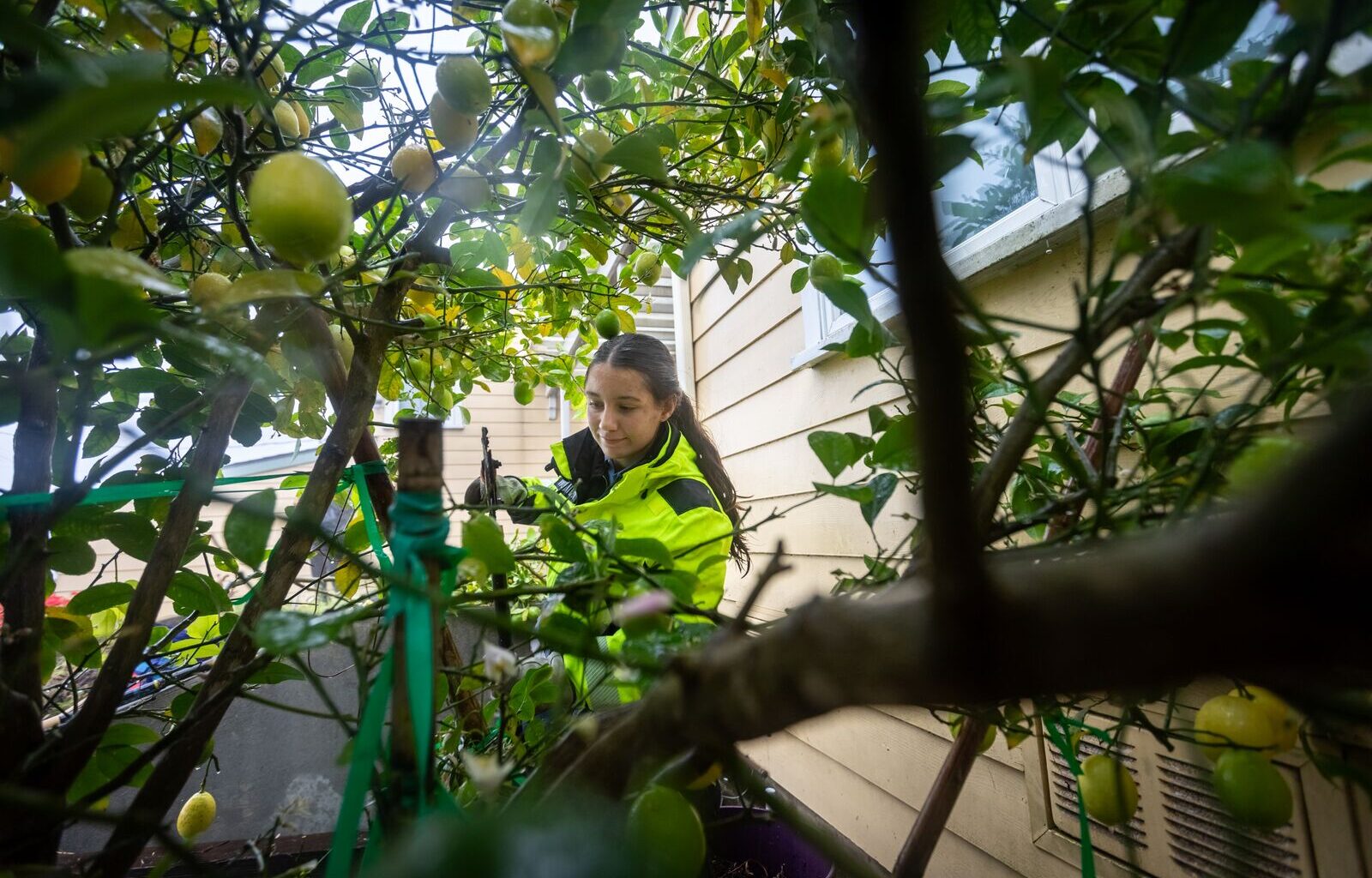
 Berkeley Fire Department Wildland Urban Interface intern Zelda Vriand clears vegetation touching a house in the Berkeley Hills during a clean-up event in April. Credit: Kelly Sullivan for Berkeleyside
A state fire policy board has rolled out a new set of proposed ember-proofing regulations that would be more lenient than the rules Berkeley adopted last year requiring residents in two hillside neighborhoods to remove nearly all vegetation from the 5 feet surrounding their homes.
But with the Berkeley Fire Department poised to begin enforcing the city’s requirement next month, there is no sign officials are rethinking the local regulations in the short term.
The polarized debate over the mandate has continued: Supporters say many in the Berkeley Hills are on board with the local requirements and working to reduce their wildfire risk proactively, while opponents have launched a campaign to recall the City Council member who championed them.
The Effective Mitigation for Berkeley’s Ember Resistance (EMBER) ordinances took effect Jan. 1, and enforcement was expected to begin this month. But the inspections BFD has done so far this year have all been at homeowners’ requests, according to Assistant Fire Chief Colin Arnold, who leads the department’s wildland urban interface division.
The main thrust of Berkeley’s new restrictions is to keep the first 5 feet around any structures, outbuildings or attached decks or stairs — and in the cases of decks and stairs, the areas underneath them — free of anything that could burn. The rules make exceptions for smaller potted plants, as well as mature trees that are taller than adjacent structures and trimmed away from buildings.
California’s Board of Forestry and Fire Protection last month proposed allowing more plants within “zone zero” than Berkeley’s ordinances. The board’s closely watched draft regulations would mandate a variable “safety zone” around homes where nothing could be planted: 1 foot around homes and under eaves; 2 feet from windows, vents and doors; and 5 feet from decks.
Properties in the Grizzly Peak ridge and Panoramic Hill neighborhoods will have to adhere to Berkeley’s stricter local regulations. (BFD has a mapping tool on their website where residents can check defensible space requirements by address.)
Arnold said the more complex draft state regulations could be “very difficult” for local governments to enforce with inspections. He also noted the new set of proposals is not yet set in stone, and is already more than three years late for the deadline the state Assembly set for the rules to go into effect.
“I am not holding my breath on what the final language will look like until it’s signed into law,” Arnold said.
In a wildfire safety webinar Thursday, Councilmember Brent Blackaby said an ad hoc committee that earlier finalized Berkeley’s rules could re-convene once the state rules are in place and consider tweaks.
But “the intention here is that these [state] rules are a floor, not a ceiling,” Blackaby said. “They expect that local jurisdictions are going to make adjustments to fit local conditions.”
Fire Chief David Sprague went further.
“It appears that the state is diverting from adopting a science-backed standard,” Sprague said Thursday, adding that the proposed regulations “will do little to nothing to reduce the risk of structural ignition.
“A resident who was to follow the likely state code is far less likely to have their home survive a wildfire than a homeowner who follows the Berkeley code,” he said.
Opponents of regulations launch recall campaign
Critics of the Berkeley regulations charged in recall paperwork filed in February that Blackaby, whose district in the city’s northeastern hills includes many of the homes where the rules will kick in first, showed “a pattern of inadequate stakeholder engagement, insufficient transparency and leadership decisions that have diminished public trust.”
Rhonda Gruska, a resident leading the effort, will need to collect 2,578 signatures from District 6 residents by June 11 in order to force a recall election. She declined to estimate how many she had collected so far, but said the threshold was “daunting.”
Gruska is a member of the Alliance for Practical Fire Solutions, a group that has opposed the EMBER ordinance and lobbied for the city to ease the new restrictions. While the city estimates it will cost residents less than $4,000 on average to bring their homes into compliance with the mandate, Alliance members have said that in some cases homeowners will have to pay up to $60,000 to bring their property into compliance. The group previously asked that Berkeley hold off on enforcing its own regulations until the state board adopts rules for vegetation management.
Gruska said her neighbors, many of whom are retired and living on fixed incomes, are stressing over the expense of getting their homes and yards into compliance.
 UC Berkeley students clear vegetation touching a house in the Berkeley Hills. Credit: Kelly Sullivan for Berkeleyside
A wide range of experts — including state and local firefighting agencies, scientists and the insurance industry — agree that keeping the 5 feet immediately surrounding a home clear of flammable items can be the difference between that home surviving a wildfire or burning to the ground. But the circumstances of the Southern California fires last year, which Blackaby said inspired him to push for the EMBER ordinance, have not convinced Gruska’s alliance that the Berkeley Hills, with their unique ecology, are at the same kind of risk.
“EMBER is just the worst possible thing that the fire department could have done, in my estimation, and it’s the worst possible thing that Councilmember Blackaby could have chosen to champion as his legacy legislation,” Gruska said.
In a formal response to Gruska’s statement, Blackaby called the attempt “misguided,” and said she was using the recall process “frivolously to contest a policy disagreement.”
“I know this isn’t easy,” Blackaby wrote in his response. “Changing our yards is challenging but necessary to give our firefighters a chance to keep wildfire out of Berkeley.”
Fire Department wants a ‘culture change,’ not to issue fines
While the Berkeley Fire Department can fine people whose vegetation doesn’t comply with the ordinance, Arnold says that is the last thing the department wants to do.
“There’s an assumption that we’re after something in terms of enforcement that we’re really not,” he said. “What we’re really after is a culture change around where we live and what we need to do to live there safely.”
Part of the rollout plan the City Council approved last year involved exemptions from citations for homeowners who were making good-faith efforts to ember-proof their yards, even if they could not hit deadlines.
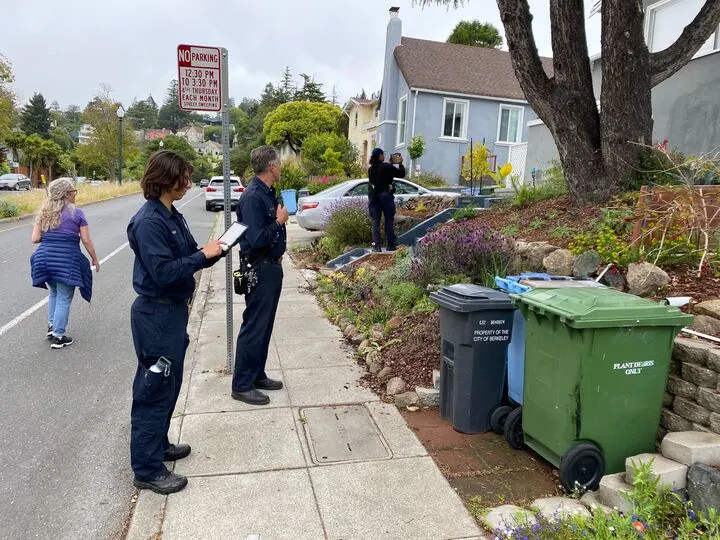 Intern Joaquin McCall (from left), Inspector Duncan Allard and intern Emilio Garcia-James at a home slated for inspection by the Berkeley Fire Department in 2024. Credit: Alex N. Gecan
BFD has conducted over 23,000 inspections since 2021 under Berkeley’s earlier, less stringent vegetation management rules. Arnold said the agency has issued perhaps 70 citations in that time, or in about 0.3% of cases.
“Our goal is to avoid the enforcement clause whenever we can,” Arnold told Berkeleyside. “I’ve been pretty inspired by the number of people that have asked for inspections, wanting to reduce risk — without us going out and saying you have to be inspected.”
In June, Arnold said, inspections would expand beyond just the homeowners who sought them out on their own. But even then, the inspectors are taking great pains to avoid citations wherever possible. If they find violations during a first inspection, homeowners have at least 60 days to fix them. BFD can charge reinspection fees if violations persist through a first reinspection, and issue citations if the violations continue through a second reinspection
Berkeley was able to snag $1 million of state money for a Resident Assistance Program for older Berkeleyans and those living with disabilities or financial hardship. Arnold encouraged anyone who qualifies and lives in the neighborhoods subject to Berkeley’s regulations to apply.
The program “has been a really great way to help folks to get all the way to compliance this year,” Arnold said. “You can save your money for the hardscaping, art or water features, or whatever else you want to put on your property.”
Gruska said that instead of vegetation management, BFD should have pursued so-called “home hardening” measures like requiring ember-resistant metal mesh on grates, and street parking in the hills that makes evacuation and emergency response difficult.
But unlike writing new vegetation management rules into the local fire code, which the fire department can enforce, requiring changes to structures would have meant writing local amendments to the state building code, which is more difficult to do and does not have as clear an avenue for enforcement.
Nevertheless, the City Council ordered the City Manager’s Office in December to come up with a proposal for banning wood shake roofs in Berkeley. While state building code prohibits new shake roofs, homeowners are allowed to keep existing ones and even repair them, provided they don’t replace more than half in any 5-year period.
BFD may not be able to compel homeowners to install mesh over grates and gutters, for example, but if offers the mesh for free and recommends installers to anyone who wants it. Nor can BFD issue parking tickets or tow vehicles off crowded hillside streets, but it does ask that hills residents leave the area preemptively when wind and humidity conditions make a fast-moving wildfire more likely. (A recent consultant report showed it could take over four hours for the hills to evacuate for a major fire.)
Berkeley Firewise communities organize cleanups, classrooms
Berkeley Hills resident Michel Thouati has heard the resistance to the city’s vegetation management rules. But Thouati, the head of the Creston neighborhood’s “Firewise” community group, said he thinks his neighbors have largely bought into the requirements.
“When you look at social media it looks like it’s absolute warfare,” Thouati told Berkeleyside. But not so, he said, “when you walk around the neighborhood.”
The Firewise groups, which have formed in neighborhoods with the highest wildfire risk, helped organize a massive fire safety cleanup in the hills last month along with groups of UC Berkeley students and other volunteers.
 UC Berkeley students clear trimmed vegetation from the Berkeley Hills on Apr. 11, 2026. Credit: Kelly Sullivan for Berkeleyside
About 350 people worked at two dozen sites, pulling out five tons of leaf debris and another 325 cubic yards of more solid vegetation that was then broken down into wood chips through the city’s chipper program. The volunteers also hauled away trash and toxic waste, and laid down 1,200 square feet of “rock mulch” — basically, gravel — in “zone zero” areas around homes to keep flammable vegetation from returning.
Ruth Ehrenkrantz, an organizer with another Firewise group, said more cleanups are coming up July 18 and 19, and in November, if Berkeleyans are looking for volunteer opportunities.
Firewise groups also organize volunteer assessment programs to advise homeowners on ember zone compliance. The assessors, who are trained volunteers who know the ins and outs of what is allowed in which property zone, spend a couple hours with each homeowner, showing them how to bring their parcels up to code.
Anyone interested in the July cleanup or becoming an assessor can register on the Berkeley Firewise website and send a direct message to Thouati or Ehrenkrantz there.
Some insurers also offer discounts on policies for homes within Firewise communities, which is at least some relief for homeowners in Berkeley and elsewhere who are dealing with a surge of non-renewals and skyrocketing premiums.
Groups like Firewise communities and the Berkeley Fire Safe Council also connect homeowners with contractors that have experience in “firescaping” homes and yards, and offer information on the city’s assistance program.
Thouati acknowledged some of his neighbors “are violently hostile to EMBER,” but said those tend to be exceptions rather than the rule.
“Most people are either going to comply reasonably happily or say, ‘Well, I have to do it,’” Thouati predicted. “Then there’s maybe 10% that are actually opposing it but in the end they will actually comply reluctantly.
Another 5%, he estimated, “will never comply.”
“*” indicates required fields