
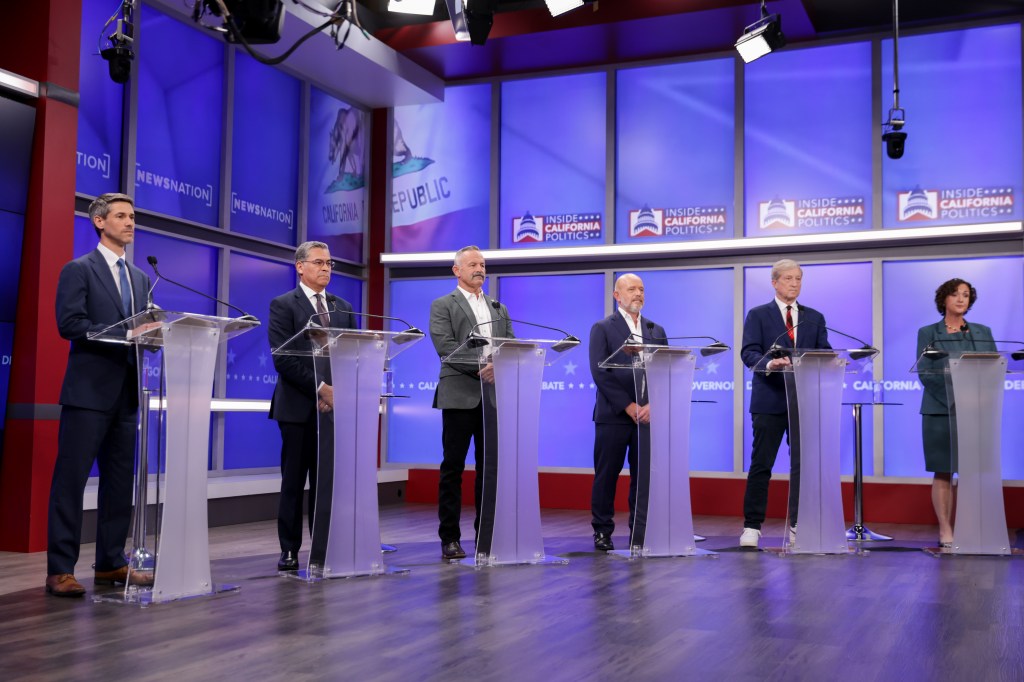
Two weeks from now, we’ll probably know which of the 61 gubernatorial candidates have come in first and second place in the primary election and will face each other in November for the dubious honor of governing a state that may be ungovernable.
The ambiguous adverb “probably” is justified because three gubernatorial hopefuls are in a very close race, and California is known for taking a long time to produce the final vote count of the election.
According to the latest Democratic Party poll, released Tuesday, Republican Steve Hilton, a British-born former Fox News commentator, and Democrat Xavier Becerra, a former attorney general, are virtually tied at 22% and 21% respectively. Billionaire Tom Steyer still holds a chance at 15%, but all other candidates who were once viable are lagging behind by single-digit percentages.
There are three possible outcomes for the June 2 primary, assuming none of the other 58 candidates defies political logic and makes it into the race over the next two weeks.
Hilton and Becerra will most likely come in first place and face off in the November election. Hilton and Steyer are less likely to come in first and second, or both Democrats are less likely to hold the top two spots.
Given Democrats’ overwhelming lead in the state’s voter registration, the only realistic chance of Hilton winning in November would be for her Democratic rival to self-destruct in some way. It is an unlikely scenario, but this campaign has already generated a series of unpredictable events, so nothing should be ruled out without further ado.
Democratic operatives have been running a semi-secret campaign to tout Hilton’s ties to unpopular President Donald Trump, hoping it will spark a groundswell of Republican support that propels him into one of the top two spots, thus avoiding a showdown between Democrats.
That’s precisely what happened two years ago in the U.S. Senate race, when Democrat Adam Schiff helped Republican Steve Garvey qualify for the November election, avoiding a showdown with Democrat Katie Porter. Porter is now running for governor, but her support has fallen to 7% in the latest poll.
Early in the gubernatorial race, Democrats worried about a 1-2 result in the Republican primary that would leave them out of the governorship, but that possibility was dashed when a prominent Democrat, Eric Swalwell, became embroiled in sexual harassment and assault allegations.
Swalwell’s withdrawal (his name is still on the ballot) catapulted Becerra, who had been relegated to the bottom of the field, into the race virtually overnight.
Since then, he has been the target of increasingly intense personal attacks from Steyer, who is spending millions of his vast fortune on a relentless barrage of television and Internet ads accusing Becerra of virtually everything except being the cause of psoriasis’s suffering.
The most striking accusation is that Becerra is somehow guilty of a scheme in which money was diverted from one of his campaign accounts into the pockets of a former adviser.
Three people have pleaded guilty to federal charges in the case, and prosecutors consider Becerra to have been a victim, not a perpetrator. But that hasn’t stopped Steyer from launching attacks that border on the accusation against Becerra.
One of Steyer’s scathing criticisms: “Becerra’s campaign manager and chief of staff were accused of stealing from his campaign, which begs the question: Was Becerra complicit or too incompetent to notice?”
While the scenario of a 1-2 Republican result has faded with Becerra’s rapid rise and the decline of the other Republican candidate, Riverside County Sheriff Chad Bianco, the prospect of a Republican blockade has so unsettled Democratic leaders that they now plan to eliminate the first-two system. that neither they nor the GOP bureaucrats liked it in the first place, because it leaves too much to chance.
Or, in other words, it is considered to be too small “d” to be democratic.
Dan Walters is a CalMatters columnist.