
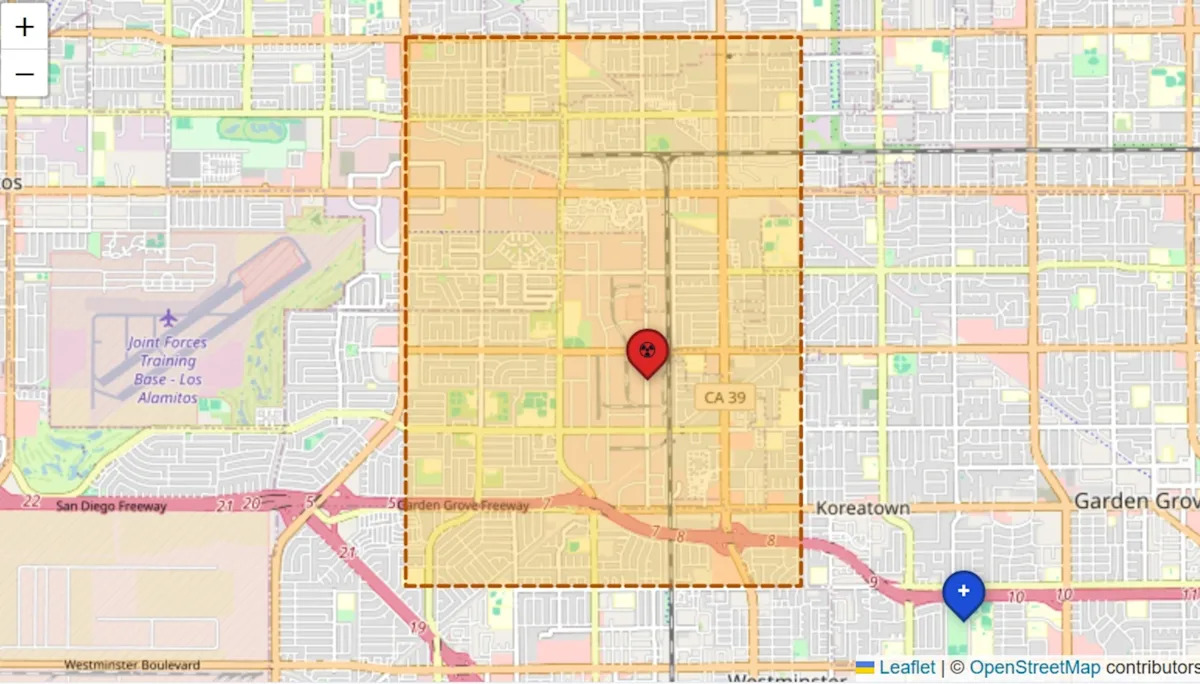
Thousands of Southern California residents have refused to obey evacuation orders as public safety officials warn of a “highly toxic” threat unfolding in Orange County amid a failing chemical tank housing methyl methacrylate.
Mandatory evacuation orders were issued for around 40,000 people in Garden Grove, California, and surrounding cities, including parts of Anaheim, Stanton, and Westminster, amid a critical situation at the GKN Aerospace facility. A massive chemical storage tank is projected to either fail or explode, with officials warning that both outcomes will release “highly toxic” substances into the surrounding communities.
Advertisement
Public safety officials called the situation “significant” and “unprecedented” and urged people in the area to leave immediately and find a safe space at a press conference on Friday afternoon. No answer was given for how long evacuations would remain in place as the tank threatens to either fail or explode.
The Orange County Fire Authority (OCFA) reported that the crisis began Thursday afternoon around 3:30 p.m. when a 34,000-gallon storage tank containing methyl methacrylate—a highly flammable chemical used in plastics manufacturing—overheated and began leaking, releasing toxic vapors and triggering a massive hazardous materials response. Evacuation zones were established across a wide section of Garden Grove on Thursday. Evacuations were briefly lifted overnight, then reissued Friday morning and later expanded in the afternoon as the situation worsened.
The mandatory evacuation zone now encompasses areas:
East of Valley View Street
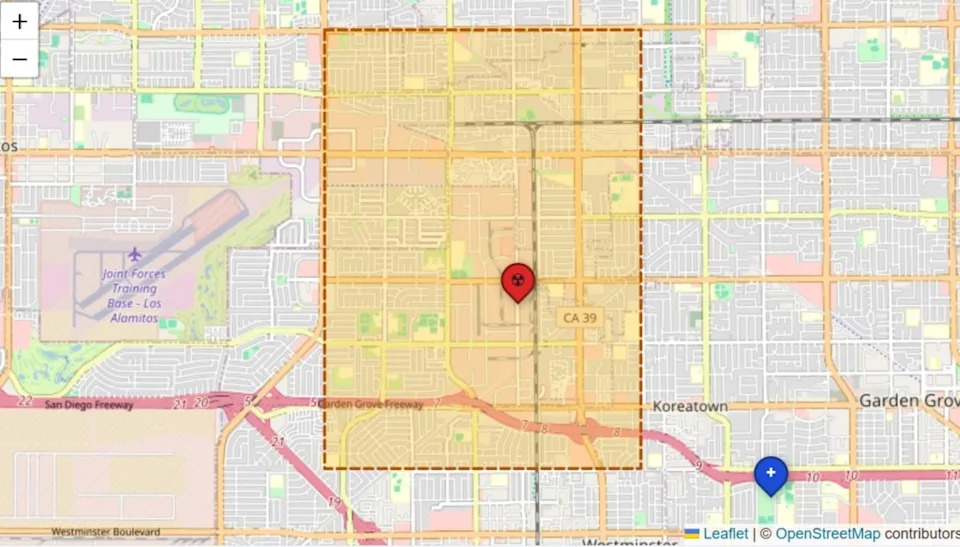
An updated map of the evacuation orders in place for Garden Grove, California, which includes thousands of residents.
Garden Grove Resident Describes ‘Unsettling’ Evacuation
Ashley Clavijo, who lives within a half mile of the facility, told Newsweek that the chemical emergency and subsequent evacuations have been an “overwhelming” and “unsettling” experience because residents are still without clear answers about the situation.
Advertisement
“I feel like we’ve been given the same updates since yesterday,” she said. “We evacuated our home yesterday in the afternoon got the clear to return home around 9pm and we’re woken up at 6 in the morning to evacuate again. [It’s] an unsettling experience for all members in the community as we don’t know what will happen or when we can return home.”
Situation Deteriorates: Two Remaining Scenarios
Public safety officials issued an urgent Friday afternoon update as structural and chemical stabilization efforts failed.
“This morning we have determined that the tank that is in the biggest crisis is, in fact, unable to be secured and mitigated in the current information we are getting from the manufacturers,” said OCFA Division Chief Craig Covey in a video statement released on X.
Advertisement
“There are literally two options left remaining: One, the tank fails and spills a total of about 6,000 to 7,000 gallons of very bad chemicals into the parking lot in that area. Or two: the tank goes into a thermal runaway and blows up, affecting the tanks around it that have chemicals in them as well.”
Newsweek reached out to OCFA by phone for comment.
Governor Gavin Newsom has been briefed on the situation, his press office posted on X on Friday afternoon.
Other elected officials, including U.S. Senator Adam Schiff and U.S. Representative Derek Tran, have also said they are monitoring the situation.
Advertisement
“I have spoken to GKN Aerospace leadership and urged the company to take full responsibility for the panic and disruption that tens of thousands of residents are currently experiencing,” Tran posted on X. “We agreed the priority is the safety of the community and addressing the urgent crisis at hand. I’m continuing to work with emergency personnel to ensure that residents are safe and have the resources they need while officials work to mitigate the impacts of the hazmat incident.”
On Friday night, OCFA told residents not to call the emergency number to propose solutions regarding the incident.
“We understand this is a unique hazmat incident and appreciate the public’s concern and willingness to help. Please know that subject matter experts are working around the clock to mitigate the emergency safely and effectively,” OCFA posted on X. “At this time, we ask the public to refrain from calling to offer suggestions so emergency personnel can keep communication lines focused on incident operations and public safety needs.”
Where Is Garden Grove, California?
Garden Grove is a densely populated city located in northern Orange County, positioned within the broader Los Angeles metropolitan area.
Advertisement
Location: Approximately 35 miles southeast of downtown Los Angeles, bordered by major regional hubs like Anaheim and Long Beach. State Route 22 (the Garden Grove Freeway) runs directly through it.
Proximity to Landmarks: The city features a dense blend of residential neighborhoods and industrial zones. The incident occurred at the GKN Aerospace facility on Western Avenue, located roughly one mile from the Disneyland Resort and eight miles inland from the Pacific coast.
Population: According to the 2020 U.S. Census, Garden Grove is home to 171,949 residents.
Current Garden Grove Air Quality
As of Friday afternoon at around 1:40 p.m. local time, air quality in Garden Grove and surrounding areas was considered “moderate,” according to the Environmental Protection Agency (EPA) AirNow map.
Under the EPA’s Air Quality Index, a “moderate” reading—defined as an AQI between 51 and 100—means air pollution levels are elevated but still generally acceptable for most people, though a small number of individuals who are unusually sensitive to pollutants, such as those with asthma or heart and lung conditions, may experience minor health effects or irritation.
The chemical tank was “off-gassing with some fumes” on Thursday, but as of the most recent update from OCFA, there is no active gas leak in the area.
Advertisement
What Is Methyl Methacrylate?
Methyl methacrylate is a highly versatile manufacturing agent that serves as a core building block for many everyday synthetic materials. However, its volatile nature makes it a significant safety concern if it escapes containment.
Industrial Use: It is a chemical widely utilized to produce acrylic plastics, resins, consumer goods, construction products, and aircraft components.
Physical Properties: A colorless liquid characterized by a sharp odor that easily evaporates into vapor, particularly when exposed to heat.
Is Methyl Methacrylate Toxic?
The chemical poses severe health risks to anyone in the immediate vicinity, making rapid emergency response and public evacuation absolutely essential. Because it threatens bodily health and physical infrastructure, officials must manage it with extreme caution.
Exposure Risks: Classed as a hazardous substance, it is especially dangerous when its vapors are inhaled at elevated concentrations.
Acute Health Effects: Exposure can cause irritation to the eyes, skin, and respiratory system, leading to coughing, chest tightness, or dizziness.
Neurological & Long-Term Impacts: Acute inhalation exposure is linked to headaches and lightheadedness, while prolonged or repeated exposure can damage organs such as the lungs and kidneys.
Dual-Hazard Classification: Emergency responders treat leaks as a double threat due to the chemical’s high flammability and severe health risks.
Current Situation Impact: These hazards forced precautionary evacuations on Thursday; though initial cooling efforts briefly reduced visible vapor, conditions have since deteriorated.
Related Articles