
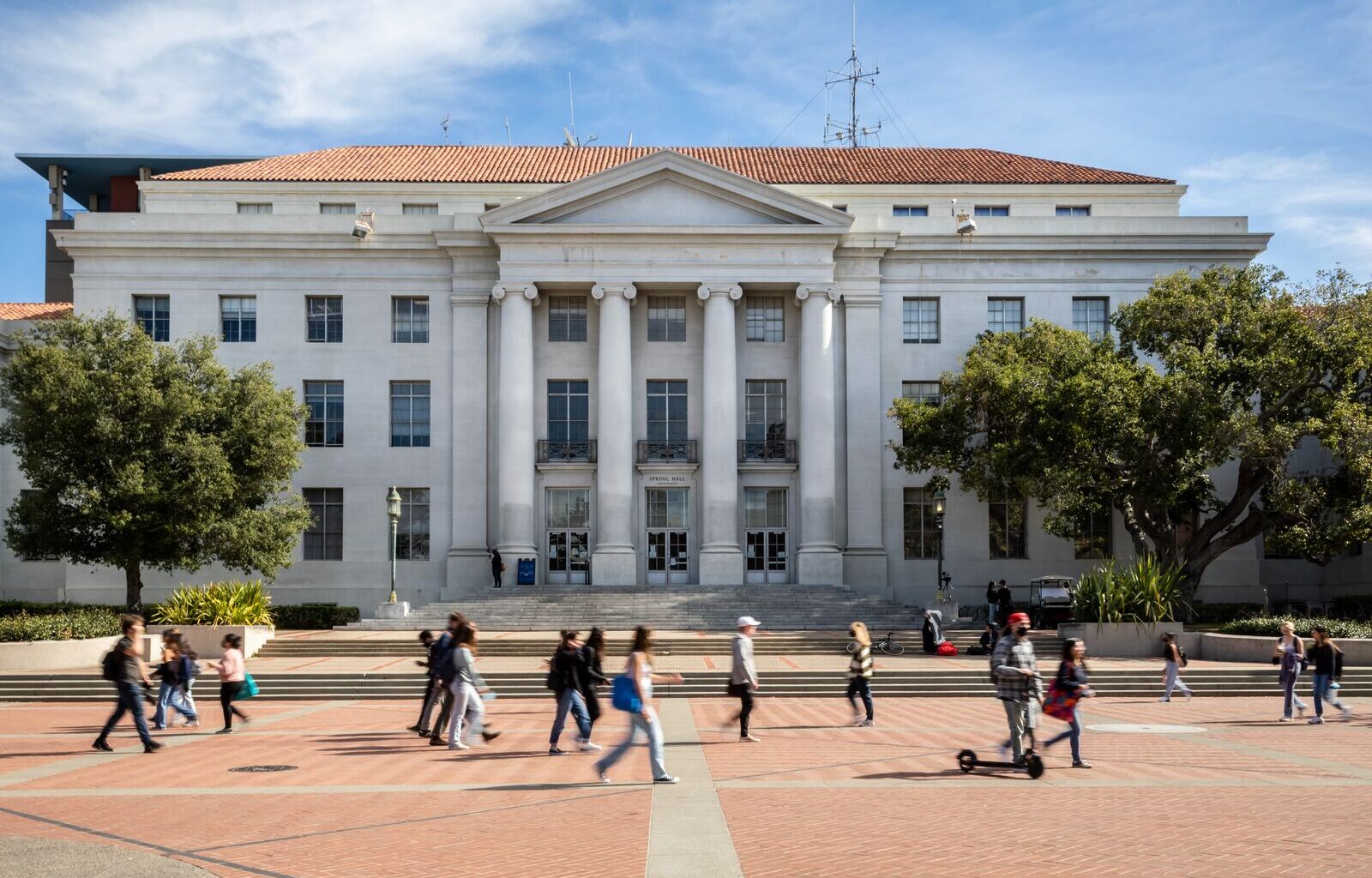
 UC Berkeley’s Sproul Hall in March 2022. Credit: Kelly Sullivan for Berkeleyside
More than 2,000 University of California tech workers voted to seek union representation earlier this month, saying they’re concerned about layoffs and want a say in how the university implements artificial intelligence.
If the vote is certified by the state’s public employment relations board, the University and Professional Technical Employees union would have the largest tech worker bargaining unit in the country, union officials said, with 8,400 members including more than 600 at UC Berkeley.
The vote comes as AI is disrupting workplaces of all types and major tech companies are laying off thousands of employees. Union activists involved in the organizing drive framed it as a way to ensure that the on-campus workers who best understand AI can, through collective bargaining, help shape the university’s use of the technology.
“High-level decisions regarding AI or any technology are often not made by people who are actually implementing these tools, but those are the people that should have a place at the table,” said Max Belasco, a business systems analyst at UCLA.
UPTE already represents about 24,000 healthcare, research and education workers across the UC system, including some IT employees. University of California spokesperson Heather Hansen said in a statement that the Public Employment Relations Board was reviewing the union’s petition and the university was awaiting guidance from the board.
“The University of California values the contributions of its technical and IT employees and remains committed to maintaining productive relationships with represented and non-represented employees alike,” she said.
Dan Russell, the union’s president and a business technology support analyst at UC Berkeley, said job security was the biggest concern he heard from colleagues on campus. Some campus IT departments had seen layoffs in the last six months, he said. At the same time, workers have been following the bloodletting at technology companies in the private sector; just yesterday, Meta announced it will lay off 8,000 employees and shift others to AI-focused roles.
“I think we’ve seen the university follow some of the trends that you see in the private sector, so I’m worried about that,” he said.
Belasco said tech workers were concerned that when teams shrank as some members left for other jobs, vacant positions were going unfilled with the university assuming that automation could take up the slack. Hansen did not reply to specific questions about those concerns.
Campus unions across the country are increasingly seeking to incorporate provisions regulating AI into their contracts, from faculty worried about their course material being repurposed without their permission, to healthcare workers concerned about patient privacy.
Last year, UC nurses represented by the California Nurses Association negotiated contract language guaranteeing them a role in designing new technology systems, including AI.
A separate contract for student services and advising staff, inked by the university and the United Auto Workers union in March, reads, “The use of technology shall not be a substitute for an employee’s exercise of professional judgment in the execution of job duties.”
While the percentage of tech workers nationwide who are unionized remains miniscule, their ranks include 1,400 workers at Google parent company Alphabet and IT workers employed by the state of California and represented by the Service Employees International Union.
“There’s sometimes a bad rap that folks in IT have that perhaps we may not be as open to unions, and may be on occasion antisocial,” said Belasco. “What I’m hoping is that this victory gives people the sense that tech workers deal with a lot of the same workplace situations as people in other industries, and it is possible to bring people together for a shared vision of how our workplace can be.”
Union representatives said they expected to hear back from the Public Employment Relations Board within the next month.
Berkeleyside partners with the nonprofit newsroom Open Campus on higher education coverage.
“*” indicates required fields