
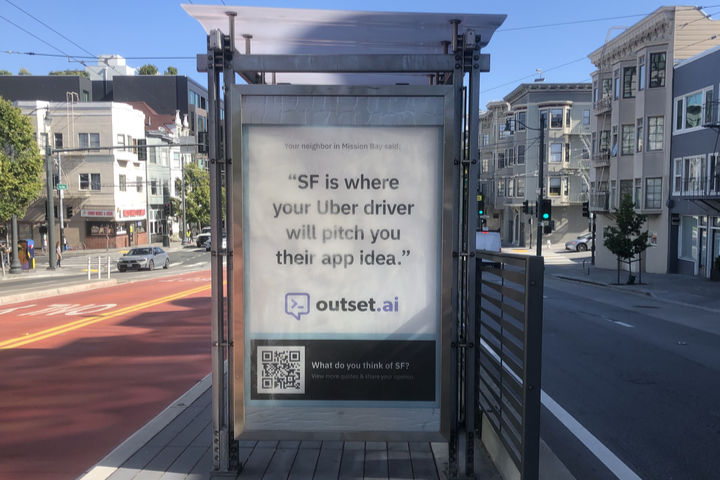
Ads for artificial intelligence companies are prevalent along Muni’s 49-Van Ness/Mission route, including this stop at Van Ness Avenue and Union Street.
Carl Nolte/S.F. Chronicle
There are three advertising signs on the bus shelters along Van Ness Avenue that ask an important question: What do you think of SF?
It’s a clever campaign, run by Outset, a San Francisco based AI research platform that describes itself as offering “behavioral intelligence and emotional analysis to bridge the gap between what consumers say and what they do at unprecedented speed and scale.” It’s market research.
So what do people really think of San Francisco while riding along on a bus? Outset AI offers a few answers from people they say are city neighbors.
Article continues below this ad
At the bus stop at Sacramento Street: “SF is just a tech campus with Victorian houses.”
At Union Street: “SF is where your Uber driver will pitch you with their app idea.”
San Francisco Chronicle Logo
Make us a Preferred Source to get more of our news when you search.
Add Preferred Source
A little farther on: “There are more run clubs here than night clubs.”
A 49-Van Ness/Mission bus wrapped in an artificial intelligence ad illustrates the prevalence of AI in San Francisco.
Carl Nolte/S.F. Chronicle
Those are all interesting statements. I hear them all the time in my travels around San Francisco. But they bring up a larger question: Will the artificial intelligence boom change San Francisco? Or will San Francisco change the tech people who are developing this booming new world?
Article continues below this ad
You can see it all on Van Ness Avenue, where Muni’s 49-line buses are packed full almost all the time: people going to work, going home, going around town, old people, young people, dogs, schoolkids on a field trip. It’s a crowded ride, bumpy, low-tech. About half the buses are covered with AI ads, some of them completely shrink-wrapped in messages. I rode on a big bus covered in red and black: “Firecrawl,’’ one end of the bus said. “Web Data for AI,” on the other. The ads obscured the bus windows, making it tough for the passengers to see out.
When they got off the bus, riders could see other ads: “Are your APIs ready for AI agents?” and other high-tech messages. Seeing the passengers crowding on and off the bus, you have to wonder: Are these bus passengers the kind of low-tech workers who will be replaced by artificial intelligence one day soon?
I was thinking about some of what there is to see out the bus window on Van Ness Avenue. There are no Victorian houses, but the California Street cable car stops there, and at Sacramento Street is the grand stone Old First Presbyterian Church, founded in 1849 in the midst of another boom, destroyed in the big 1906 earthquake and rebuilt on Van Ness in 1909.
Old First Presbyterian Church at Sacramento Street and Van Ness Avenue is rooted in the history of San Francisco.
Carl Nolte/S.F. Chronicle
And just up the hill, a block away from the avenue, is the famous Haas-Lilienthal House, the city’s grandest Victorian.
Article continues below this ad
The Outset AI ad at the stop on Union Street mentions an Uber driver pitching an app idea as if that were something new. But new ideas and new projects are old news in San Francisco. Didn’t the engineer and promoter Joseph Strauss talk years ago about his plan for a bridge across the Golden Gate Strait? Didn’t Jack Dorsey and his partners develop a messaging system in San Francisco called Twitter just 20 years ago?
So, San Francisco has a reputation for something new: television, the martini, green goddess dressing, fortune cookies.
But there is a certain unease about artificial intelligence. Just the other day, ex-Google CEO Eric Schmidt was booed when he praised artificial intelligence at a commencement address at the University of Arizona. And that’s not unusual. AI is so big, so powerful that people compare it to the industrial revolution.
That brings us to San Francisco, a city that built its name on welcoming the new and celebrating the old. Can we have a high-tech hub in a Queen Anne house? Can a city that developed a kind of quirky style where oddball characters were honored welcome even more serious-minded tech bros?
It’s easy to see change — in the ads for AI, in the startling news stories about trillionaires suing each other, in the first San Francisco boxing match between two robots, and in the herds of driverless cars on the streets.
Article continues below this ad
An artificial intelligence ad at a Muni stop at Sacramento Street and Van Ness Avenue contrasts with the historical nature of the neighborhood.
Carl Nolte/S.F. Chronicle
It’s a new world, all right. The doom loop has vanished, the city is back. Just look at the traffic.
But, like a lot of other San Franciscans, I sense something missing in San Francisco, something in the air. It’s not as much fun as it used to be. The city is cleaner than it was a few years ago; it’s better, too. Fewer tents, fewer lost souls wandering the streets.
But there was a sort of San Francisco-ness about the place not so long ago. It’s still the same city, but it’s different. I miss some of those other San Franciscans: I noticed the street preachers at Powell and Market, the sidewalk flower stands, the man who sat on the city’s main drag most every day with a big sign saying, “NO SEX.” I liked the man who played a Chinese violin in the subway. I haven’t seen him for a while.
Article continues below this ad
When I was working downtown, most every day I’d see a panhandler, usually by the Old Mint on Fifth Street. He always said hello; I’d give him something every so often. I didn’t know his name. One day, he was gone, like a bit of the city we all remembered.
But Monday is Memorial Day, the first day of the long, cool San Francisco summer, stretching away all the way to Labor Day. Maybe AI will figure out a way to make summertime last all year.