
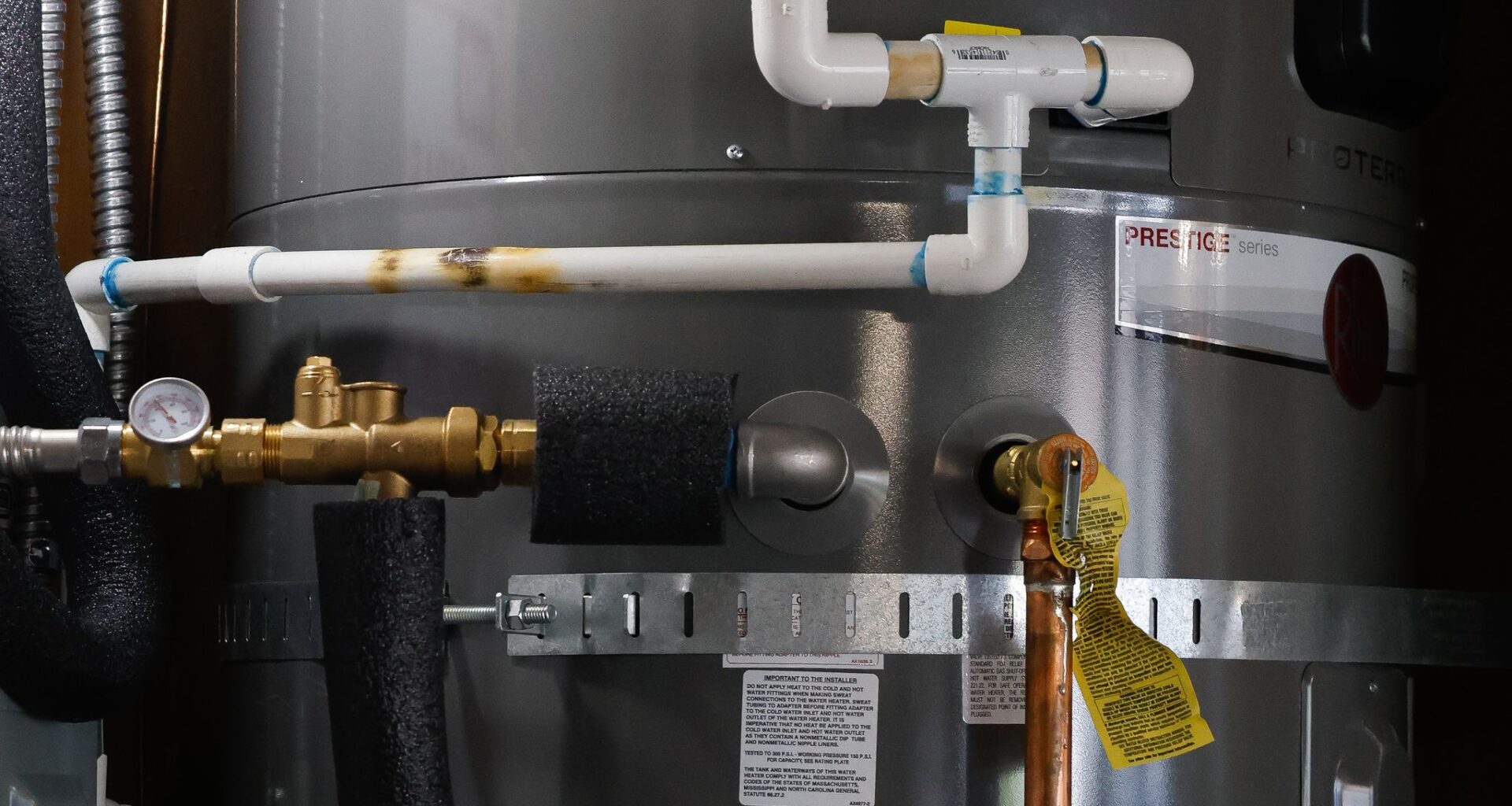
Gauges, tubes and pipes are seen on the exterior of a heat pump water heater installed in January in Foster City. Michael Allen, the owner of the home, said the installation cost $6,500. He is still trying to get a rebate.
Lea Suzuki/S.F. Chronicle
Heat pump water heaters are at the center of one of the Bay Area’s most contentious environmental debates.
Starting next year, many households will be required to replace broken natural gas-powered water heaters with non-polluting electric alternatives — and the switch is expected to come at a hefty price. Bay Area Air District staff found that, on average, the swap to a heat pump water heater would be about $3,500 more expensive, including installation costs. Both standard gas water heaters and heat pump versions last about 10 to 15 years.
Supporters say the gas water heater ban would cut air pollution, save lives and go down in history alongside landmark bans on asbestos and mercury. Critics warn the mandate will heap more costs onto already struggling homeowners. The district is set to decide in October on exemptions that could apply to 38% of water heater replacements — in particular for those in low-income households and for installations that are complex and expensive.
Article continues below this ad
Here is everything you need to know about the rule.
What is a heat pump?
With gas water heater sales being banned next year, the air district recommends installing heat pump water heaters, widely regarded as the most efficient electric option on the market.
San Francisco Chronicle Logo
Make us a Preferred Source to get more of our news when you search.
Add Preferred Source
These appliances pull heat from the surrounding air and transfer it through coils wrapped around the water tank to warm the water. The process releases cooler, drier air back into the room. Many heat pump water heaters also include traditional electric heating elements to warm water during periods of high use.
Article continues below this ad
Heat pump water heaters use the same technology as a separate type of heat pump that heats and cool homes — but those, too, will soon become more common. Beginning in 2029, new residential furnaces sold in the Bay Area will be subject to similar air pollution restrictions as water heaters — i.e. they won’t be allowed to emit smog-forming nitrogen oxides (NOx) — and that change will usher in more electric heat pumps.
Adding both a heat pump water heater and a heat pump furnace system could push more homeowners toward costly electrical panel upgrades. Older homes often have 100-amp panels, while newer or upgraded homes may have 200-amp panels or higher.
Homes with multiple new electric appliances — such as two heat pumps and an electric vehicle charger — may be more likely to need electrical upgrades, especially if they have lower-capacity panels.
How much does it cost?
Heat pump water heater installations can vary widely, depending largely on the complexity of electrical work. The air district said that an average natural gas water heater installation would be around $3,500 while a heat pump installation would cost about $7,000. At the high end, if for example significant electrical work is needed, the costs of a heat pump installation could rise to $38,800, the air district said.
Article continues below this ad
Michael Allen, who had his heat pump installed in January in Foster City, said he got quotes from three different companies at approximately $6,000, $10,500 and $12,000. He opted for the lowest one; it ended up costing $6,500.
While the upfront costs of installing a heat pump can be high, there are state, regional and local rebates that can lower expenses by hundreds or even several thousand dollars (though incentives could get drained over time if lots of people use them). Allen was expecting at least a $2,500 rebate from his electricity provider but is still navigating the reimbursement process.
“No kidding, 16 emails back-and-forth, we still did not have a permit and almost 2½, 3 months had gone by,” Allen said. When he got the necessary paperwork and submitted the rebate, the electricity provider said he was past the deadline.
Frans Cartwright, the owner of San Jose-based Better Water Heaters, the company that installed that heat pump, said Allen’s rebate was among one of the most difficult to lock down. Allen said that his household battery system saved him from needing an increase in electricity service — a point of confusion that held up the rebate process.
“Other than the permitting process (which was tied to getting a rebate), it has been a pleasant experience,” Allen said.
Article continues below this ad
It can be less expensive to operate a heat pump than a natural gas water heater.
Cartwright said a heat pump costs about $100 to operate a year versus $400 for a natural gas model. In Allen’s situation, operating his heat pump has proved to be only slightly cheaper than his old natural gas water heater so far, but the swap has allowed him to complete the full electrification of his house. He has since taken out his gas meter and gas line.
The Bay Area Air District staff estimated that high-usage households would either see savings or little change in bills after switching to a heat pump. Some studies show bigger savings because they look at specific households and electricity rates, while the district used more cautious estimates meant to reflect average costs across the Bay Area, said Kristina Chu, the district’s communication manager.
How much louder and slower are heat pumps?
Beyond the higher expense, heat pump water heaters can be larger, louder and slower to heat water than their natural gas counterparts.
Article continues below this ad
“If you have the right setup for it, yes, it could be good. But I personally would never want to put one in my house,” said Chris Guslani, the owner of Bay Area Water Heaters, which installs natural gas water heaters as well as the occasional heat pump. “They don’t heat up as fast, they’re loud, they’re huge.”
Heat pump water heaters generally come in two versions: 120-volt units that can be plugged into a standard wall socket and a 240-volt model that requires electricians to install a dedicated power line (the latter is part of the reason why it is far more expensive to install a heat pump versus a gas model). Both models will produce noise comparable to a refrigerator, which is similar to the noise of a natural gas water heater. But the heat pump will often run for twice as long, Guslani said.
While 120-volt units can save homeowners from high electrical installation costs, they can also mean less hot water availability, Guslani said.
Homes typically have 50- or 65-gallon tanks to hold hot water. Once that is exhausted, 120-volt models can typically heat from seven to 15 gallons of water per hour, while 240-volt water heaters can warm approximately 18 gallons to 23 gallons if its hybrid mode, which uses traditional electric water heater elements to warm water faster, is unlocked, installers said.
A gas-powered water heater can heat about 30 gallons of water per hour.
A five-minute shower with water-efficient shower heads can use 10 gallons of water.
How much extra space do you need?
Space constraints could also be an expensive problem for homeowners.
Guslani said that in about 60% of cases he’s seen, gas water heaters operate in spaces without any wall sockets. And manufacturers warn against using extension cords for water heaters.
Heat pump water heater tanks might need to be up to 15 gallons larger than those used with natural gas water heaters to account for slower heating times, according to the air district. Heat pumps, which are often a foot taller than natural gas models, also typically need to be installed in rooms with more than 700 cubic feet to allow for adequate airflow.
“That’s our biggest challenge,” Master Plumber Eric Aune said in a YouTube video explaining heat pump technology. “If these are going to operate successfully, people are going to be happy with their performance, we need to put them in a space where we’re giving them a chance.”
An optimal placement is in a basement or garage, even better if the conditions are hot, since heat pumps — which extract heat from the air — operate most efficiently in warmer spaces, according to the Department of Energy. If a homeowner doesn’t have access to a larger space, contractors can attach ducts to funnel cold air outside or into another room, with an added cost.
Who is exempt?
Air district staff are proposing exemptions for several categories of property owners.
These include low-income homeowners, along with those whose annual mortgage and property taxes are 28% or more of their gross income. Exemptions could also be offered to homes with electrical constraints or if the heat pump is too big for the room available in a house.
If a water heater abruptly breaks, the rules would allow a licensed contractor to buy and use a gas-fired water heater as a temporary replacement while the home is prepared for a heat pump.
Commercial and multifamily natural gas water heaters can still be sold; the phase-out for them won’t start until 2031.
When do the rules begin?
The rules are set to begin Jan. 1, 2027. However, the air district could delay implementation date to Oct. 1, 2027, to allow for additional public outreach. That will be decided in a meeting this October.
Is this legal?
Other local natural gas bans have run into legal challenges. Berkeley passed a first-in-the-nation ban on natural gas infrastructure in new buildings in 2019, but agreed to repeal it in 2024 after a federal appeals court ruled that the ordinance was preempted by the federal Energy Policy and Conservation Act. Other cities that followed Berkeley’s lead on this have also pulled back.
However, a separate lawsuit against the South Coast Air Quality Management District, a powerful Southern California air regulator that includes Los Angeles, has so far been less successful.
In that case, appliance manufacturers and industry groups challenged a South Coast rule phasing in zero-NOx standards for large water heaters and small boilers often used commercially, arguing it was effectively a gas appliance ban preempted by the same federal law at issue in the Berkeley case. But a district court sided with the air district, finding that the rule regulated pollution coming out of appliances, not the energy going into them. The rule remains in effect as the case is appealed.
Separate rules that would have phased out NOx emissions from residential furnaces and residential-type water heaters were rejected by the board.
That distinction could be central to the Bay Area Air District’s legal defense if its rule is challenged. Rather than banning gas infrastructure or regulating how much energy an appliance uses, the rule set by the air district — which has long regulated pollution from stationary sources — sets an emissions standard for air pollutants. saying in this case that water heaters can emit no NOx.
Why are regulators pushing heat pump water heaters?
The nitrogen oxides emitted by natural gas-powered water heaters can form smog and fine-particle pollution. The air district estimates that switching to electric water heaters will prevent up to 85 premature deaths and save up to $890 million in health care costs.
NOx also contributes to the warming of the planet.
“We wanted to reduce the carbon footprint of our home and we knew that there wouldn’t be comfort sacrifices,” said Julia Zeitlin, a Stanford student whose Palo Alto family installed a heat pump several years ago. “We would be able to have access to hot water whenever we needed it and we knew that this was the right decision for the environment.”
Heat pumps have an efficiency edge on other electric water heaters. Since heat pumps don’t generate heat to warm water like traditional electric and natural gas versions, they are two to three times more energy efficient than conventional electric resistance water heaters.
Unlike gas heaters, heat pumps also don’t emit deadly carbon monoxide, an odorless, colorless gas, and they have less of a chance of exploding or causing a fire if they malfunction.
And since the appliance emits cool air, it can lower the surrounding area’s temperature.
“It provides a kind of nice air conditioning in our garage,” Zeitlin said.
What areas will need to comply?
The air district governs nine counties surrounding San Francisco Bay — Alameda, Contra Costa, Marin, Napa, San Francisco, San Mateo, Santa Clara, southwestern Solano, and southern Sonoma counties.