
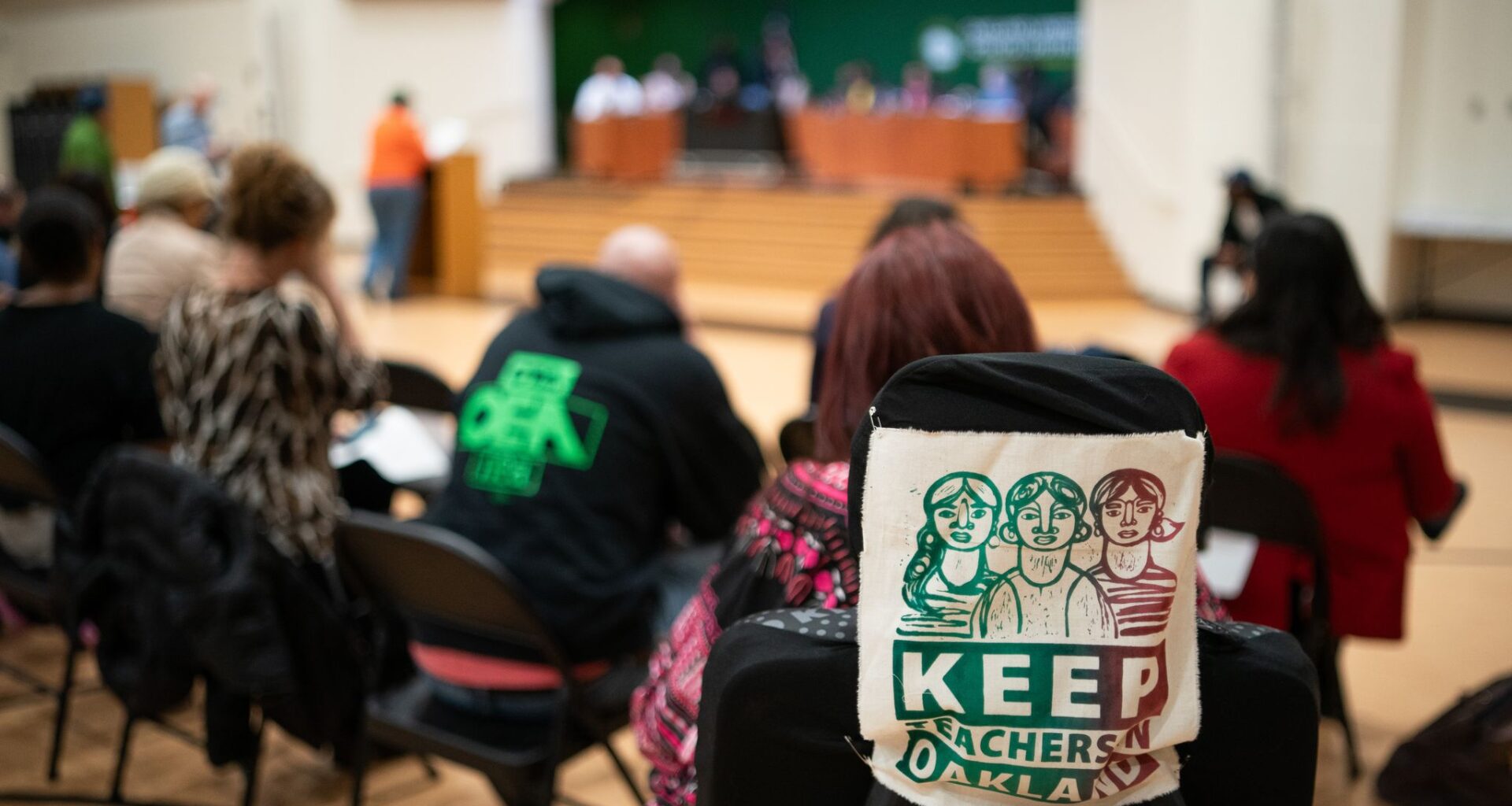
Educators and advocates brought signs supporting their causes during an Oakland School Board meeting in February. The district and teachers agreed to a deal, but months later it’s not finalized.
Don Feria/For the S.F. Chronicle
It’s been nearly three months since Oakland teachers celebrated a decisive victory at the bargaining table after district officials gave in to nearly all their demands to avoid a strike.
Yet, so far, the expensive deal is still pending, meaning salary increases and other wins for the union remain on hold, including the educators’ retroactive raises back to last July.
The reason for this delay is tangled in a complex web of questionable bookkeeping, backroom deals, school board bickering and an overall sense of chaos, according to the extensive public record of meetings, correspondence and official documents.
Article continues below this ad
Or, more specifically, it’s unclear whether the Oakland Unified School District can afford it — and recent budget projections have vacillated between district coffers filled with cash and a balance sheet running on empty.
Keeping up with the complicated developments has challenged even the most dedicated district devotees. The Chronicle has tracked the evolving situation and created a reference guide on what is happening in the perennially embattled public school district and, in part, what led to this and how bad it could get.
What did the tentative agreement with the teachers union include?
The deal, reached on Feb. 27, includes an 11% to 13% raise for all members of the union over a two-year period, including a retroactive raise back to July 1, 2025. It also gives additional increases to specialized educators nurses and social workers.
San Francisco Chronicle Logo
Make us a Preferred Source to get more of our news when you search.
Add Preferred Source
Besides compensation, the agreement also includes reduced class sizes, smaller workloads for counselors and increases prep time for teachers, among other benefits.
Article continues below this ad
Was the tentative agreement reached without the district knowing how much it would cost?
Yes. And, no, this is not normal operating procedure. Typically, district negotiators cost out a deal before agreeing to it so they know if they can afford it. In this case, Oakland’s top district officials stepped in to avert a strike and agreed to the deal without a clear estimate of the cost.
District officials said earlier this month the deal would cost an estimated $13 million this school year, $33 million next year and then $62 million for the 2027-2028 school year. But, so far, there is no detailed breakdown or analysis on how the district will cover those costs, which is required before the school board can vote on it.
The tentative agreement “is among the most complex multi-year labor commitments in this District’s recent history,” Superintendent Denise Saddler said in a letter to the County Office of Education explaining the delay. “Accurate costing requires a level of analytical rigor that produces figures this Board, our bargaining unit, and this community can rely upon. That work is currently underway.”
Ok, but if those figures are accurate estimates, can the district afford the contract?
That’s the $108 million question. Currently, there is no official answer.
Article continues below this ad
Wouldn’t that price tag add to an already massive deficit and fiscal crisis?
Yes. In December, the annual structural deficit had reached $100 million — with the school board consistently using one-time funds to cover the difference between spending and revenue. That includes pandemic recovery money, which is now gone.
Since then, officials have made cuts to staffing and services while shifting some costs to restricted pots of money, like grant funding, reducing costs by $65 million. But that still leaves about a $20 million deficit this year and up to $50 million next year, given rising costs and not including the price tag on the teacher’s contract.
There is also a new contract with SEIU support staff, which is expected to cost about $12 million over a three-year period, starting this year.
What does all this mean in terms of the district’s fiscal bottom line?
That remains unclear. Oakland Unified’s books are a bit of a mess right now. Those in charge are currently doing a major budget overhaul, which means moving a lot of money from one pot to another within a system that is incredibly complicated and bureaucratic.
Article continues below this ad
They have until the end of June to not only come up with a balanced budget for the upcoming school year and get approval from the school board, but also estimate the budgets for the following next two years.
How’s all that going?
Well, District officials say everything is fine, nothing to see here, while others are predicting serious issues and bracing for disaster.
The doomsdayers cite the wild fluctuations coming out of the district’s budget office in recent weeks. That includes a $16 million cash balance at the end of the 2026-2027 school year, which was part of a budget synopsis they submitted in late April to Alameda County Superintendent Alysse Castro, who oversees district budgets.
Less than two weeks later, during the May 18 school board meeting, those same officials projected an ending cash balance of $150 million to $180 million, for the same date, with no detailed explanation for the discrepancy.
Article continues below this ad
How is that even possible?
That could happen as part of the budget overhaul. But it could also be a huge red flag that things are going seriously sideways, Castro told the Chronicle.
There are a lot of questions about the district’s fiscal stability that won’t be known until the June budget is complete, she said, adding county staff are meeting with district officials regularly to provide guidance and better understand the situation.
But, for a while now, a lot of people, including Castro, have been in the dark about what exactly is happening in Oakland Unified’s budgeting department, which the district’s human resources director also runs.
“I’m not sure they know how much money they have; I’m also not sure they don’t,” Castro told the Chronicle. “We have to sit in that uncertainty a little longer.”
Should staff, students and families be worried?
Well, in the short-term, the district won’t run out of money. But the question is whether it can stay afloat next year or the year after, especially given the costly labor contracts. Current budget estimates show the district with a $133 million deficit next year, including the new labor contracts, which could shrink to $60 million or so given expected budget reductions. The following year, the deficit would still be at least $50 million.
Without significant cuts, and depending on state revenue and which of the district’s recent budget projections is used, the city’s schools would have between $6 million and $30 million left in their savings account two years from now.
At the same time, average daily attendance and the state funding that goes with it is expected to decline, according to district projections.
Worst-case scenario: The district runs out of money to pay the bills, requiring a state loan and triggering another state takeover. The city’s schools paid off the previous $100 million loan last year — 22 years after falling short of the cash needed to make payroll.
What are district officials saying?
Saddler and the school board majority, which is aligned with the teachers union, have staunchly defended the district’s financial position, saying they have taken the situation seriously and are moving toward solid ground with enough cash and plan in place to make that happen.
“We are not finished but we are making real, measurable progress, and we are moving in the right direction,” according to a staff presentation during the May 13 board meeting. “And the district is on a path toward long-term solvency.”
What are critics saying?
Those not in sync with the board majority, including outspoken board member Mike Hutchinson, fear the worst, saying information has not been clear and decisions are being made without proper public vetting.
That includes a board leadership decision to suspend a search for a new superintendent to replace Saddler, who was appointed as an interim leader when the previous superintendent resigned under pressure.
Instead, the board majority, at just before midnight on May 13, voted to extend Saddler’s contract for a year and remove her interim title, a contract initiated and negotiated behind closed doors and approved with little public notice.
Hutchinson called the situation “scandalous.”
What happens next?
With the governor’s May Revise out, district finance officials across the state are scrambling to put together next year’s final budgets and get them passed by the end of June. In Oakland, the public should see a first draft in mid-June.
At this point, it appears any costs related to the teachers contract will be pushed into the next fiscal year, with the price tag for the retroactive pay raise and the July 1 increase added to the 2026-2027 budget.
Saddler remains optimistic.
“Oakland Unified is committed to the path of fiscal stabilization and long-term excellence,” she wrote in an April 29 letter to Castro, who had ramped up fiscal oversight based on the district’s fiscal status.
“The work ahead is significant, and we do not minimize it,” Saddler continued. “But the District is on that path, moving in the right direction, with a real plan, a capable team, and a clear destination.”
Based on the convoluted budget numbers, the factious board meetings and a teachers tentative agreement gathering dust, not everyone was comforted or convinced by the superintendent’s reassurances.
That includes former school board member Sam Davis.
“I don’t miss being on the board — it was stressful having to take unpopular positions while I was in office,” he said. “But I did exactly that because I was trying to avoid the directionless sh–show that we’re in now.”