
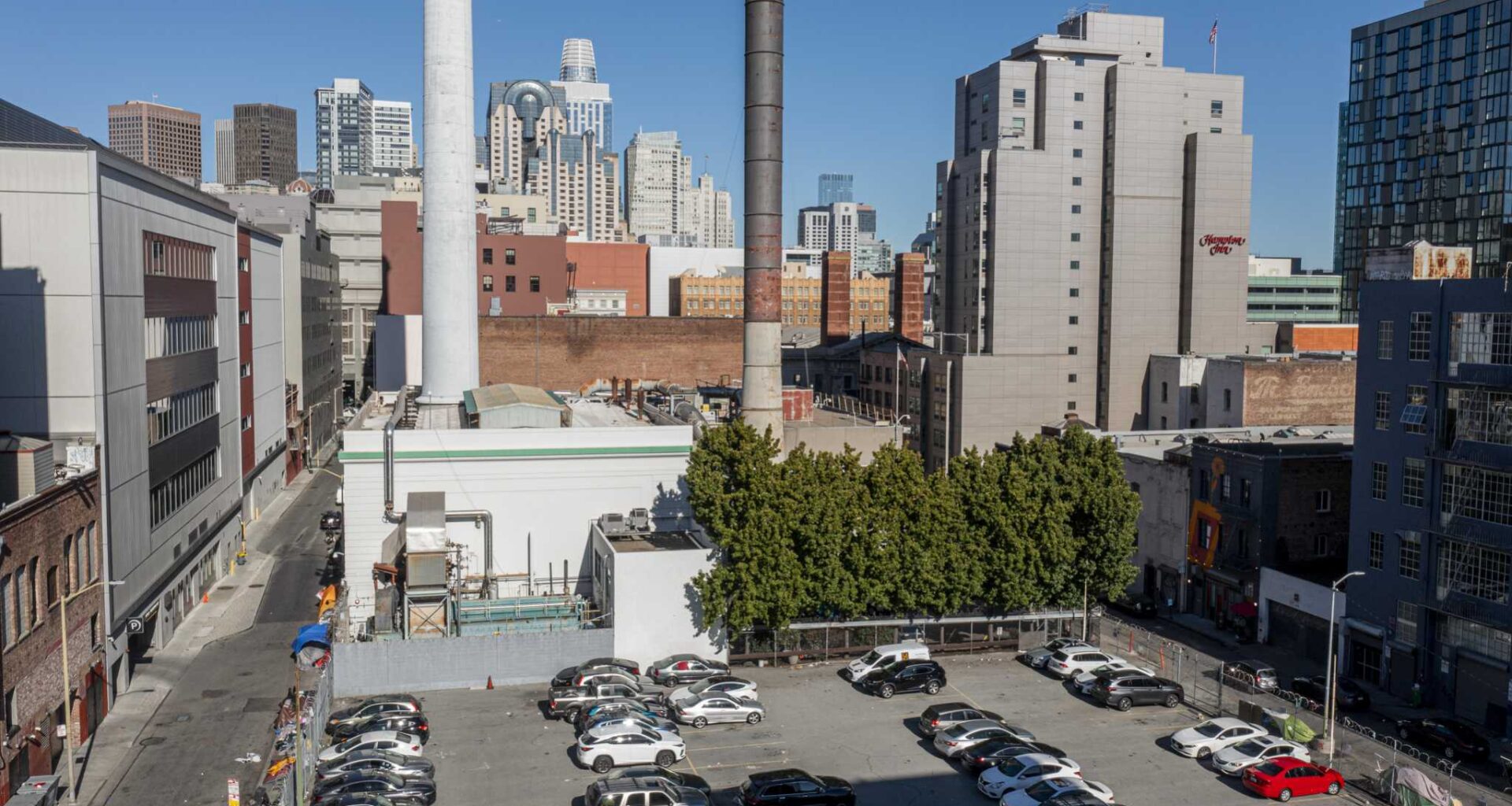
Shade stopped 469 Stevenson St. in San Francisco from becoming 495 units of housing. It remains a parking lot.
Santiago Mejia/The Chronicle
Did you know that shade shares the same environmental classification as toxic soil under California law?
Yes, under the California Environmental Quality Act, relative sun exposure is a form of environmental degradation. And the lack of a clear definition in CEQA for what constitutes a “significant” shadow allows opponents to stall housing projects for years with environmental reviews.
It should go without saying that conflating shadows with toxic waste makes no sense.
Article continues below this ad
Last week, San Francisco Supervisor Bilal Mahmood introduced legislation to stop the weaponization of shade in the city. His Slashing Housing Appeals & Delays Everywhere (or SHADE) Act would streamline environmental review procedures that go beyond state requirements — by removing shadows cast by buildings as a criterion for local CEQA review and as a basis for environmental appeals.
Since 2017, shade-related CEQA appeals have delayed or stalled 11 housing projects, impacting 2,195 housing units in San Francisco, according to Mahmood. Most infamous was the former Nordstrom valet parking lot at 469 Stevenson St. An appeal to a proposed 495-unit development there claimed the building would cast a shadow on nearby Mint Plaza. That appeal effectively halted construction and turned the lot into a symbol of the city’s housing dysfunction, triggering a state investigation.
San Francisco Chronicle Logo
Make us a Preferred Source to get more of our news when you search.
Add Preferred Source
Today, Mint Plaza is barely used; many of the businesses there have shut down. The parking lot nearby remains — a parking lot. In March, an entitlement extension was requested for the project — one that reduces the inclusionary affordable housing units from 19% down to 15%, likely due to the cost delays.
Mahmood told me 469 Stevenson was “the genesis” of his legislation. “That was 495 units that would have been housing, but the appeal delayed the project for years, and now it’s nonviable.”
Article continues below this ad
According to a Planning Department analysis, San Francisco is the only city in California that evaluates shadow impacts as a standalone category for its CEQA analysis. Other cities have some component of the category, but ours is the strictest. San Francisco’s 1984 Sunlight Ordinance is notoriously complex in how it calculates shadows. This is by design.
People have been arguing for CEQA reform to eliminate such considerations since the law’s inception in 1970. It’s taken decades, but those calls are finally gaining momentum: Last June, California enacted Assembly Bill 130, which created 10 new CEQA exemptions to streamline approvals for housing and other projects like childcare centers, clean water infrastructure and health clinics.
Shadows, however, remain part of the law.
For decades, zoning and planning regulations — such as those first established in New York in the early 20th century — prioritized preserving sunlight and airflow in dense urban areas, sometimes treating shadows as a negative. But in an increasingly warming world, shade is starting to be considered an amenity, not a nuisance.
In his 2025 book “Shade: The Promise of a Forgotten Natural Resource,” environmental journalist Sam Bloch reported on the equity impacts of shade, or rather the lack thereof. He cited a study that shows how, in almost every city, the neighborhoods that were historically redlined have the highest land surface temperatures. “There are reasons why some neighborhoods are hotter than others,” Bloch wrote. “They were planned and built that way.”
Article continues below this ad
San Francisco still has gray and foggy summers, but it has also become dramatically hotter in recent years. Because San Francisco has been a temperate city with a cool coastal climate, our bodies and buildings are largely unadapted for extreme temperatures. This will become more problematic as temperatures rise; the city is expected to have up to 24 extreme heat events annually (any day over 85 degrees) in the coming decades.
We’ve also stopped designing homes that take advantage of nature. Too many are constructed without consideration of what solar orientation and building materials can do to allow a space to heat and cool. We rely instead on heaters and air conditioners.
As Bloch argued in his book, architects, engineers and developers are using past climate conditions to determine if new buildings will be safe in the future, using historic weather data to formulate their heating and cooling systems. But now, “a changing climate calls the utility of the old data into question. When architects work in climates that have dreary winters, how will they ensure that a brilliant sunlit interior doesn’t become a hotbox during an unanticipated freak heat dome?”
Other countries have long designed buildings and infrastructure to combat heat — overhangs and shaded courtyards in the Middle East, say, or covered pedestrian walkways in Singapore. The Royal Institute of British Architects recently commissioned a guide to designing for a warmer climate, even in a city as foggy as San Francisco — London.
As temperatures rise, shade should be recognized as essential infrastructure, something that should be treated similarly to power lines or sewers. Heat-related deaths are rising globally and in the U.S. due to climate change, with roughly 489,000 annual heat-related deaths worldwide from 2000 to 2019. California heat-related deaths tend to be extensively underreported.
Article continues below this ad
Should Mahmood’s legislation pass, another obstacle to building in San Francisco will be removed. Along with it, the city will hopefully gain a better understanding of shade as a resource.
When I asked the supervisor how he might respond to critics of his legislation, he said, “The broader answer is ‘What is best for our environment?’ Under the premise of protecting the environment, we are actually hurting it. We are course correcting that.”
Guest opinions in Open Forum and Insight are produced by writers with expertise, personal experience or original insights on a subject of interest to our readers. Their views do not necessarily reflect the opinion of The Chronicle editorial board, which is committed to providing a diversity of ideas to our readership.
Read more about our transparency and ethics policies
Sarah Dennis Phillips, director of the Planning Department, agrees: “Simply put, we have to get out of our own way.”
Mahmood’s legislation is expected to be heard by the Planning Commission in June. Removing this bureaucratic obstacle will help reduce the cost and the timeline of new construction. I hope it also encourages aesthetic innovation. We’ve got the tech, the materials and the know-how to design buildings for a warming planet. So let’s do it.
Article continues below this ad
Allison Arieff is a columnist and editorial writer for the Opinion section.