
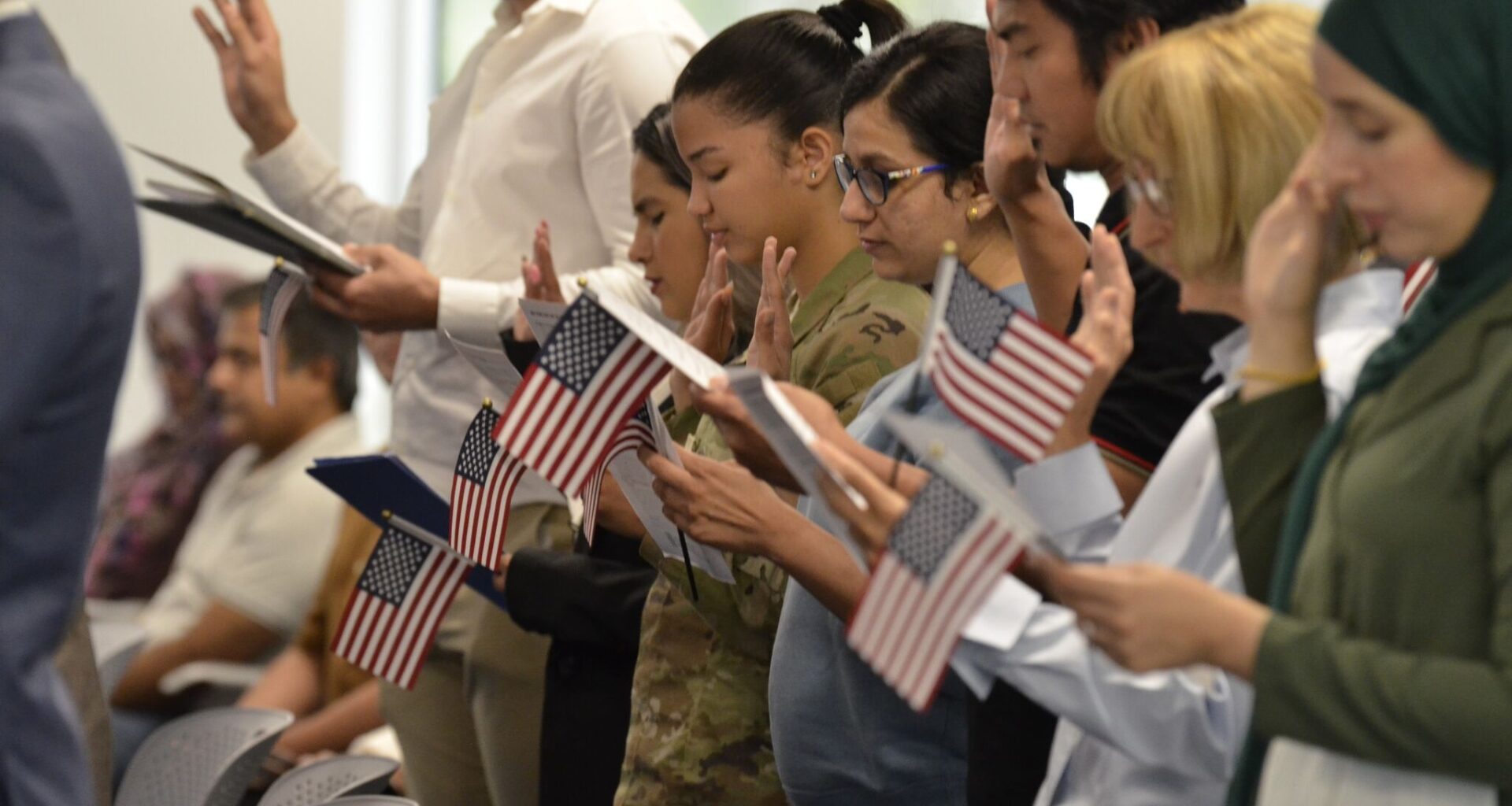
Green card seekers will have to apply outside the U.S. under a policy announced Friday by the Trump administration.
U.S. Citizenship and Immigration Services
Bay Area immigration advocates expressed bewilderment and alarm after the Trump administration announced that people seeking green cards in the U.S. will soon be forced to return to their home countries to apply.
The change, announced Friday in a memo by U.S. Citizenship and Immigration Services, would upend longstanding immigration policy, which has allowed foreign nationals with legal immigration status — among them, work and student visa holders, refugees and people married to citizens — to secure permanent residence without leaving the U.S.
“Something like half a million people adjust their status each year,” said Abigail L’Esperance, director of the East Bay Community Law Center’s Immigration unit. “They’re turning something totally ordinary and calling it extraordinary by fiat.”
Article continues below this ad
USCIS’ announcement said all foreigners in the U.S. who want a green card “must return to their home country to apply, except in extraordinary circumstances.”
U.S. Citizenship and Immigration Services announced Friday that all foreigners in the U.S. who want a green card “must return to their home country to apply, except in extraordinary circumstances.”
Dreamstime/Tribune News Service
USCIS spokesperson Zach Kahler said in a news release that the government is returning to the “original intent of the law to ensure aliens navigate our nation’s immigration system properly” and to allow the country’s immigration system “to function as the law intended instead of incentivizing loopholes.”
San Francisco Chronicle Logo
Make us a Preferred Source to get more of our news when you search.
Add Preferred Source
Immigration experts pushed back, noting that for more than half a century before President Donald Trump’s administration, the federal government has allowed immigrants working and living in the U.S. to apply for their green cards in the country.
Article continues below this ad
In a searing LinkedIn post, Doug Rand, former USCIS official, called the government’s claims in its policy announcement “little more than lies.”
“Adjustment of status is a bedrock element of our immigration laws, not a ’loophole,’” he said. “The purpose of this policy is exclusion. Remember that Trump has banned people from over 100 countries from returning to the U.S., so forcing them to go abroad for consular processing is no pathway at all.”
According to USCIS’ own policy manual, Congress passed legislation allowing adjustment of status within the U.S. “to enable certain aliens physically present in the United States to become (lawful permanent residents) without incurring the expense and inconvenience of traveling abroad to obtain an immigrant visa.”
It’s not clear how USCIS workers handling applications would determine which ones are exempt, said Patrick Kolasinski, a Modesto immigration attorney. He described the language of the policy as vague, saying it leaves a great deal up to the discretion of federal workers. Because USCIS officers in California “tend to be reasonable,” he said, it’s possible the change could have a limited impact on the state.
But if the policy is enforced to its full extent, Kolasinski said, the effect will be “disastrous,” making it harder for hundreds of thousands of people across the country to secure permanent residence. He expects that the change will soon be challenged in court.
Article continues below this ad
“There is broad-based panic in the community,” Kolasinski said. “Our phones are blowing up.”
Securing a processing appointment outside the U.S. can take more than a year under current workloads, which Kolasinski said would probably increase as a result of the change. Green card seekers would have to leave their jobs and families during that time, racking up travel and legal expenses.
Immigration advocates warn that President Donald Trump’s new green card policy, requiring many applicants to leave the U.S., could upend legal immigration.
U.S. Citizenship and Immigration Services
“It costs a fortune to travel,” he said. “Instead of going down to your local USCIS office for a one-hour interview, we’re now adding tremendous expenses for people who have to leave the country.”
On Saturday, advocates and immigration experts noted that ramifications of Trump’s policy shift remained unclear.
Article continues below this ad
In the Bay Area, the change would especially strain tech companies that rely on immigrant workers. LinkedIn co-founder Reid Hoffman wrote on X Friday that the policy was a “harmful move for tech, business and America broadly.”
“The new White House policy requiring green card applicants to apply from outside the U.S. is a capricious attack on legal immigration,” artificial intelligence entrepreneur Andrew Ng concurred on X. “It will hurt families, leave us with fewer doctors, teachers and scientists, and hurt American competitiveness in AI.”
For some, the announcement brought flashbacks of Trump’s September proclamation that he would impose a $100,000 annual fee on H-1B visa applicants, the majority of whom were tech workers as of 2023. That announcement sparked similar chaos, especially during the hours before the White House clarified that the policy would not apply to current visa holders.
Concord immigration attorney Johanna Torres said she believes both announcements were intentionally confusing in an attempt to “create hysteria.” She had back-to-back meetings Friday with panicked clients who would be affected by the policy.
Torres, who serves a largely Spanish-speaking clientele, is especially concerned about room for prejudice in the discretionary policy.
Article continues below this ad
“It could be, ‘Well, we don’t want Latinos in the U.S., so we’re going to use our discretion to deny these cases without saying that we’re doing it because they’re Latinos,’” she said. “The current administration is against any type of immigration, both legal and illegal. This is a legal way for people to get their residency and citizenship, but they’re creating obstacles.”
Shev Dalal-Dheini, senior director of government relations at the American Immigration Lawyers Association, said the Trump administration’s announcement could also put immigrants from dozens of countries in a precarious position because the State Department had paused processing visa applications for people from 75 nations or from other countries where it does not have diplomatic relations or consular offices, such as Iran.
“If you can’t process your green card application here and the Department of State isn’t processing overseas applications, what are you supposed to do?” Dalal-Dheini said.
“The Trump administration said they were going to go after people who were criminals or violating the law — these are not those people,” she said. “These are the people who have been waiting in line, and who subjected themselves to background checks. And that is towards our safety. If someone can’t go overseas and (process their application at a consulate) or it will be years before they can reunite with their families or their employer, what does that mean for them? Are they going to go into the shadows? It makes us less safe.”
Jamal Abdi, president of the National Iranian American Council, described the policy announcement as a “kind of cruel joke.”
The government’s travel ban, lack of diplomatic relations with Iran and the ongoing war meant that Iranians have “no options for coming back,” he said.
“There are so many hurdles that I can’t imagine anyone willingly moving forward with this process,” he said. “It means that if you leave the U.S., effectively, you’re not coming back until this president is no longer in office.”