
Fifty years ago, Don Dickenson left a voicemail for California’s attorney general. Then he climbed into his car and drove toward the sea. If what he had heard was true, he had precious little time to save one of the most ambitious artworks in California’s history.

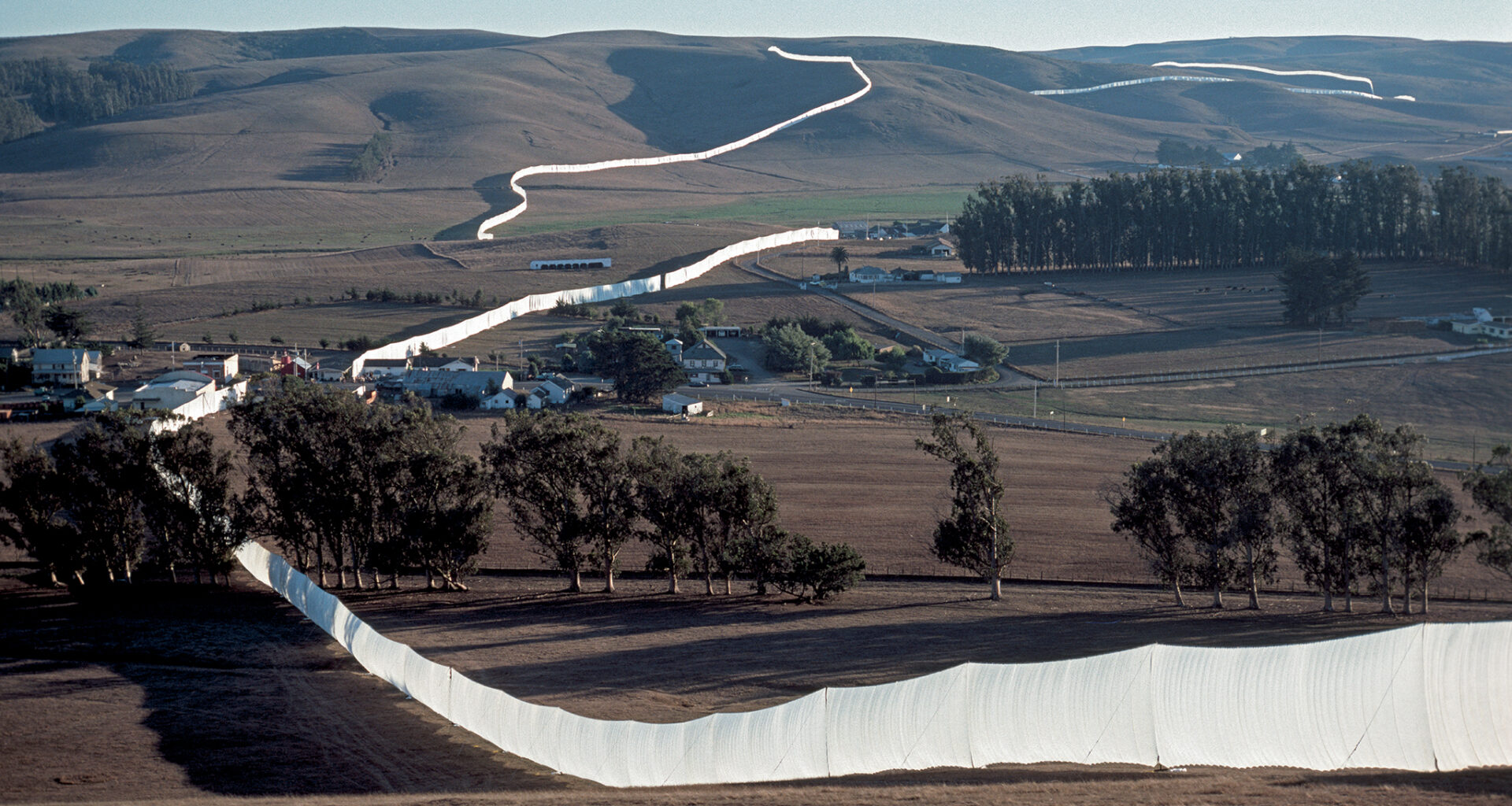
The artwork in question was “Running Fence,” a 24-mile installation by artists Christo and Jeanne-Claude that wound through Sonoma and Marin counties, weaving across their rolling hills before dropping into the Pacific Ocean. In appearance, it was closer to a curtain than a fence, a series of 18-foot-high nylon sheets suspended between 2,050 steel poles. In its finished form, “Running Fence” looked like a white ribbon laid across the landscape, flapping lazily in the wind.
The piece stayed up for only two weeks, but it was the culmination of a four-year effort, during which time the artists chased down permits, attended public meetings, rubbed elbows with ranchers and battled local opposition. The artwork had required a 265-page environmental impact report, 300 workers, and more than $2 million in funds to construct. In the process, the artists fielded both a bomb threat and vandalism from disgruntled neighbors.
Article continues below this ad
Richard Cole of Environmental Science Associates, Inc., leader of the project’s environmental impact report, explains his procedures and findings at a public hearing of the Sonoma County Board of Supervisors on Dec. 16, 1975.
Wolfgang Volz via the Christo and Jeanne-Claude Foundation
Through it all, “Running Fence” had prevailed. But just as it was set to be completed, it ran into a crisis that almost derailed the whole project. For the first time, the artists appeared to have violated the law. They had extended their fence into the Pacific Ocean without the approval of the California Coastal Commission.
Dickenson, who worked at the Marin County Planning Department, had heard rumors that a temporary injunction was on the way. If Christo was served, construction would be stopped, and “Running Fence” would be left unfinished.
When Dickenson arrived at the stretch of coast near Bodega Bay, metal poles held down by weighted anchors had already been dropped into the sea. A hive of workers were busy unfurling the white nylon curtains, and Christo was in the middle of a TV interview.
Article continues below this ad
In an interview with SFGATE, Dickenson recalled trying to interrupt the artist’s Q&A. “Christo, you’ve got to get out of here,” he said he told the artist. “You don’t want to be served.”
The end of “Running Fence” ran into the Pacific Ocean.
Wolfgang Volz via the Christo and Jeanne-Claude Foundation
Dickenson had been the one to report Christo’s violation to the attorney general, as required by his oath of office. But in the months he had worked to get “Running Fence” in compliance with county codes, he had come to respect Christo and his project. He wanted “Running Fence” to succeed.
The artist took his warning, and drove off to the Sonoma hills, where he hid out for two hours in a eucalyptus grove. No injunction arrived, and “Running Fence” was finished. But for those two hours, Dickenson was prepared to keep a secret.
Article continues below this ad
“I mean, I knew where he was, but I wasn’t going to tell them,” Dickenson told SFGATE.
The circus comes to town
By the 1970s, Christo and Jeanne-Claude were stars of the art world. Hailing from Bulgaria and France, respectively, they were born on the same day in 1935. By the time of “Running Fence,” they had dropped their last names and were living in a New York loft.
Christo in his New York studio with preparatory drawings for “Running Fence.”
Wolfgang Volz via the Christo and Jeanne-Claude Foundation
The artists were known for their “wrappings,” projects that involved covering something — a building, natural feature — in plastic. Previously, they had temporarily covered a stretch of the Australian coast in plastic, and they hung a 200,000-square-foot curtain in a Colorado Valley. The latter project, “Valley Curtain,” took 28 months to complete and lasted less than two days.
Article continues below this ad
Coming off of these successes, the artists aimed bigger. Christo and Jean-Claude drove up and down the Pacific Coast in search of the perfect staging ground for “Running Fence.” They scouted several locations, Christo’s nephew, Vladimir Yavachev, told SFGATE, but the hills and coast of the North Bay made the area a natural choice.
Years after the completion of “Running Fence,” the artwork is celebrated. The Smithsonian compiled a retrospective in 2010, complete with archival photos and pieces of nylon from the fence. The Museum of Sonoma County is hosting a 50-year retrospective, scheduled to open in June.
In the 1970s, though, opinions were split. From the beginning, “Running Fence” polarized locals, especially in Sonoma County. Mary Fuller McChesney, a local artist who had received a grant from the National Endowment for the Arts, told a Sonoma County newspaper that the fence was “not art at all.”
“It’s a business enterprise,” she said. “And Christo is not an artist but a corporation.”
Article continues below this ad
A sketch of “Running Fence.”
Charles Roussel/Wolfgang Volz via the Christo and Jeanne-Claude Foundation
She was half right. Christo and Jeanne-Claude set up an actual business, the Running Fence Corporation, to press through the bureaucratic proceedings. It was helmed by Jeanne-Claude, who was the project’s logistical mastermind, and at one point had nine lawyers on its legal team. Publicity did help pay the bills, since sales of Christo’s sketches funded the project.
Other locals, like poet Clarence Jonk, were more emphatic in their hatred of the fence: “Christo should be wrapped in it and buried!”
A documentary crew helmed by the Maysles brothers (“Grey Gardens”) followed Christo and Jeanne-Claude as they maneuvered through the four-year project, and caught debates about the fence on camera.
Article continues below this ad
“It’s all a bunch of garbage,” one agitated man says in the documentary. “That’s art? Some lousy curtain coming through here with a bunch of city slickers looking at it? To hell with it. I’m against it. I think it’s stupid.”
These complaints did not faze the artists.
Christo in his New York studio working on a preparatory collage for “Running Fence.”
Wolfgang Volz via the Christo and Jeanne-Claude Foundation
“The project is irrational,” Christo acknowledged in a 1975 interview with the Sacramento Bee. “It has nothing to do with rational things. There are the steel poles. There is the fabric. There is the fence. That’s all. I just like to do things my way.”
Article continues below this ad
At times, opposition threatened to turn into violence. Vandals slashed the tires of a truck associated with the project, and an anonymous caller warned a newspaper in Petaluma that three bombs would go off along the fence. (The threat ended up being a hoax.)
‘Everybody here is part of my work’
The greatest threat to “Running Fence” was probably bureaucracy, not bombs. Christo and Jeanne-Claude spent a total of $87,000 on permits. The “Running Fence” required permitting by and deliberation of an alphabet soup of governmental bodies, including, but not limited to: the Sonoma County Board of Supervisors; the Marin County Board of Supervisors; the Marin County Planning Department; Sonoma County Board of Zoning Adjustments; North Central Coast Regional Commission; the California Coastal Commission; the Sonoma County Superior Court; the California Court of Appeal.
Rancher Ed Pozzi speaks in favor of the “Running Fence” project at a public hearing of the Sonoma County Board of Supervisors in December 1975.
Wolfgang Volz via the Christo and Jeanne-Claude Foundation
As opposition grew, the bureaucratic machinery surrounding the project thickened. By 1975, the fence’s opponents had organized themselves into the Committee to Stop the Running Fence, and successfully pressured the Sonoma County Superior Court to revoke Christo’s land use permit. The artist spent $39,000 on that 265-page environmental impact report, and the installation of “Running Fence” was pushed back a year, forcing Christo and Jeanne-Claude to go through the permit process once more.
Article continues below this ad
The frenzy that cropped up around “Running Fence” — countless public meetings and a media circus — seemed to be exactly what Christo wanted. According to his philosophy, the four-year slog to complete “Running Fence” was integral to the artwork. Allies and opponents were part of the project. The chaos was theater, and everyone was an actor, whether they knew it or not.
“The art project is right now, here,” Christo tells an audience at a public meeting in the “Running Fence” documentary. “Everybody here is part of my work. If they want it, if they don’t want — anyway they’re part of the work.”
“He would thank people for being opposed to him, because he wanted to create thoughtful conversation, controversy,” Dickenson told SFGATE. “That was the nature of his project.”
Article continues below this ad
Stan Lawson, who grew up in Marin County, was recruited as a welder and mechanic for “Running Fence” while standing around an auto shop. He had just graduated from high school.
“I went to Tomales High School, which is a country school,” Lawson told SFGATE. “Most of the guys who went there had ranches and farms and stuff. So they weren’t very much into the art world.”
Christo introduces the “Running Fence” project to rancher David McCullough in 1974.
Wolfgang Volz via the Christo and Jeanne-Claude Foundation
In the battle to push “Running Fence” through, Jeanne-Claude and Christo found an unlikely sect of supporters: the ranchers on whose private land their fence would stand. The artists visited their houses one by one, sat for coffee and gradually won them over.
Article continues below this ad
“It was just a matter of direct human relations — talk with them, eat with them, be one of them, know all about their children and how many grandchildren they have,” Christo told the Sacramento Bee in 1975. “I know everybody now. And all that takes time.”
It helped that Christo and Jeanne-Claude offered compensation in the form of $250 cash, plus any parts of the fence that were erected on their property. Forty-eight ranchers agreed to allow the fence to cut through their land, and only three refused. By the time “Running Fence” was under construction, most had become ardent allies.
“The man’s got an original idea, which is something you don’t see too often,” Ed Pozzi, a sheep rancher, told a New Yorker writer at the time. “It’s not going to cost us a damn cent, and it should bring a lot of money into the county, so why not let him do it?”
Catching the wind
With a team of mostly college students from the two counties, paid at a rate of $2.40 an hour, “Running Fence” went up surprisingly quickly. By summer, most of the preparations were already in place. Christo and Jeanne-Claude had purchased 2,050 steel posts from Vietnam War surplus and bought the fence’s white nylon from an auto manufacturer. A factory in West Virginia had stitched it into 68-foot-wide panels. Prior to the installation, the team held rehearsals at the Sonoma-Marin Fairgrounds. Once work began, a fleet of seven Greyhound buses shuttled them to work sites along the 24-mile route.
Article continues below this ad
Workers drill holes for the posts of “Running Fence.”
Wolfgang Volz via the Christo and Jeanne-Claude Foundation
Dickenson still recalls how the fence looked when its panels were finally unfurled, flapping loosely in the wind.
“I mean, you envision it, but it wasn’t until you saw it that you really appreciated how beautiful it was, how artistic it was,” he recalled.
Some 60 art dealers and museum directors flew in from Europe and packed the Petaluma Inn, eager to witness “Running Fence” themselves.
Article continues below this ad
“I was so fascinated,” Emile deHantsetters, an art collector from Antwerp, told the Sacramento Bee at the time. “I wanted to take part in this happening. I traveled for perhaps 26 hours. I am glad.”
Workers unfurl the nylon panels of “Running Fence.”
Wolfgang Volz via the Christo and Jeanne-Claude Foundation
The California Highway Patrol, fearing traffic jams, had a helicopter on standby and eight officers on motorcycles. Sonoma County, anxious to avoid snags, forbade parking along the fence’s route, and did not permit the artists to publish a map of the fence’s path through the county. Nonetheless, the crowds came, and the unincorporated community of Valley Ford experienced its first-ever bottleneck. Some visitors rented planes to see the whole fence from above.
“Whoever comes to see the fence should bring his own lunch and have a full tank of gas,” John McLarty, a CHP commander, told the San Francisco Examiner.
Article continues below this ad
“Running Fence” at sunset.
Wolfgang Volz via the Christo and Jeanne-Claude Foundation
The finished fence even softened the hearts of opponents. Lawson, the welder, recalled a morning when a group of his friends decided to drive through the fence with their trucks to tear it down. “And they got there, and the sun was rising,” Lawson recalled. “And that’s just such a beautiful time with that nylon fence, with the dew and the sunrise. It all turned pink instead of white.”

Stay informed, and entertained.
By signing up, you agree to our Terms Of Use and acknowledge that your information will be used as described in our Privacy Policy.
Struck by the fence’s beauty, Lawson’s friends decided to leave it be. They turned around and drove home.
Article continues below this ad
Christo and Jeanne-Claude stand in front of “Running Fence.”
Wolfgang Volz via the Christo and Jeanne-Claude Foundation
Within two weeks, the fence was gone. Aside from photos, hardly a trace remained. Fifty years later, Stan Lawson still has a signed book from Christo, with a scrap of nylon inside. Lawson, who says he can’t draw a stickman, still talks about his summer as a “Running Fence” mechanic with a degree of pride.
“It’s the one artistic thing that I’ve ever done in my life,” he said.