
In recent years, there’s been a trend of modern female creatives reworking classic literature to resonate with 21st century audiences. Take Greta Gerwig’s “Little Women” or Kimberly Belflower’s “John Proctor is the Villain” — both iconic adaptations by female writers aiming to show how women’s lived experiences and plights have changed and, more so, how they’ve remained the same. As Gerwig and Belflower showed, these can be majorly successful and thought-provoking projects.
Unfortunately, the same cannot be said for Kate Hamill’s “Dracula: A Feminist Revenge Fantasy, Really.” Hamill’s adaptation of Bram Stoker’s Gothic classic, currently running at the San Francisco Playhouse, follows Mina Harker (Sharon Shao), a housewife forced to confront the terrifying Count Dracula (Johnny Moreno) as he threatens to convert all of her loved ones into bloodthirsty minions for his vampiric army. The play attempts to pierce the heart of patriarchal tyranny but fails to provoke anything more than rolled eyes and stifled groans.
The biggest issues with “Dracula: A Feminist Revenge Fantasy, Really” are obvious from the title alone: It forgoes any form of subtlety, instead opting to beat audiences over the head with trite dialogue and simplistic plotlines. Lines such as “As long as they have power over us, they will abuse it,” and “Words of the common people — and women — become superstition” are written and delivered to the audience on a silver platter. Critiquing the patriarchy is not necessarily a bad or wrong theme, of course, but presenting it with so little craftiness is a surefire way to lose the oomph of the message.
Worse than weak dialogue, though, is bad line delivery.
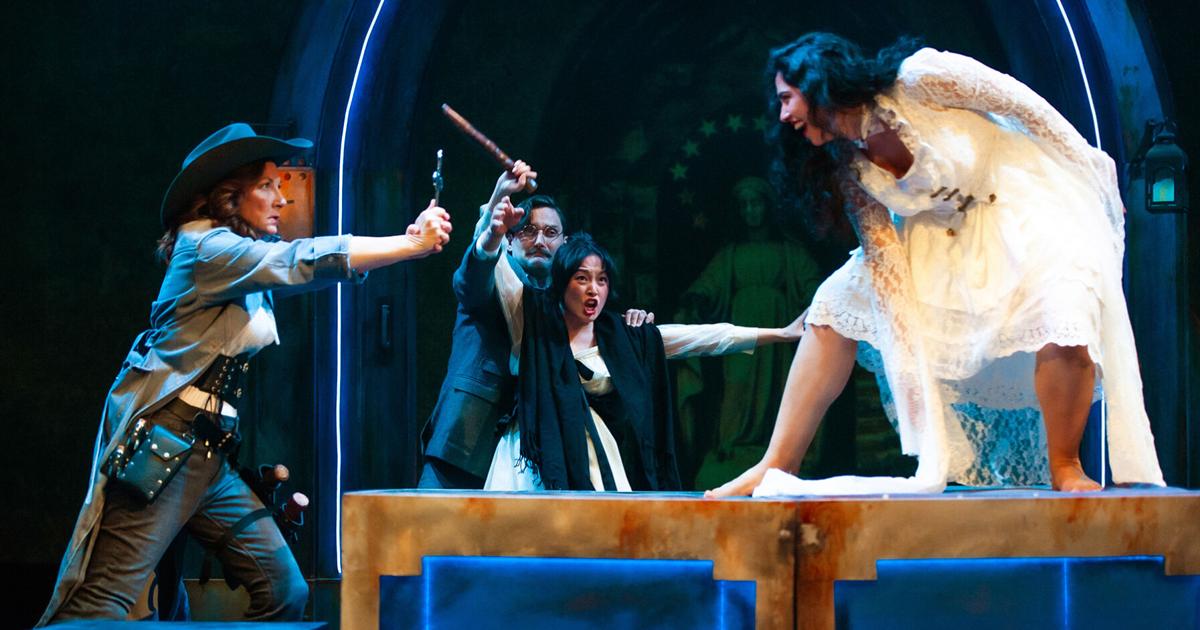
Some of the corniest lines come from doctor Van Helsing (Susi Damilano), the vampire expert who comes in to help defeat the titular big bad. “Dracula: A Feminist Revenge Fantasy, Really” gender swaps the iconic character in an attempt to add another line of commentary on sexist societal standards. Unfortunately, while the casting change is a great idea on paper, Damilano gives a performance as wooden as the stakes she kills with. The script seems to beg for a campy western action hero in Van Helsing — as does the brilliant silver cowboy getup designed by Kathleen Qiu — but Damilano’s inability to deliver is felt in nearly every scene.
Damilano’s shortcomings are made even more obvious when watching the incredible performances around her. Particular standouts are Nemma Adeni as Lucy Westenra, Mina’s best friend, and Stacy Ross as Renfield, Dracula’s crazed familiar. Both deliver breathtaking performances as victims of Dracula’s power-hungry vampirism: Adeni has a commanding physicality on the stage that is impossible to look away from, while Ross has a quietly gut-wrenching presence that will captivate audiences.
Lucy and Renfield’s character arcs are also commendable for being the only reason the audience has to care about Dracula. It is a truly baffling experience to realize halfway through Act 2 that the titular character hasn’t appeared in what feels like forever. Moreno does a solid job dominating the stage when he is there, but his menace is simply not convincing when he is offstage. The attempts to convey his presence through cheesy screen projections and his minions’ shoddy lipsyncs of his dialogue only make his absence more noticeable.
Despite the glaring issues with “Dracula: A Feminist Revenge Fantasy, Really,” it’s hard not to feel like the bad guy for bashing on it. While it is commendable that a show written by a woman and featuring strong female characters is running at a major theater, the biggest issue is in how little the play actually has to say. Moments of nuanced storytelling are over as soon as they begin, and the audience is left with nothing but a lingering bloodlust for more.