
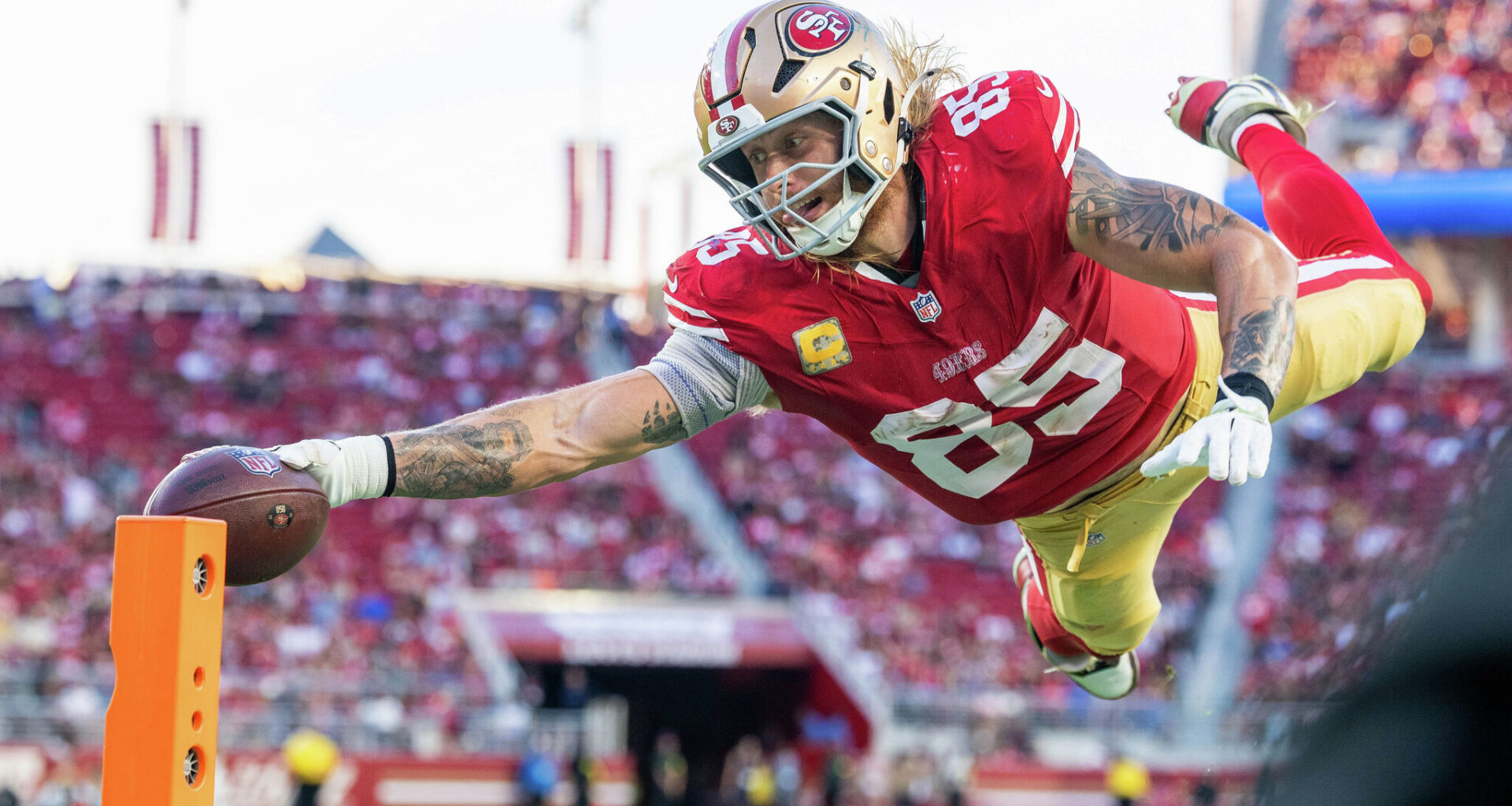
November 9, 2025; Santa Clara, California, USA; San Francisco 49ers tight end George Kittle (85) scores a touchdown during the fourth quarter against the Los Angeles Rams at Levi’s Stadium. Mandatory Credit: Kyle Terada-Imagn Images
Kyle Terada/Kyle Terada-Imagn Images
On Nov. 9, with three minutes left, the San Francisco 49ers trailing the Rams by 22 points and Levi’s Stadium half-full, George Kittle was going all-out in a blowout.
The Niners’ tight end caught a pass from quarterback Mac Jones along the left sideline at the 4-yard line, slammed on the brakes to avoid stepping out of bounds and leapt, fully outstretched, Superman-style, toward paydirt. Kittle touched the end-zone pylon with the ball, which he was palming with his right hand, and looked to a nearby official for a signal. A few seconds passed. Finally: touchdown.
Kittle said afterwards of his 13-yard score after the 49ers’ 42-26 loss, “It turned out really, really well.”
Article continues below this ad
For Kittle — and photographer Kyle Terada. Terada, 40, a Bay Area native, Palo Alto High School alum and Oakland resident who works for Imagn Images, was also rewarded for his work on the play, with his payoff arriving six months later.
Last week, Terada’s arresting shot of Kittle in mid-air was voted the NFL’s best action photo in 2025 by the Pro Football Hall of Fame, topping nearly 1,300 entries in its annual Dave Boss Award of Excellence contest.
The game was, in effect, over. But Terada’s award-winner is evidence of why sports photographers remain, well, focused, until at least a few minutes after games are over. There could be a fight amid the usual hugs and handshakes. Or a compelling shot from the midfield prayer circle. Or, when most fans and TV viewers have tuned out, a player flying into the frame of your Sony a1.
San Francisco Chronicle Logo
Make us a Preferred Source to get more of our news when you search.
Add Preferred Source
“You never know if storytelling will happen at the last second,” Terada said.
Article continues below this ad
The image, in which Kittle’s bug-eyed, half-smiling face is captured cleanly as he strains to score with his tongue out, tells a story. Those who don’t know Kittle is one of the NFL’s best and most exuberant players? They can get that sense from that shot.
“In one photo,” judge Brad Smith said, “you can feel the athleticism, the intensity, the joy and the competitiveness of the subject.”
The story of how Terada got the shot is amusing. And his post-photo reaction is revealing.
Terada was positioned in the left corner of the end zone as the 49ers approached on their seven-play, 65-yard drive that ended with Kittle’s score. His Sony, which has a tilt screen, was on the ground, and Terada, on his knees, was looking down into the lens.
His setup was strategic. Terada was hoping to get the type of corner-of-the-end-zone, ground-level shot that he landed. But he was becoming increasingly dubious it would happen. An NFL videographer, positioned ahead of Terada, closer to the field of play, kept moving as the 49ers offense moved closer.
Article continues below this ad
“The videographer was just creeping forward a little bit more as each play went on,” Terada said. “And I couldn’t move because there was someone to my left and someone to my right. I was getting nervous and wondering if I should move to a different spot. But I stuck it out.”
The result: The videographer’s left knee is sticking out in the right corner of Terada’s award-winning photo. The blemish is why Terada doesn’t count the Kittle photo as his career favorite. That distinction belongs to a shot of a fencer Terada captured during the 2012 Summer Olympics. Terada mentioned the videographer’s knee, unpromoted, on four occasions during a recent phone interview.
“I guess I’m hard on myself,” Terada said. “I think it’s a great photo. It’s just that knee in the corner of the frame just bugs me. Luckily, (he was wearing) black pants instead of hot-pink.”
Terada is passionate about his work, the pursuit of which began at an early age. He was born with a congenital knee condition that didn’t allow him to play competitive sports beyond elementary school, and he joined the yearbook staff as a photographer in middle school. Even before then, however, Terada attended sporting events with his mom and would borrow the camera she always brought to snap his own photos.
Basketball had been his sport. This allowed him to keep shooting.
Article continues below this ad
“I missed being part of the action,” he said.
After high school, Terada attended Foothill College and began interning at Stanford, where he spent six years. He’s worked for Imagn Images (previously known as USA Today Sports Images) for the past 16 years.
Terada’s work has taken him around the world. And his photo of Kittle will take him to the Hall of Fame in Canton, Ohio, where he will be recognized in late June at the Awards of Excellence program. His award-winner will be printed, mounted and displayed inside the museum.
Most visitors won’t know the photo was taken in the meaningless final minutes of a blowout. But they will appreciate the result of two men, striving for perfection and working until the end.
Article continues below this ad
As another judge, Paul Spinelli, wrote of the image, titled, “George Kittle TD”: It exemplifies “what it means to be a professional athlete and a professional photographer.”