
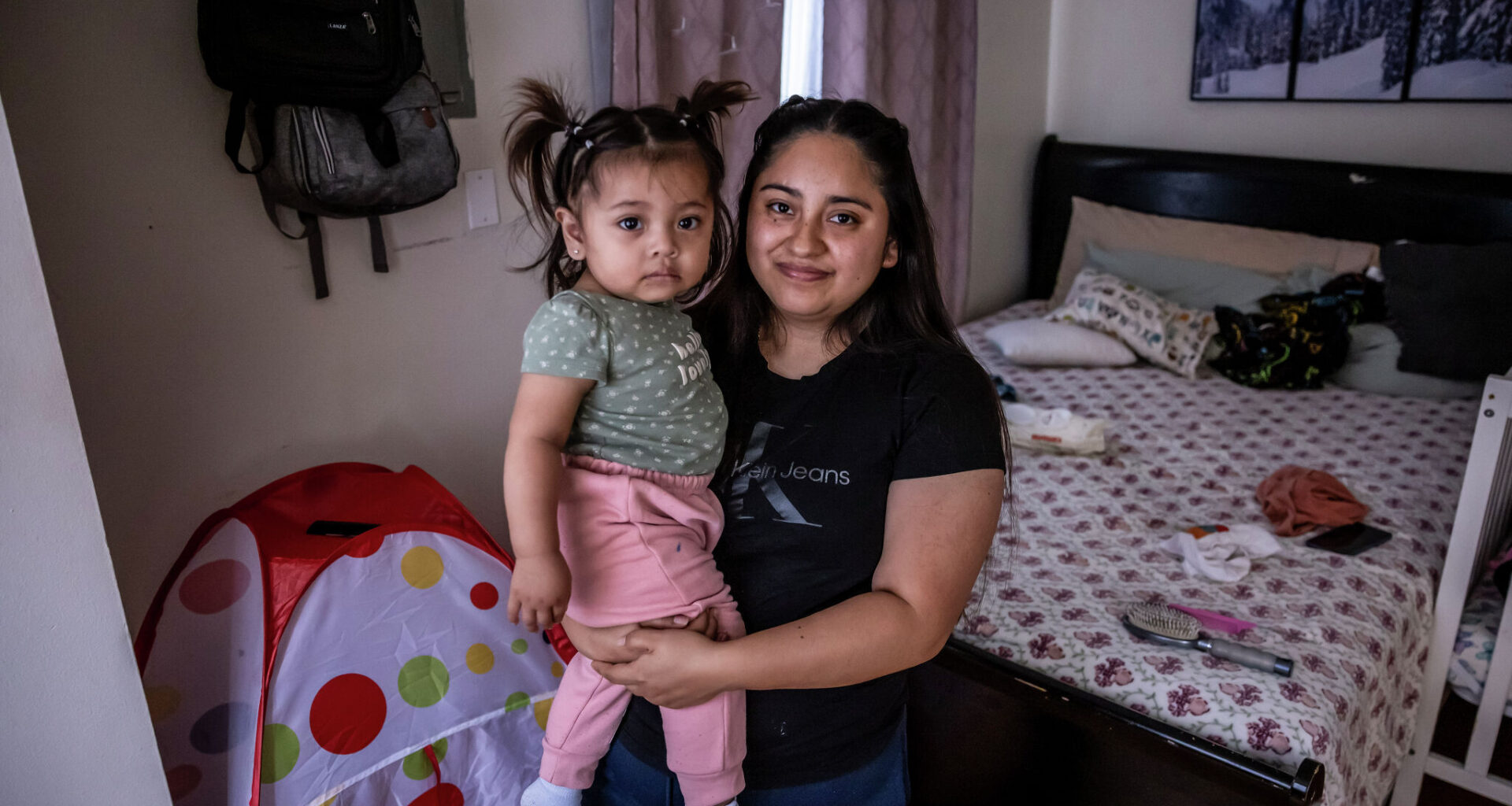
Yulisa Alvarado Ambrocio is an asylum-seeker living in San Francisco with her daughter, Heilany, and partner. Last fall, she was almost arrested as part of the Trump administration’s ICE surge at immigration courthouses, which resulted in dozens of arrests in San Francisco and multiple legal challenges.
Carlos Avila Gonzalez/S.F. Chronicle
The immigration judge made the foreboding remark before Frescia Anthuane Garro Pinchi exited the courtroom on July 3, 2025.
According to court filings, Judge Patrick O’Brien had given the 27-year-old asylum applicant more time to protest the government’s request to dismiss her case — a precursor to speeding up her deportation. He set a new hearing for the end of the month, before adding, “But I probably won’t see you then.”
The Hayward gig economy worker, who had been sending money to her daughter and mother in Peru, stepped outside the courtroom and was promptly arrested by masked federal agents.
Article continues below this ad
The same thing happened to Carmen Aracely Pablo Sequen, 30, an abuse survivor from Guatemala with a pending asylum application and a bakery job in San Francisco; Ligia Garcia, 55, an asylum applicant from Colombia working at a restaurant in Santa Clara County; and at least 86 other people who attended San Francisco Immigration Court during a six-month period last year, according to the city’s bar association.
Yulisa Alvarado Ambrocio knew she could be one of them.
San Francisco Chronicle Logo
Make us a Preferred Source to get more of our news when you search.
Add Preferred Source
After her first immigration court hearing in September 2025, the 24-year-old asylum-seeker from Guatemala remained inside the courtroom, clutching her 9-month-old daughter as two lawyers pleaded with the ICE agents outside not to separate mother from child.
In an interview translated from Spanish, Alvarado Ambrocio called the experience “spine-chilling.” It also proved galvanizing, spurring her to join a class-action lawsuit that could end the practice of immigration courthouse arrests nationwide.
Article continues below this ad
Last May, the Trump administration approved arrests inside immigration courthouses as part of its maximalist strategy to ratchet up deportations. The unprecedented practice ensnared thousands of people showing up for their immigration proceedings and contributed to a historic rise in unlawful detention claims, known as habeas petitions. It also sparked at least five federal lawsuits, two of which centered on what was happening inside San Francisco’s immigration courts.
The local challenges secured notable rulings in December, when a federal judge temporarily blocked the government from redetaining immigrants without cause or conducting immigration courthouse arrests across Northern California as well in Hawaii, Guam and Saipan — the area overseen by ICE’s San Francisco field office. The lawsuit that Alvarado Ambrocio joined alongside Pablo Sequen, Garcia and another plaintiff is vying to expand that relief to the rest of the country.
That would be a seismic victory for a group of asylum-seekers who fled corrupt or broken governments only to find themselves “in an impossible situation,” said Milli Atkinson, director of the Immigrant Legal Defense program at the Bar Association of San Francisco.
On the one hand, the plaintiffs have reason to avoid provoking a Trump administration that has attempted to cancel asylum, refugee admissions and birthright citizenship for children like Alvarado Ambrocio’s daughter, who was born in the U.S. On the other hand, Atkinson said, “If you do nothing and say nothing, you’re not going to have the protection of the courts and those rights that they have in the Constitution.”
In the courtroom that day, Alvarado Ambrocio did not know of the legal battle that lay ahead. She did not even know if she was about to be taken from her child.
Article continues below this ad
Origins
The site of a failed political uprising and a volcanic disaster at the turn of the 20th century, Guatemala’s San Marcos was built and then rebuilt into steep mountain ranges so high that the tops of the city’s low buildings appear to scrape the sky. Today, the Tajumulco volcano is quiet and security assessments warn of dangers from narcotrafficking, political corruption and malnutrition, not lava.
By the time Alvarado Ambrocio left her embattled hometown in April 2024, her sense of the life she was saving had already shifted to the one developing inside of her. “The motive was to give my baby a better future,” she said.
She took a bus north into Chiapas, Mexico, flew to Ciudad Juarez and hiked two hours at night to the U.S. border in El Paso, Texas.
“Yes, I was afraid,” she said. “And yes, the walk was challenging. Difficult. But it all turned out well.”
Article continues below this ad
According to her attorney, Alvarado Ambrocio encountered federal immigration officials and requested asylum. She was briefly detained and “released on her own recognizance” after the officials determined she was neither a flight risk nor a safety one, her lawsuit states. She reunited with her partner in San Francisco, formally applied for asylum and kept a quiet life, with “no criminal record anywhere in the world,” the lawsuit says.
In December 2024, she gave birth to her daughter, Heilany.
The following month, President Donald Trump signed a piece of paper that said her baby wasn’t really a citizen.
Since his return to office, Trump has invoked arcane powers and toppled decades, and even centuries-old, norms in striking a warlike posture toward immigrants in the country. He’s sought to revoke birthright citizenship from children of unauthorized or temporary immigrants; invoked the Alien Enemies Act to suspend due process and expel immigrants to foreign prisons; ended refugee admissions temporary protected status and humanitarian parole; and used false or exaggerated claims about immigrants as a pretext to assail voting rights, seize personal data, withhold disaster aid from blue states and deploy the military into American cities.
Most of these decisions have been temporarily blocked by federal courts, often after people were detained, deported or otherwise had their lives upended. Last month, Trump’s birthright citizenship executive order drew skepticism from the Supreme Court, which previously limited the reach of lower-court injunctions against it. A decision is due by the end of June.
Article continues below this ad
Alvarado Ambrocio would be pulled into a different skirmish.
ICE began entering immigration courthouses in May 2025 on the backs of two policy memos.
Arrests in the San Francisco Immigration Court spurred faith leaders to demonstrate in July 2025.
Stephen Lam/S.F. Chronicle
In January 2025, the Executive Office of Immigration Review, which sits under the U.S. Department of Justice and conducts immigration court proceedings, rescinded a 2021 policy restricting most immigration enforcement activities in or near immigration courts. The rescission order dismissed the chilling effect the arrests would have on immigrants deciding whether to show up for mandatory court appearances.
But the immigration review office is not in charge of ICE, and ICE didn’t begin the arrests until the agency lifted its own restrictions on courthouse arrests in May 2025. Yet, while the internal policy memo from acting Director Todd M. Lyons explicitly instructs ICE agents to “generally avoid enforcement actions” at courts “dedicated to non-criminal proceedings,” the Justice Department broadly interpreted the policy to apply to civil immigration courts.
Over the ensuing months, thousands of immigrants were arrested this way. Videos of masked agents grabbing people in corridors and hustling them to vans circulated on social media. Demonstrators descended, activists held press conferences, politicians issued statements and immigrant rights groups filed lawsuits in California, New York and Washington D.C.
Two of the lawsuits zeroed in on the San Francisco Immigration Court where, according to Mission Local’s immigration arrests tracker, at least 31 people had been taken by the time of Alvarado Ambrocio’s Sept. 11, 2025, hearing.
Interveners
It was supposed to be a routine appearance, Alvarado Ambrocio’s first since crossing the border.
Unable to afford an attorney or arrange childcare, she brought her partner and 9-month-old. She saw other parents enter the courtroom with children. Two women introduced themselves in Spanish. They were with the attorney of the day program, which is run out of the San Francisco bar association’s Justice & Diversity Center.
For about 30 years, the program has sent legal observers into immigration courtrooms to assist unrepresented immigrants. When the arrests started, the observers took on a first-responder role as well, said the bar association’s Atkinson, who oversees the program.
“We were on the ground in the courtroom when ICE showed up,” she said.
It’s Atkinson’s team who confirmed at least 88 arrests at San Francisco’s two immigration courts last year. At Concord’s immigration court, another 25 people were arrested, according to the California Collaborative for Immigrant Justice. Outside the region, at least 39 people were taken from Sacramento’s immigration court, a Centro Legal De La Raza attorney attested in a court declaration, as were about 100 people in San Diego, another attorney estimated.
In San Francisco, Atkinson said, a publicly funded resistance infrastructure blunted the effect of ICE’s arrests. It functioned like an assembly line.
Courtroom observers identified arrested immigrants and relayed their information to attorneys who intercepted them once they reached ICE’s field office on Sansome Street. Another fleet of attorneys quickly filed habeas petitions demanding their releases. Fifty-six petitions were filed, all successful, Atkinson said. “We’re really proud of that work.”
Along with freeing individual immigrants, the network identified immigrants willing to challenge the government practice once and for all.
Inside the courtroom, two legal observers told Alvarado Ambrocio that the government’s lawyers would ask the judge to dismiss her case to place her into expedited removal proceedings. It happened like they said. The judge gave her 10 days to respond in writing, but it didn’t appear she would have that long. ICE agents were waiting outside to arrest her, the observers told her.
“Then I became really nervous,” Alvarado Ambrocio said.
The women told her to wait inside the courtroom. They left to speak to the agents.
For the better part of an hour, Alvarado Ambrocio remained on the outside of a closed-door negotiation about what was to be done with her. Her daughter sensed the tension, crying and clinging to her. “She was desperate,” Alvarado Ambrocio recalled.
The observers occasionally reappeared to ask for documents. The couple fished out Heilany’s birth certificate and Social Security card. Alvarado Ambrocio’s partner went outside to make sure ICE knew their daughter was still breastfeeding. Alvarado Ambrocio had little to do but think.
“I was thinking about what would happen with my baby,” she said, “if I would have to leave her.”
After a while, the observers returned. ICE wouldn’t arrest her that day. But they hadn’t agreed to not arrest her after the next hearing. Her attorneys described it as “a cruel Hobson’s choice — appear in immigration court for their hearings and face immediate arrest and detention, or forsake their asylum claims and American dreams and receive in absentia removal orders.”
ICE had taken other mothers and pregnant women. They had incarcerated children and babies. The Trump administration has said it does not enforce a family separation policy, that deported parents can take their U.S.-born children with them. According to a new analysis from the Brookings Institution, the Trump administration has separated more than 145,000 American children from at least one immigrant parent.
Alvarado Ambrocio’s reprieve felt hollow.
ICE wanted her to go to the fifth floor, their floor, to formally check in before she left that day. One of the legal observers asked Alvarado Ambrocio’s permission to pass her information to a group preparing to challenge what she temporarily avoided. She gave her blessing.
Back at her apartment a couple weeks later, Alvarado Ambrocio answered the phone. It was an attorney from the Bay Area chapter of the Lawyers’ Committee for Civil Rights, a midsize nonprofit that expanded its pro-bono caseload after the Trump administration cowed large law firms from suing it. The attorney invited her to add her name to a lawsuit against the country’s most powerful immigration officials. She thought about where she had come from, what she had been through and about the people going through the same thing.
“That’s when I decided to do it,” she said. “So people wouldn’t feel so alone.”
Whack-a-mole
The government’s lawyer was struggling.
On Dec. 9, 2025, in the Northern District Court of California in San Jose, U.S. attorney Douglas Earl Johns attempted to defend the government’s position that immigration courthouse arrests were legal and that the lawsuit challenging them should be dismissed.
And on at least four occasions, he acknowledged his clients hadn’t submitted evidence to support their claims — that there was a precedent for their actions; that they considered the chilling effect on immigration court attendance; that ICE was prioritizing national security threats, convicted criminals, gang members and others outlined in its policy; and, critically for the judge, that they had followed the Administrative Procedures Act, an 80-year-old statute governing how agencies’ set that policy.
The Trump administration has broad “authority to conduct these types of enforcement actions,” argued Johns, who joined the Justice Department in 2017, Trump’s first year in office.
“That’s not the question,” retorted federal Judge Judge P. Casey Pitts. The administration, he said, “has to get the law right.”
On Christmas Eve, Pitts signed an order temporarily halting immigration courthouse arrests in the area.
Atkinson called the order “my personal Christmas present.”
Jordan Wells, the senior staff attorney at the Lawyers’ Committee who argued the motion, said it marked “a critical step in ensuring that immigrants can safely pursue their immigration cases without fear of arrest.”
Since it was issued, immigration courthouse arrests in the region have slammed to a stop, say the on-the-ground attorneys and advocates who monitor them.
San Francisco has seen multiple acts of resistance to the Trump administration’s immigration enforcement efforts, including at Dolores Park on Jan. 30, 2026, when students, workers and other Bay Area residents participated in a national “ICE out of everywhere” day of action.
Yalonda M. James/S.F. Chronicle
This month, they were also blocked by a federal judge in New York, where Justice Department attorneys acknowledged that the May 2025 ICE memo propping up their defense didn’t apply to immigration courthouses after all, a major blunder showing they had misinterpreted their own justification for nearly a year.
In San Francisco, both sides are awaiting a final decision on the lawfulness of the courthouse arrests policy, which has national implications, Wells said.
The government will react to the ruling without Johns, who withdrew from the case and left the Justice Department in April. He is one of more than 9,400 employees to leave since Trump became president, according to budget documents. He now works at the Santa Clara Office of County Counsel, which has sued the Trump administration numerous times, including over its birthright citizenship and sanctuary policies.
But a chill has been felt.
Deportation orders for people missing immigration court soared past 310,000 in the 2025 fiscal year, exceeding the total for Trump’s entire first term, when fewer than 268,000 people were ordered deported for missing court. Through the first two quarters of the 2026 fiscal year, in absentia removal orders averaged more than 26,000 a month, government statistics show, nine times the monthly average in 2016 and easily reaching a 10-year high.
Meanwhile, Trump’s Justice Department is actively soliciting applications for “deportation judge,” and offering hiring bonuses in blue cities, including Los Angeles, Sacramento and San Francisco, which is dealing with a dire shortage of immigration judges.
The DOJ has fired more than a dozen at the backlogged court in the past year and targeted its Montgomery Street location for closure, shifting most of its caseload to the Concord court, which is down to five judges.
The moves are indicative of the collapse of immigration courts across the country, said Jeremiah Johnson, a San Francisco immigration judge who was fired last April and is now with the National Association of Immigration Judges.
For people with pending cases or who relied on the court’s support network, “The majority of them are going to be stuck, left in legal limbo,” Johnson said during a virtual news briefing Wednesday. “It’s made it more difficult to follow the law.”
Atkinson said she understands why immigrants are scared to keep up their end of the bargain, and that it’s hard to tell them not to be.
“The government just shifts to something else,” she said. “In that sense, it is whack-a-mole.”
But, she added, the end of courthouse arrests has allowed the bar’s Immigrant Legal Defense program to shift resources to those other fronts.
“It’s San Francisco,” she said, “so there’s various networks and collaboratives and coalitions working together.”
Soccer mom
On a Saturday morning in April, a siren squall briefly disrupts the vibe inside Alvarado Ambrocio’s cutely appointed apartment. Heilany, an irrepressible force at 16 months old, fusses intermittently about sharing her mother with two reporters.
It’s been less than a year since Alvarado Ambrocio almost became separated from her daughter, a prospect that other immigrant women haven’t escaped.
According to a Department of Homeland Security response to Senate Democrats’ inquiries, 35 mothers of infant children, including 15 who were breastfeeding, and 86 pregnant women were incarcerated in ICE detention centers in February, practices that legal scholars and human rights advocates say violate ICE’s own policies.
The government had deported more than 360 pregnant, postpartum or breastfeeding mothers from January 2025 through Feb. 16, the letter stated. At least 16 women miscarried in ICE detention during that time.
In measurable ways, new and expectant mothers are among the most vulnerable targets of the Trump administration’s immigration enforcement. In the courts at least, they’re also formidable opponents to that agenda, backstopping successful challenges to the president’s attempts to cancel birthright citizenship and other legal protections.
“We represent some really courageous clients who have stuck their necks out in various ways in their countries of origin, which is why they had to flee in the first place,” said Melissa Crow, director of litigation at the Center for Gender & Refugee Studies out of UC College of the Law San Francisco, which has challenged the administration’s restrictions to asylum and refugee admissions. “It does not surprise me that that same population is having to stick their necks out against policies here.”
Alvarado Ambrocio said she is “very proud” to be part of a lawsuit that halted immigration courthouse arrests in Northern California and beyond.
Yulisa Alvarado Ambrocio says her daughter, Heilany, always wants to play, no matter the time of day or night. After she was nearly taken by ICE during a September 2025 immigration court hearing, Alvarado Ambrocio feared leaving her home for months. She said she joined the lawsuit against ICE “to help other people going through what I went through.” She’s not so afraid anymore.
Carlos Avila Gonzalez/S.F. Chronicle
With her asylum application still pending, she keeps the kind of small-goals routine of a full-time parent to a small child. She wakes around 7, washes her face and brushes her hair, feeds and entertains Heilany and decides whether to venture to the park and what to make for dinner. In her spare time, Alvarado Ambrocio said, she plays soccer with her partner’s sister and cousins. She’s a forward, attacking the goal with the ball dancing between her feet. Heilany likes to play, too, her mother said proudly, “although she’s very small.”
For months after the courthouse incident, Alvarado Ambrocio was scared to leave the apartment — and worried that her fear was getting in the way of her daughter’s development.
“Children her age need to go out,” she said. “They’re at that age of discovery.”
She brightens when talking about Heilany, whose personality is sharpening into focus — happy, funny, restless and undaunted by the concerns of adults.
Alvarado Ambrocio wants her daughter to have the same things as any American child; she still believes in the America she left Guatemala for.
“My opinion has not changed,” she said. “This is a country that offers many opportunities and I want my daughter to grow in it.”
But, she added, “you always have to take precautions.”
So before mother and daughter leave for the park, Alvarado Ambrocio scans the street for vehicles that could belong to the government.
Nanette Asimov and Keila Lugo-Rañal provided interpretation and translation.