
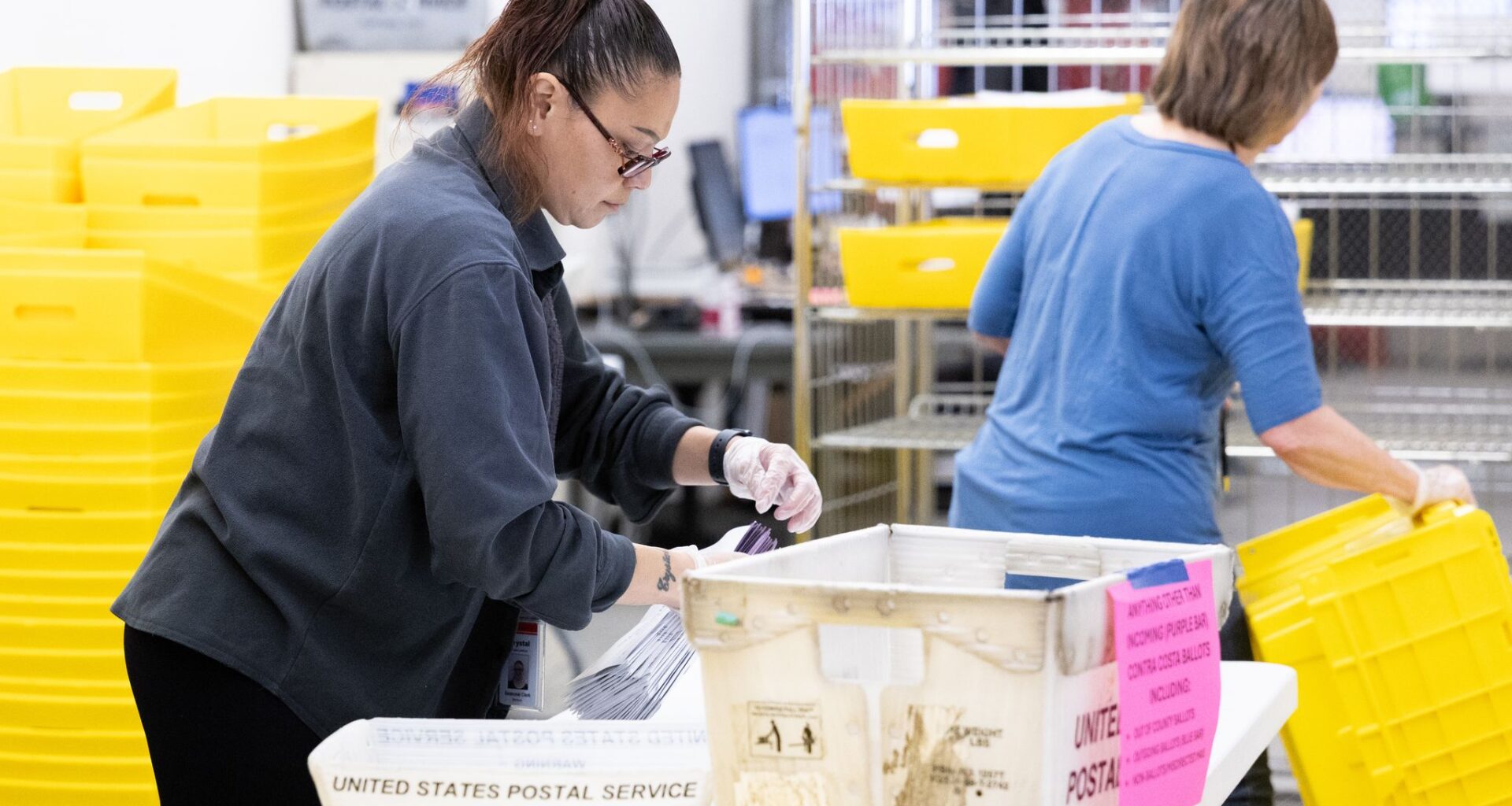
Crystal Jackson sorts mail-in ballots for processing in Martinez on May 8, 2026. The Trump administration has eliminated a crucial mechanism to return absentee ballots, which makes voting very difficult for overseas military members.
Benjamin Fanjoy/For the S.F. Chronicle
It’s never been easy to cast an absentee ballot from inside a military submarine. But now that the Trump administration has eliminated a crucial mechanism to return absentee ballots, overseas voting requires even more of a herculean effort.
It’s an archaic reality: California’s absentee voter laws rely heavily on fax machines and the U.S. Postal Service. For military members in far-flung deployments or at sea, where Postal Service is unreliable to nonexistence, the Department of Defense’s free email-to-fax service was a lifeline to democracy for the last 36 years. The Department of Defense in August announced, without explanation, it was cutting the fax service as the administration axed federal programs it said constituted wasteful spending. The voters who used the program are now facing their first election cycle without it.
“We’re thinking of the military voters who will no longer be able to cast their ballots in time,” said Sen. Sabrina Cervantes, D-Riverside, who is attempting to reform state absentee voting law in the legislature. “We want to make sure we aren’t abandoning Californians who are deployed abroad or serving overseas.”
Article continues below this ad
It isn’t just a California problem. Six other states — including Texas and Florida — still dictate fax machines as the alternative, by law, to the Postal Service to return overseas ballots to election offices. Meanwhile, 31 other states have what they call secure electronic ballot transmission available only to those overseas that can be accessed by a smartphone or computer. Yet California leaders — including the secretary of state — are hesitant to adopt similar policies, citing cybersecurity risks at a time election security is already under intense scrutiny.
“We are concerned that ushering in such a system will only serve to undermine public confidence in our elections,” Timothy Cromartie, a lobbyist for California Secretary of State Shirley Weber’s office, said during a recent Senate committee hearing.
San Francisco Chronicle Logo
Make us a Preferred Source to get more of our news when you search.
Add Preferred Source
Voting advocates say that without some compromise, the reality is that fewer overseas voters will return their ballots in time to be counted, if they attempt the cumbersome process at all. A case currently before the U.S. Supreme Court could complicate things even further by imposing a strict window in which mail ballots can be counted. Fifteen states and D.C., including California, allow overseas ballots to be tallied even if they show up a few days after Election Day — as long as they’re postmarked on time.
Republicans argue voter ID laws — like a measure to impose ID requirements that will face California voters in November — and limits on the period in which mail ballots can be received, make elections more secure. Voting rights advocates say they’re part of systematic efforts to make voting more difficult and suppress turnout.
Article continues below this ad
Susan Dzieduszycka-Suinat, president of the Overseas Voter Foundation, said that encrypted online ballot delivery and extended ballot return deadlines have, so far, shown to be the best solution to ensure a ballot completes its journey in time for those living overseas or deployed by the military. Federal law does require absentee ballots to be ready at least 45 days before the election, but sometimes that cushion is not enough.
“Without a really substantial federal-level investment, we’re always going to have this hodgepodge of fragmented solutions across the nation,” said Dzieduszycka-Suinat, a California voter based in Germany. “That’s what we’ve got, and I don’t see it changing.”
It’s an imperfect system, and has been for decades. In California and other fax-reliant states, counties can send the blank ballots digitally but cannot accept them returned that way. Sailors are expected to print out ballots though access to printers isn’t guaranteed at sea. Then there’s the mail service to send that printed ballot back, which could come maybe every one to two weeks under perfect circumstances — but war and other international conflicts can easily upend that schedule.
A full mail-in process can become its own race against time. A week before California’s June 2 primary election, Dzieduszycka-Suinat said her ballot from San Mateo County had yet to show up to her home in Munich. During the 2024 election, 1 in 7 military voters did not receive a ballot in time or never received one at all, according to a federal survey.
In that same election, about 67% of active-duty military members were registered to vote. Of that group, less than half — about 42% — voted, according to a report to Congress. Among the roughly 3.3 million people living overseas — which includes military families, students studying abroad and people working abroad — just 11% voted in the 2024 election. That’s about 247,000 ballots. (Domestic voter turnout among those registered was about 76%.)
Article continues below this ad
Cervantes introduced a bill this session — SB970 — that calls on the secretary of state to create a way for military and overseas voters to submit their ballots electronically. Among the 31 states and D.C. that have these types of methods, 24 have a specialized portal or email option, Cervantes said.
Evelyn Magas sorts mail-in ballots for processing in Martinez on May 8, 2026.
Benjamin Fanjoy/For the S.F. Chronicle
But the bill quickly drew opposition from voting security advocates and Weber.
“The secretary of state is certainly sympathetic to the objectives of the bill,” said Cromartie, the office’s lobbyist, during the April 7 committee hearing. “The issue is she’s not willing to jeopardize an existing secure election system.”
In 2020, the federal Cybersecurity and Infrastructure Security Agency wrote in a memo that electronic ballot return technologies are “high-risk even with controls in place.” The now defunct fax service was created in 1990 during the Gulf War to get ballots out of the Middle East, where mail was unreliable. In a 2025 report to Congress, the voting assistance program called it an “ad hoc solution” whose use has diminished in the wake of new electronic transmission options. Eventually, the program only offered the service to those overseas voters who were voting in states without laws that allowed for fax alternatives and mail.
Article continues below this ad
The Federal Voting Assistance Program referred the San Francisco Chronicle to a Pentagon spokesperson when a reporter asked why the fax program was cut. The spokesperson did not return a request for comment.
Last election, the Department of Defense fax program reported it accepted about 14,000 emailed election documents — usually ballots — that were then faxed to election offices in states where faxes are still the letter of the law. Although just a handful of states were still reliant on the fax service at the time, they included the country’s three most populous states: California, Texas and Florida.
“We have to make sure our laws are changing with the times,” said Contra Costa County Clerk-Recorder Kristin Connelly.“Because we haven’t addressed this, we have erected a barrier for our military and overseas voters.”
In Contra Costa County, for example, there were 4,894 voters in the military or overseas during the 2024 election. Of those, 3,150 returned a ballot by mail and 482 by fax, according to the elections office. Another 260 couldn’t be counted because they arrived too late. Connelly said states such as Rhode Island and Massachusetts saw their rejection rates drop with the use of online systems. Late returns are the leading cause of rejected ballots.
Colorado has been using what it considers a secure portal for overseas voters for the last decade. As a result, fewer than 1% of its ballots came in via fax during the 2024 election. To use the online system, overseas voters have to sign in with their driver’s license ID number or the last four digits of their Social Security number. They fill out the ballot online and then sign an affidavit confirming their identity. The image of the ballot is then sent to election officials, who verify the signature and separate the ballot from the affidavit the same way they separate mail-in ballots from their signed envelopes, said Maysa Sitar, a voter accessibility administrator in the Denver clerk office.
Article continues below this ad
“Our voters typically really appreciate using this system,” Sitar said. “The mail can be so slow depending on what country you’re in or if you’re deployed for the military.”
At the end of the 2024 election cycle, the federal fax service started getting so many ballots delivered at once, it warned clerks it might have a backlog.
“Due to the high volume of overseas ballots that are being faxed to the … DoD fax service, they cannot guarantee they will be able to transmit all of them to the county elections offices by 8:00 p.m. PST on November 5,” read the memo, obtained by the Chronicle.
As a result, then-Nevada County Clerk Natalie Adona sued Weber’s office to ensure the votes got counted. Thirteen in total got caught in the backlog at no fault to the voter, according to the lawsuit. Adona now is the registrar of voters for Marin County, where she is still advocating for better military voting access.
“Sometimes I feel like our military and overseas voters are an afterthought because they’re not physically here,” Adona said. “Who is going to stand up for these people? They’re voters too.”
Cervantes said her bill is open-ended because she does not want the state to be married to a single technological solution, but she wants military voters to have equitable access to voting the same way they do in 31 other states using electronic options. The states that do use the portals use end-to-end encryption, multifactor authentication and audit logs. Cervantes compared it to the infrastructure financial institutions and the government use daily. The Department of Defense, after all, is still using email while handling top-secret information.
During the bill’s last committee hearing, Sen. Scott Wiener, D-San Francisco, voiced concern about the timing of the elimination of the fax service — especially as the war in Iran continues.
“They are obsessed with blocking access to voting,” he said of the Trump administration. “They are methodically destroying the Postal Service … we have a bad situation particularly for anyone who is overseas.”
So, he posed, how are these people supposed to vote?
Under state law, voters can pay for a third-party fax service to get their ballots to California election offices. But there’s even less of a guarantee than before that those methods are secure — usually people just attach an image of their ballot to an email and a fax service takes care of the final leg to get it to the election’s office fax machine.
“Who has a fax machine anymore?” said Dzieduszycka-Suinat with the Overseas Voter Foundation.