
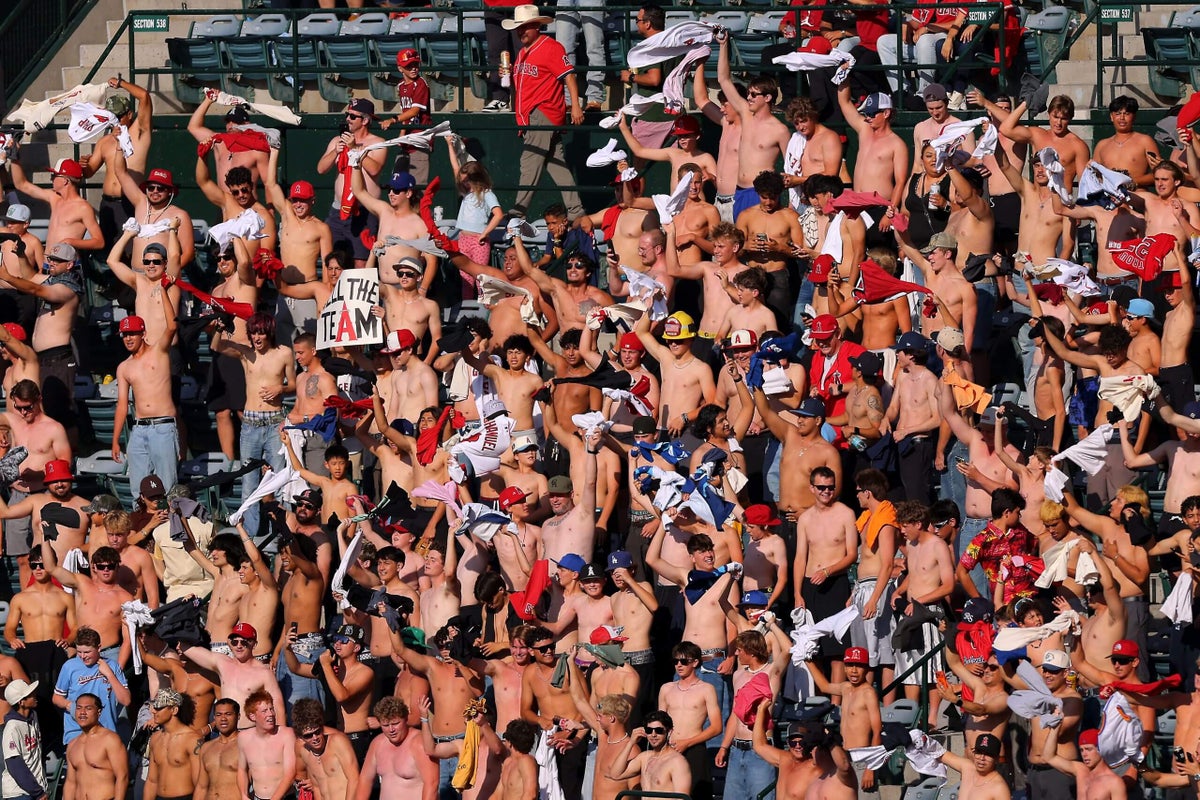
ANAHEIM, Calif. — After a week of protests against team ownership in and around the stadium, Los Angeles Angels manager Kurt Suzuki was asked a simple question before the team’s game on Sunday.
The shirtless fans are supportive of the team; they’re cheering for the Angels to win. They’re also repeatedly yelling, “Sell the team.” What has it been like hearing them this week?
Simple questions have proved to be difficult to answer for the Angels, who have plugged their ears and closed their eyes to a fanbase that’s been desperately trying to get its message across in the past week.
“They have the right to their opinion … I think it’s pretty neat for (our players) to have that kind of support,” Suzuki said, after a long and waffling preamble where he asked about other fanbases engaging in the “Tarps Off” shirtless movement across baseball. “Isn’t that a social media thing? Is it? Was it remove the tarp, or the tarps something? Tarps off, or something like that.”
In Anaheim, “Tarps Off” has been much more than a social media movement. What those fans, and many others, are looking for is an acknowledgement that their opinion has validity. They’re not hearing it. The fans have been gaslit by an Angels’ ownership saying that winning isn’t the fans’ top priority. The Angels’ general manager has told them that the league’s worst team has its “best baseball” ahead of it.
They’ve been told by the skipper that the losing is all one big cold stretch, not reflective of broader issues.
Angels fans, whose writ-large reputation is one of passivity, have become angry. Perfect weather, a dense Orange County population center, and just enough hope that the team will contend have kept attendance numbers at “The Big A” near the top in MLB for years.
But as fans protested with signs, shouts and shirts — sometimes on, sometimes not — it was clear the dynamic is changing, whether or not the team is willing to acknowledge that.
“We’ve just watched the lack of investment, the not caring about the players, about the farm system,” said Kristen Gallagher, an Angels season ticket holder for more than 40 years. “You just feel it. You feel it among the staff. We know the ushers in our section, and they’re also dejected.
“It’s even different from the pre-World Series (2002, when the Angels won their only title) days. People still had hope then.”
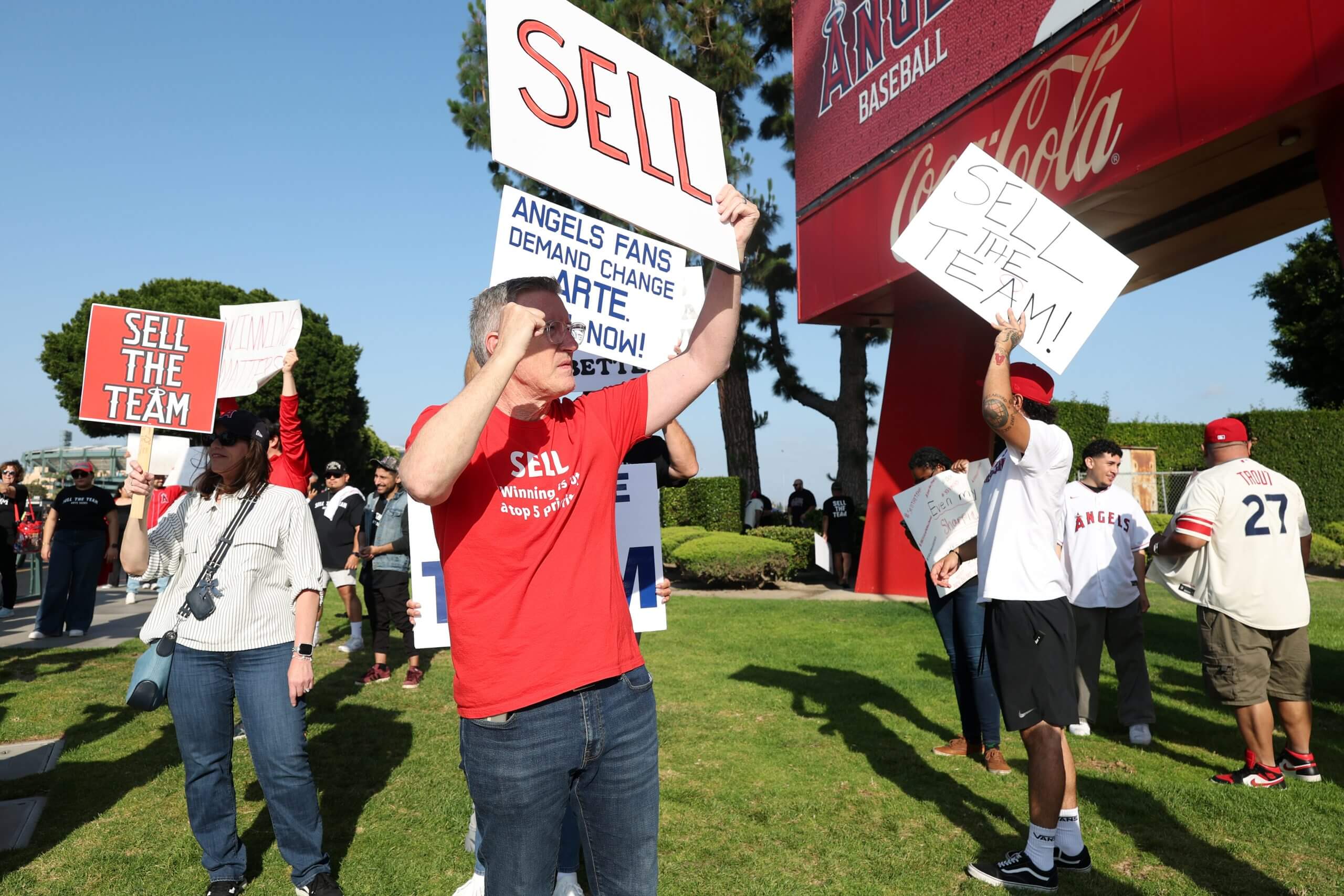
Angels fans gathered outside of Angel Stadium before Saturday’s game to demand change and urge Arte Moreno to sell the team. (Kiyoshi Mio / Imagn Images)
Angels executive leadership declined to comment when asked for their thoughts on the protests. The Angels Baseball TV broadcasts have largely avoided showing the fans or acknowledging their persistent chants.
The Angels’ beloved all-time superstar, Mike Trout, who should not have to answer for the team’s leadership, similarly declined to wade deep into the topic.
“I hear the chants for sure,” Trout said earlier this week, when asked by Mike DiGiovanna. “It is what it is.”
The chants were very audible on the Angels television broadcast when they first began last Monday. However, in recent days — even as the crowds of protesters metastasized to consume four or five sections — it was far more difficult to make out what was being said.
The technology does exist to lower the volume on fan mics, said people familiar with the Angels broadcasts, who added that, like many teams, Angels officials have been known to call the production staff with audio requests related to fans yelling.
An Angels official said that no proactive action was taken in the last week to limit crowd noise on the telecasts, noting that the fans moved to a different part of the ballpark later in the week.
“We care enough to show up and to let our voices be heard,” said Angels fan Johnny Gonzalez, who organized a protest outside the team’s parking lot before Saturday’s game. “That’s what true fans do. They show up.”
The protest on Saturday was lively, as hundreds of cars honked in support on their way into the ballpark. One fan designed and printed “Sell the team” T-shirts to hand out. Inside the ballpark, thousands gathered with those shirts no longer being worn, chanting for change.
The players indulged them in a roll call, with shortstop Zach Neto even egging them on to be louder, after his name was called. These fans feverishly want the team to win, but are there because the hope that the Angels will win is mostly non-existent.
Across the field before Sunday’s game was another (former) Angels supporter. Rangers manager Skip Schumaker, a SoCal native who spent many of his formative years coming to Angels games as a fan, was asked for his reaction to the protests. He smiled and said, “Nice try.”
“I grew up an Angels fan,” he said, waxing poetic about attending the 2002 World Series. “You want all organizations to be successful. That’s all I’ll tell you.”
The one-time National League Manager of the Year wasn’t necessarily going to touch it, but he didn’t have to. Fan sentiment is clear. Both through a noticeable uptick in empty seats and outsized anger.
For years, the Angels have ignored the downward direction of the team. And now, with the consequence of that staring them in the face, they’re ignoring it some more.
In March 2023, Angels owner Arte Moreno was asked about his decision to retain ownership of the club and take it off the open market. Fans, at the time, were irate.
“You always have a vocal minority that’s not going to be happy no matter what,” Moreno said.
Moreno can often be insulated from the criticism. He rarely attends games and is flanked by security when he does. The fans who do greet him often do so politely. In this world, he’s still a celebrity. He’s off social media, he said, which is where so much of the criticism toward him has existed.
The protests, the chants and the anger probably won’t do much tangibly. But they do drop the illusion for Moreno, and force the reality of his failures to stand there in front of him without a shirt in sight.
He might believe it’s a vocal minority. But they’re getting louder and growing larger. And the only one silent right now is Moreno and the people around him.
— The Athletic’s Austin Green contributed to this story.