
I wrote in March that Natalie Gee could win in D4. Having followed the D4 campaigns, I am even more convinced this can happen. Here’s why.
Gee is Most Dynamic Candidate
Natalie Gee is the most dynamic candidate in the race. Her energy level has to be rubbing off on voters. Gee says she has knocked on every voters door three times. I believe her. She is campaigning 24/7 to win this race.
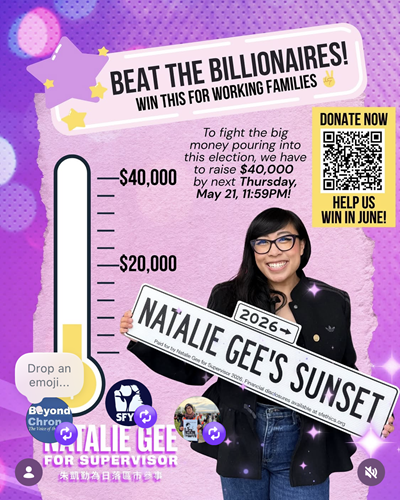
Check out Gee’s Instagram posts (itsnataliegee). Mayor Lurie has shown the power of Instagram and Gee is regularly posting for her campaign. Many posts highlight the big money being spent against her. Urging voters to “Beat the Billionaires,” Gee is counting on D4 voters desire to have a supervisor that puts district interests first.
Gee’s nearly 1200 followers may seem like a small total given the size of the electorate but this is an election that could be decided by under 100 votes.
Gee is a sharp contrast to her rivals, Alan Wong and Albert Chow. Wong has many positive attributes but he’s not a dynamic or exciting candidate. Chow brings a different type of energy but can’t match Gee.
Many people vote for a candidate that personally asks for their vote. That’s why Gee’s intensive door-knocking makes a difference.
Wong’s Challenges
Soon after his appointment I wrote about why Alan Wong could win the D4 race. I saw him getting the majority of second place votes from Albert Chow and David Lee, the likely third and fourth place finishers.
I soon revised my assessment to elevate the chances of Gee and Chow. It remains a tight three-way race.
While Gee is out talking to D4 voters, Wong is at City Hall doing his job as supervisor. And while Mayor Lurie’s endorsement should help him, a recent poll found that only 34% of voters are influenced by Lurie’s backing of other candidates or initiatives (in a poll that found Lurie very popular).
Given Lurie’s support for the highway closure that led to Sunset Dunes, I’m not sure Lurie’s endorsement means that much in D4. The mayor’s support has flooded the district with independent expenditures for Wong, but glossy mailers attacking Gee mean less when voters have met her directly.
Wong also faces an RCV problem. Wong must get enough RCV votes from Chow and Lee to win. Chow fiercely opposes the closure of the Great Highway, and his voters likely do as well. This position aligns them with Gee, not Wong. Few Chow voters will make Wong their second choice.
David Lee has a history of indirectly helping to elect progressive candidates. Had he not run in D1 in 2020, fellow moderate Marjan Philhour would have likely defeated Connie Chan (Lee got over 6200 first place votes and Chan only won by 125).
Lee is most likely to take first place votes from Alan Wong. Will enough Lee voters give Wong their second-place votes to put the appointed incumbent over the top? The answer could decide the race.
D4 Vote Will Send Citywide Message
San Francisco voters like district elections. They like neighborhood independence. That’s why all the talk about creating citywide seats never translates into a ballot measure; it would lose handily.
Prior D4 Supervisor Joel Engardio was recalled for taking a political position popular citywide but unpopular in his district. The message is that supervisors must put district interests first.
If the D4 supervisors race is about district empowerment, that clearly benefits Natalie Gee. Wong is a mayoral appointee backed by big money from outside the district; this is not the best election cycle to be identified with citywide interests.
That’s why claims that Gee is too “progressive” for D4 voters misses the point. They primarily want a supervisor who they can count on to always put D4 interests first—-and Natalie Gee fits the bill.

Randy Shaw is the Editor of Beyond Chron and the Director of San Francisco’s Tenderloin Housing Clinic, which publishes Beyond Chron. Shaw’s new book is the revised and updated, The Tenderloin: Sex, Crime and Resistance in the Heart of San Francisco. His prior books include Generation Priced Out: Who Gets to Live in the New Urban America. The Activist’s Handbook: Winning Social Change in the 21st Century, and Beyond the Fields: Cesar Chavez, the UFW and the Struggle for Justice in the 21st Century.