
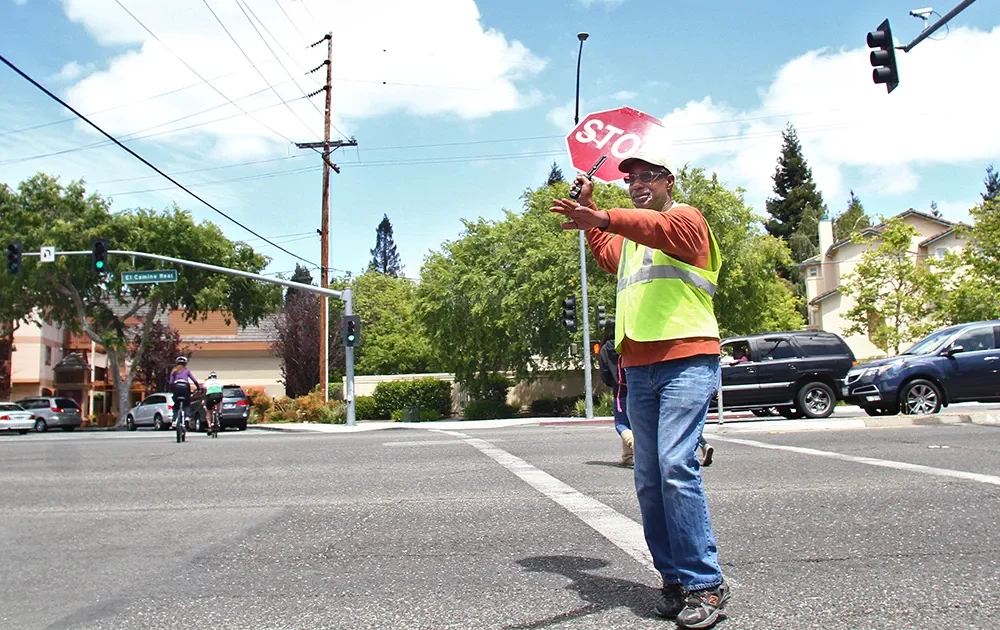
Despite ongoing budget challenges, Palo Alto is preparing to restore some of the funding it was planning to cut from the city’s crossing guard program and ask the school district to help pay for the popular service, according to a recommendation the City Council Finance Committee approved May 19.
As part of its final hearing before the revised budget goes to the full council, the finance committee also recommended finding creative ways to incentivize hiring in the Palo Alto Police Department and adding a council administrative assistant.
Councilmembers George Lu, Pat Burt and Ed Lauing — who sit on the committee — focused extensively on rebalancing the budget given additional feedback from the council and residents, who urged the city to find ways to finance additional projects and positions such as crossing guards and transportation staff. The crossing guards, which were proposed to be cut by 10%, was an item that caused significant outcry from the community who feel the guards are necessary to ensure children can get to school safely.
Under the revised budget, the city will continue to fund 50% of the crossing guards that were slated to be cut, contingent upon the Palo Alto Unified School District footing the rest of the bill. If that doesn’t happen, the council will need to revisit the item during the midyear budget review in February next year.
Given the resounding opposition to the cuts by the council and residents, the finance committee spent little time at the meeting discussing it further.
The hearing gave the committee its first chance to review the proposed $1 billion budget since the full council weighed in on it. The budget proposed by City Manager Ed Shikada in April includes a $311 million general fund, which pays for most services not related to utilities. Earlier this month, the finance committee held two meetings to review the budget of every department.
Split on administrative help
While the committee was on the same page when it came to restoring funding for crossing guards, the one item that did cause a split was the addition of a council administrative assistant role. This is set to be financed through fiscal year 2026 council contingency funds, and the position will help councilmembers organize schedules and plan trips related to city business. However, the position is also envisioned as a pilot program that would sunset in December, and the committee considered extending it to the midyear budget review in February with the addition of $15,000.
Burt came out staunchly against the idea of an administrative assistant, especially because it uses council contingency funds that are historically spent on community events. The position is being added at a time when the city is facing a budget gap of about $17 million, which the city plans to close through a combination of service cuts, elimination of vacant positions and reductions in capital expenditures.
“This is for the council to serve themselves,” Burt said. “I think it’s a complete break from the principle of (contingency funds). … I wouldn’t want to answer to the voters to justify that.”
Lauing was more supportive of the idea as a pilot, but said he was comfortable sunsetting it in December and from there evaluating its successes. Lu seemed similarly ambivalent toward the idea, noting that many artificial intelligence tools can accomplish the same scheduling and organizational tasks that an assistant would otherwise perform.
Their reservations notwithstanding, Lauing and Lu both voted to recommend the council approve the addition of the assistant position, while Burt opposed it.
Trimming expenses
The administrative assistant was not the only area where committee members found themselves debating the merits of the program at a time when the city is looking to cut about $7 million from its general fund. The budget Shikada proposed last month would also trim expenses for tree protection.
The city works with the nonprofit Canopy to preserve and maintain its urban trees, and this contract was scheduled for about a 10% cut in fiscal year 2027, amounting to about $43,000.
“It feels less ideal for staff if we’re cutting a staff position but not touching the equivalent Canopy contract at all,” Lu said.
JP Renaud, Canopy’s executive director, urged the committee to minimize the cuts. He emphasized that while some aspects of the program may not seem as necessary, such as digital tree health monitoring, the cuts would “reverberate throughout our organization.”
“Disinvestment in urban forestry is ultimately a disinvestment in the long term livability, resilience and health of our neighborhoods,” Renaud said.
The committee heeded some of Renaud’s concerns, instead approving a reduction of $15,000 for the next fiscal year instead of the proposed $43,550.
Police staffing
Staffing concerns at the police department were also a major concern for residents and councilmembers. Police Chief James Reifschneider had previously proposed “lateral incentives” to help the department hire more officers from neighboring jurisdictions.
As examples, he noted vacation, relocation benefits and other incentives that would cost about $5,000, which might be enough to motivate an officer to join Palo Alto’s ranks.
“We’re basically just trying to give ourselves the ability to be nimble and have some variety of different incentives that we can use to best fit the needs of the individual candidate,” Reifschneider told the committee.
The committee seemed amenable to these requests. The lateral incentives are not listed as a budget transfer because they would be funded through existing police salary savings. City staff will bring a full list of recommendations related to these hiring incentives to the council on June 15, which is when officials are set to adopt the budget for fiscal year 2027.
Some other budget shuffling was done to fund additional capital improvement projects, such as allowing the Palo Alto Museum to dip into $250,000 in savings from the Mitchell Park Library repair project, which would go toward fixing water damage and other issues that have delayed the museum’s opening.
The Office of Transportation will also replace one part-time role with a full-time one, partially funded through Measure B, a 2016 county measure that generates sales-tax revenue for local streets, roads and transportation programs. The full-time role, according to Chief Transportation Officer Ria Hutabarat Lo, would work on daylighting projects, traffic calming and traffic congestion. Some of the position’s job responsibilities would also be dedicated to oversized vehicle enforcement, but this work would not be eligible for Measure B funding, according to staff.
As for oversized vehicles, another hot button issue for the community, the committee recommended spending $384,000 on alleviating the problem. Most of this money, about $200,000, would go toward extending the operation of a safe parking program on Geng Road for residents living in vehicles, which would otherwise run out of city funding in September. The remaining dollars would be spent on oversized vehicle enforcement and towing.
The city’s “quiet zone” project would also advance more rapidly for the Churchill Avenue crossing, as directed by the committee. Design would be funded for fiscal year 2027 with construction the following year, and councilmembers were motivated to prioritize this intersection due to its proximity to Palo Alto High School and the recent deaths of two students by suicide.
The quiet zone designation requires more secure gates to prevent cars and pedestrians from accessing the tracks when a train is approaching. The Federal Rail Administration then allows trains to pass through without sounding the usual horn, a sound which not only frustrates residents who live close enough to hear it every day, but which has also served as a constant reminder of the recent tragedies for the Paly community.
City staff have prioritized reductions in the capital improvement budget and technical adjustments to account for the increased expenditures this year, according to Chief Financial Officer Lauren Lai.
The full council is expected to take up the budget on June 15 before it goes into recess for the summer. The new fiscal year begins July 1.
This story originally appeared in Palo Alto Weekly. Riley Cooke is a reporter at Palo Alto Weekly and Palo Alto Online focusing on city government.