
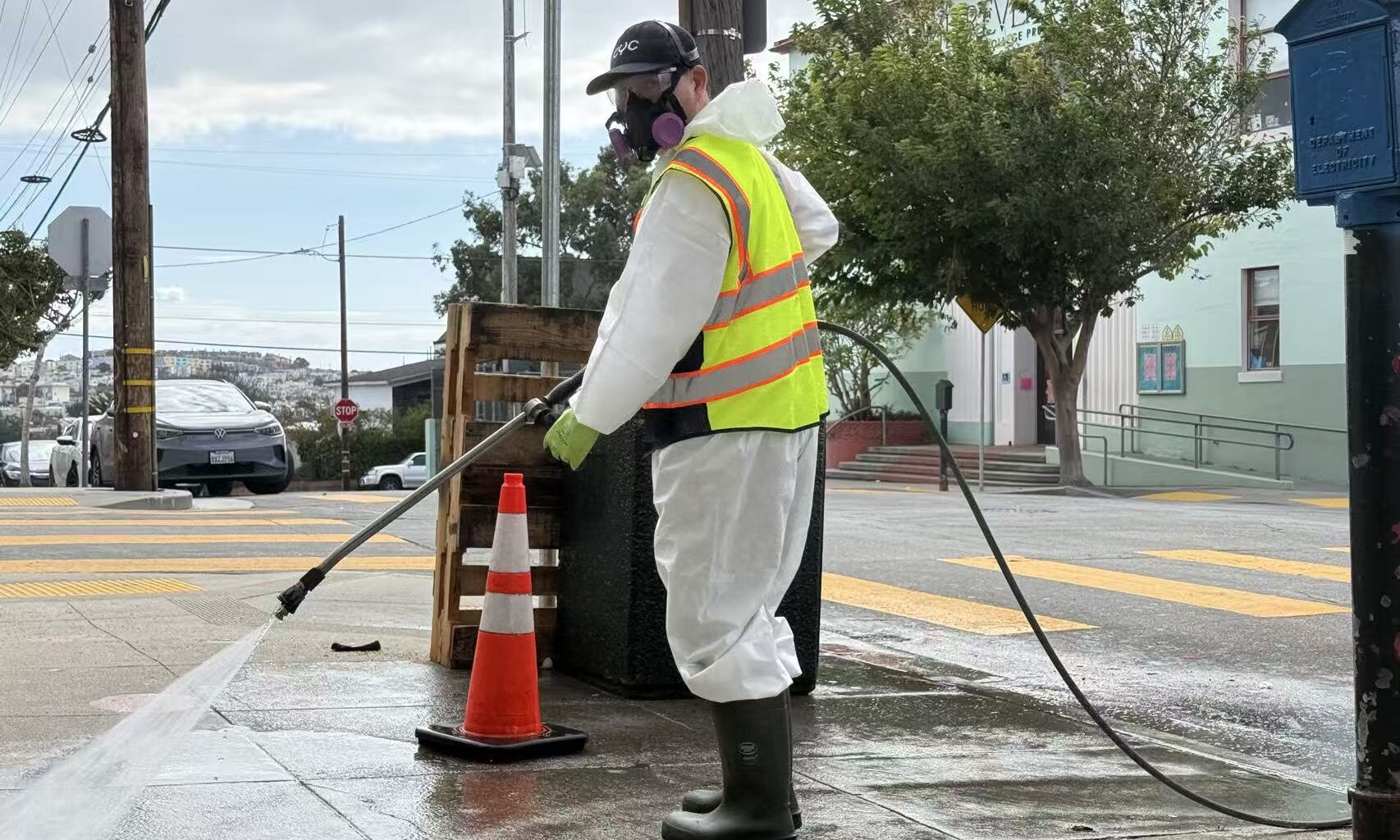
When Yiping Yang moved from Taishan, China to San Francisco, he worked in a restaurant kitchen. It was hard work. Co-workers fought with each other. Passions ran high.
Decades later, the work is still hard, it smells way worse, but his crew of 14 middle-aged, mostly Chinese men do not tend to bicker as they make their way through San Francisco, cleaning the city’s 2,800 public trash cans, one by one.
The crew is hired by a Chinatown-founded nonprofit with a city contract to power wash every city-owned trash can in San Francisco. They’re paid between $25 to $27 an hour and work five days a week, driving around the city in Ford Super Duty trucks.
On a recent weekday morning, the 58-year-old Yang, dressed in a full body protective suit, headed to Bernal Heights. His only company was a work truck, a power washer, a mug of American ginseng tea, and some paperwork tracking his progress of cleaning his 18 cans of the day. Yang can’t read most English documents, but the routine sheets are an exception. He has filled them out so many times, he does it by muscle memory.
The story of how Yang came to this line of work is a complicated one. He can’t remember exactly how he heard about the job, but as a longtime regular at his family association’s mahjong hall, the Yan Wo Benevolent Association on Grant Avenue in Chinatown, he and the Community Youth Center were always on each other’s radar.
Yang got hired in 2018, less than a year after the Community Youth Center, a nonprofit that was founded in the 1970s to help funnel Chinatown teenagers away from juvenile delinquency and into respectable jobs, got a city contract to clean the cans. That happened in 2017, during the late Mayor Ed Lee’s era.
The city’s Department of Public Works, which had been sanitizing public trash cans in-house, wanted more frequent cleaning. It solicited applications for a workforce development grant to create a trash-can cleaning jobs program for people facing barriers to employment. The Community Youth Center won the grant.
“At the beginning, I have to say it was pretty scary, because we suddenly had a fleet of 14 trucks,” said Sarah Wan, executive director of Community Youth Center.
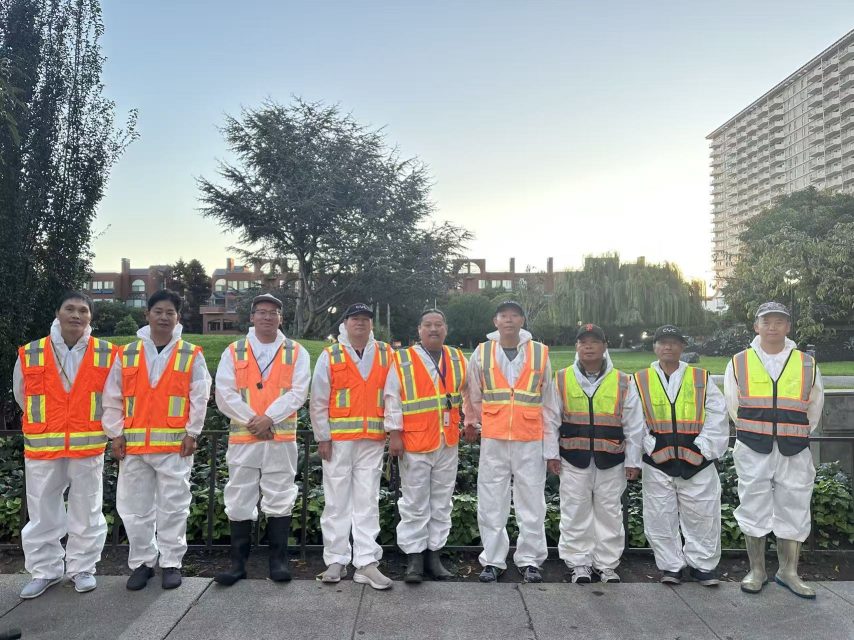 A group photo of nine Asian workers who clean all of San Francisco’s 2,800 public trash cans on Oct. 21, 2025. Photo by Ziwen Feng.
 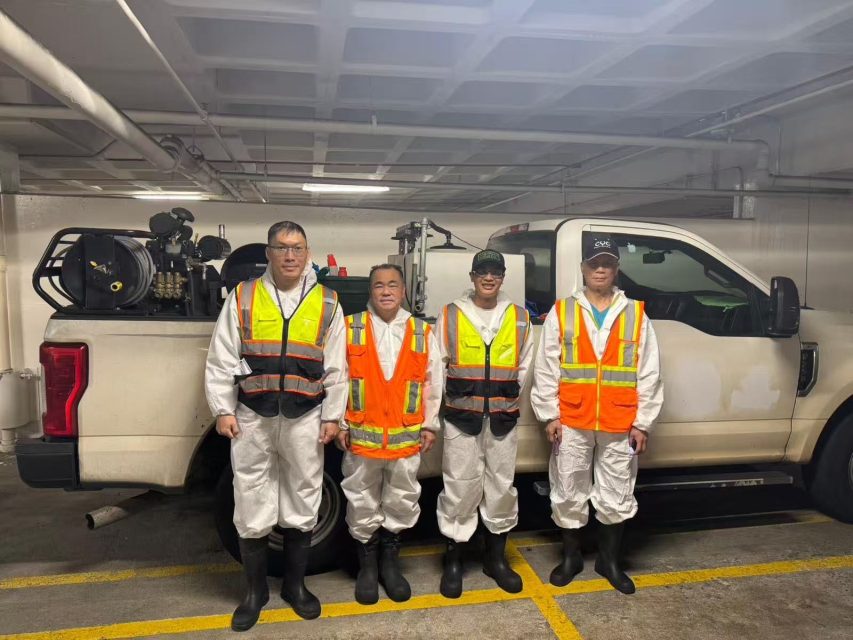 A photo of the workers who work late shifts between 7 p.m. and 1 a.m. to clean the trash cans lining commercial corridors on Oct. 21, 2025. Photo by Ziwen Feng.
Best trash-can cleaners turned out to be Asians over 50
The newly formed Power Wash Mobile Team program started from scratch, learning from Public Works how to pressure wash the streets, figuring out how to maintain the pickup trucks.
Building up a team willing and able to do the dirty work yielded an unexpected crew.
The best workers turned out to be men like Yang: those over the age of 50 who were not exactly on a path to juvenile delinquency, but possessed limited English skills that closed off other job opportunities. They turned to the job after exhausting other options, clinging to it as a lifeboat.
Across the country an increasing number of middle-aged citizens reach retirement age but cannot afford to retire. Immigrant seniors, who are more likely to have faced low wages and wage theft during their working years, are often in even more precarious circumstances.
“They can’t communicate in English, but they all earn their living with their own hands,” said Ziwen Feng, Yang’s supervisor. When asked to describe the crew, Feng said simply: “hardworking.”
At 33, Feng is two decades younger than most in his 14-person crew. He calls the group “my people,” and started on similar footing to most of them. When he came to the United States as a teenager, he “didn’t even know what the 26 letters were,” Feng said.
Over time, Feng went from interpreting between the crew and their non-Chinese-speaking supervisor to becoming the supervisor himself.
On a recent Thursday morning, Yang started his day at around 4 a.m., when he left his home on Silver Avenue in the southern part of San Francisco — a routine that has taken a toll on his wife’s sleep quality, he said. He headed across town to the Portsmouth Square Garage in Chinatown, where the teams’ trucks are kept.
It took “a community effort” to find a 24/7 parking lot that the team could use, said Sarah Wan, of the centrally located parking spaces. “It’s really because it’s in Chinatown. That’s why we were able to work this out.”
By 10 a.m. Yang had progressed from the dirtiest sections of his route, which goes through the Mission to quieter streets where cans aren’t overflowing with garbage. The handful of cans on 24th Street can be a headache, he said. As he opened one to clean its crevices, he expressed relief at the absence of feces — canine, or otherwise.
“Sometimes when I open a trash can door, that smell … ” said Yang, in Mandarin, trailing off and grimacing.
“This isn’t something that makes me want to quit though,” he said, shaking his head. “It’s simply something I need to get through.”
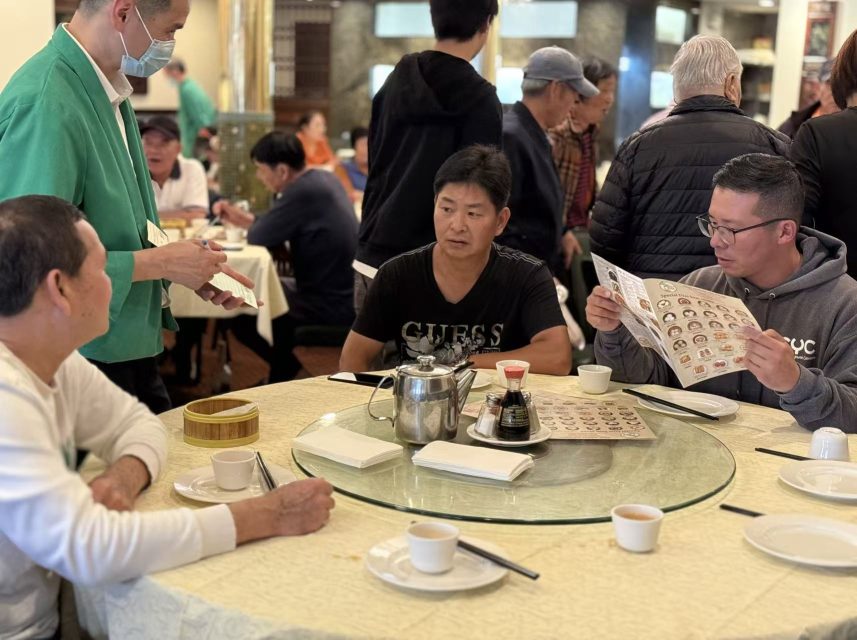 Yiping Yang (left) and some of his colleagues at the Great Eastern Restaurant on Jackson Street on Oct. 9, 2025. Photo by Yujie Zhou.
‘The day we dread most is Sunday’
Yang spends, on average, between 10 and 15 minutes cleaning each can. First, he clears trash off the sidewalk around the can. Then he bombards it with an arsenal of sanitizing agents and degreasers, and follows that up by rinsing the can and its vicinity with a power washer. He ends with a spritz of what he called “perfume” as a finishing touch.
As a connoisseur of just how disgusting a trash can can become (on average, each can is cleaned every 20 days, and a lot can happen in that time), Yang and his peers greatly favor the green Renaissance model. The perforated surfaces improve air circulation, he said, so the stench doesn’t linger as badly.
The $26-an-hour wage is modest compared to many jobs, and some of his former co-workers have moved on to better paying occupations, including government jobs at Muni or the Postal Service.
But Yang finds steadiness in his work. “I can’t communicate in the language here, so I don’t have many choices,” he said. Yang is, in fact, a polyglot who’s proficient in Cantonese, Mandarin, Taishanese, and Hakka. Sing Tao Radio keeps him company on his daily routine: He said he gets the most joy when the Chinese outlet’s editor-in-chief, Joseph Leung, starts his program on local and global affairs.
Yang’s peers who work later shifts — the trash cans lining commercial corridors get cleaned between 7 p.m. and 1 a.m. — always move together for safety, “to make sure they can see each other,” said Feng.
“The day we dread most is Sunday,” said Yang. The streets are littered with the aftermath of Saturday night revelry, sometimes so deep that Yang fills three or four black trash bags at the site of each can in boisterous areas, leaving them next to the bin for Public Works to collect.
Nonetheless, turnover is low, said Feng, even though wages haven’t kept up with inflation. No one’s left the team in over a year.
That doesn’t mean the job won’t leave them. Their sister program at the Community Youth Center, which cleans sidewalks in Chinatown, almost got eliminated before this budget season.
Power Wash Mobile Team’s contract with Public Works ends in June 2027. For Yang and his peers, planning for the long term feels impossible. Yang, meanwhile, has no plans to retire. “If I lose my job,” he said, “I’ll just find another one.” Then another one, till the day he can no longer work, Yang said.
Around noon, Yang finished his work for the day. But he wasn’t done with his coworkers. The team has built camaraderie that extends well beyond the end of a shift.
Sometimes they cycle around the city together. Sometimes they hang out at Fisherman’s Wharf. The language barriers do not deter the two non-Chinese folks on the crew — they join too, using Google Translate and simple English.
On this particular day, the plan was dim sum. Yang shed his protective gear, and joined his colleagues at the Great Eastern Restaurant. They sipped tea and began ordering, their laughter blending into the buzz of the Chinatown crowd.