
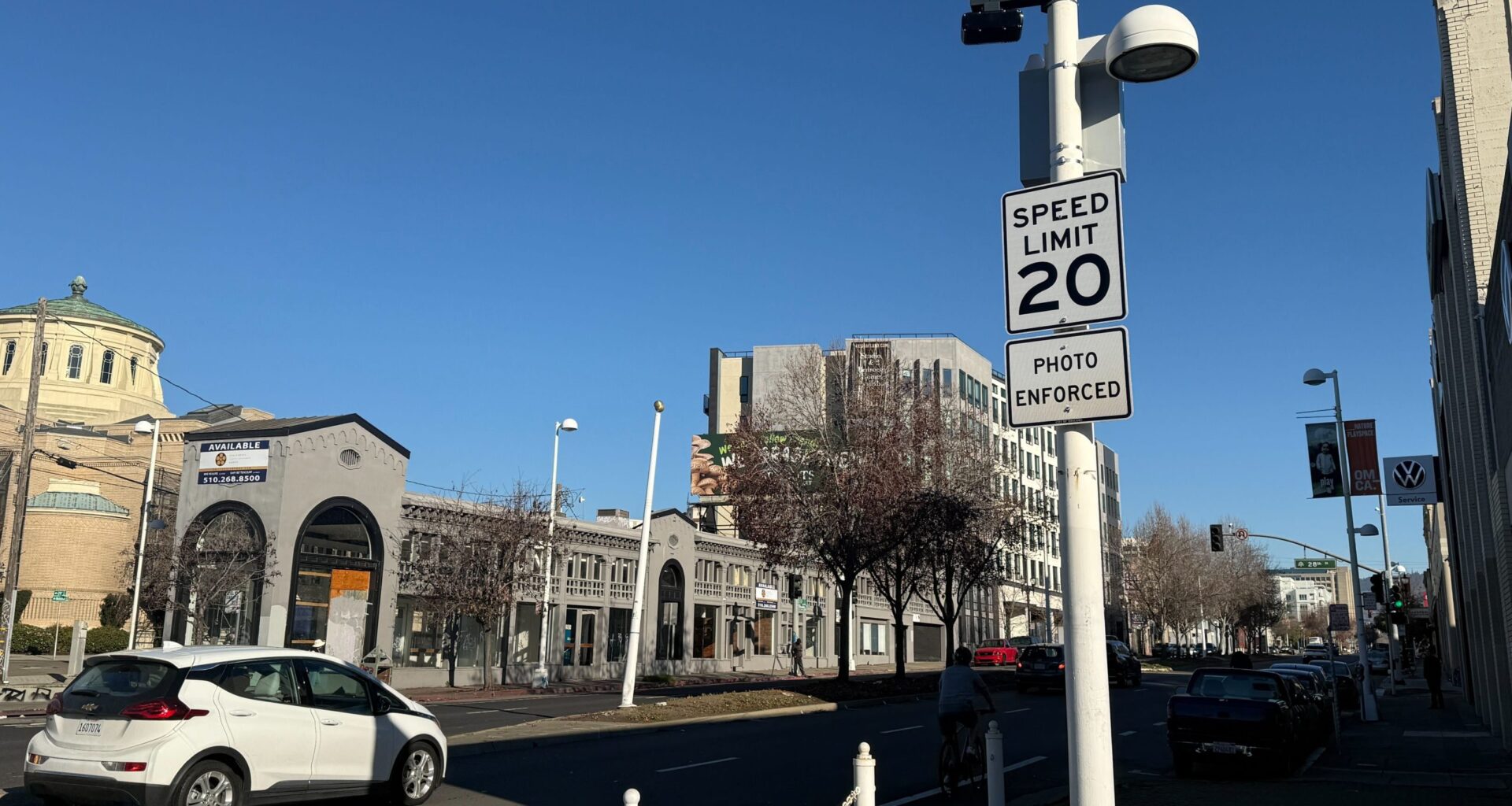
The data is in. Oakland’s new speeding camera program began ticketing on March 15, and the cameras have resulted in more than 2,000 speeding tickets a day.
According to a May 7 presentation at Oakland’s City Hall by Craig Raphael, the Oakland Department of Transportation’s speed safety camera program manager, for the Institute of Transportation Engineers, the speeding cameras that went live in January at 18 locations in Oakland are giving out lots of tickets.
From January 15 to March 14, the 35 cameras — a pair at most locations — only resulted in warnings. But since March 15, Oakland has issued any second-time offender a speeding ticket. First-time offenders traveling between 11 and 15 miles per hour over the speed limit will continue to receive warnings, as required by the state law that sanctioned the pilot program.
“If a driver travels 16 miles per hour or more over the speed limit, then it will be issued as a citation,” even if it’s a first-time offense, Kent Bravo, the OakDOT information officer, told us.
Raphael said the city gave out 82,000 citations and 69,000 warnings in the first 40 days of enforcement — from March 15 to April 25 — for an average of 60 citations and 50 warnings per camera per day. The 110 daily enforcement actions per camera is slightly up from the roughly 100 warnings a day each camera produced during the first 40 days of the system’s early warning period.
Raphael did not provide revenue numbers. But if each citation was for the minimum $50 fine, the tickets could generate $4 million in revenue. That number would shrink if many of those fines get reduced through the city’s low-income and public benefits discounts, bringing those $50 tickets down to $25 or $10 each.
All of the cameras were installed on Oakland’s High-Injury Network, the streets that account for the majority of the city’s severe collisions. The top eight speeding locations over the first 40 days of enforcement, Raphael said, were consistent with those that surfaced in the warning period, based on data from January 15 to February 21.
The top number of speeding vehicles, were:
In first place, a camera facing southbound traffic at 2345 73rd Avenue, with 8,127 citations and 5,500 warnings, on an average ticketed speed of 44.7 miles an hour on a 35-mile-an-hour speed limit road;
In second place, southbound traffic at Hegenberger Road and Spencer Street, with 6,902 tickets and 3,793 warnings on an average ticketed speed of 55.3 miles per hour in a 40-mile-per-hour zone;
In third place, the northbound camera at 2206 73rd Avenue, with 6,147 tickets and 3,422 warnings on an average ticketed speed of 44 miles per hour in a 30-mile-an-hour zone;
In fourth place, the northbound camera at 2710 Broadway with 6,118 tickets and 6,100 warnings on an average ticketed speed of 33.8 miles per hour in a 20-mile-per-hour zone;
In fifth place, the westbound camera at 1050 West Grand Ave., with 5,406 citations and 4,554 warnings on an average ticketed speed of 43.6 miles per hour in a 30-mile-per-hour zone.
The Broadway camera location has been discussed by residents as a possible speed trap, given that it’s an arterial street whose speed limit was recently changed to 20 miles an hour from 25 miles an hour, surprising many longtime drivers. That speed limit reduction came about because of a statewide law that allows municipalities to lower limits in and around business districts.
At the presentation, Raphael, the OakDOT staffer, did not provide the highest speeds recorded by drivers at each location during the first 40 days, nor did he provide data about how many of those vehicles ticketed were repeat offenders — a key metric for whether the cameras were driving a behavior change. During the pilot project’s warning phase, OakDOT found that repeat offenders were common, with two-thirds of warnings going to drivers who had two or more warnings.
Highest speeds at Hegenberger
Raphael only provided data on the top eight cameras by number of citations.
Of those locations, the cameras at Hegenberger found the highest average speeds, with 55.3 miles an hour northbound and 55.1 miles an hour southbound — more than 15 miles an hour above the local speed limit.
According to OakDOT’s Bravo, the department plans to provide a more comprehensive report in the summer with a “deeper analysis,” including before-and-after speed data.
Raphael said at the City Hall meeting that OakDOT is focused at the moment on improving its customer service, including processing citation reduction requests for low-income drivers and transferring fine liability from cars that are rented or sold. According to Bravo, the city will dismiss tickets sent to an owner’s address for vehicles or plates that are stolen “upon receipt of a valid police report.”
Earlier this month, OakDOT also updated its impact and surveillance policy reports about the pilot project, providing insight into how it manages license plates for privacy — including by using encrypted data and narrow data retention periods — and how much money it is spending on managing the program, which for now is about $2.5 million per year, most of it pegged to salaries.
“*” indicates required fields