
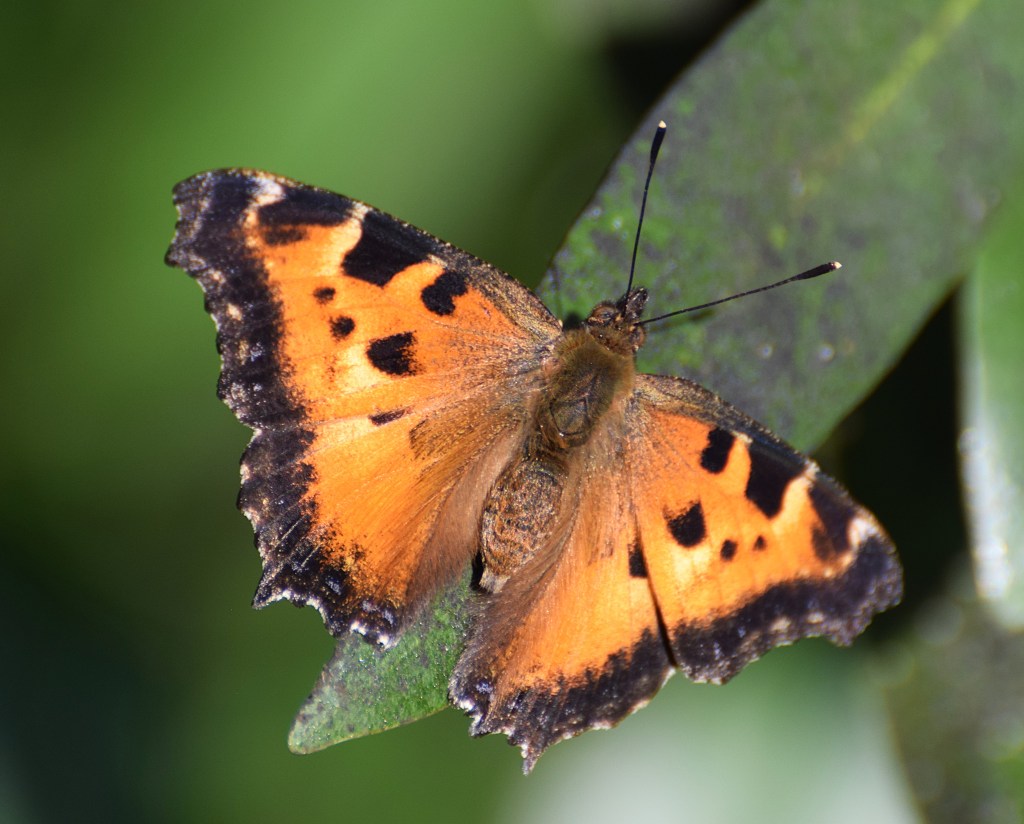
Normally, this time of year for Bay Area residents means blooms of orange poppies, graduation announcements and hand-wringing over the San Francisco Giants’ record.
But this year there’s something unusual: butterflies. Lots of them. For the past few weeks, swarms of diminutive butterflies have been seen flittering en masse in parks and backyards across the Bay Area.
The elegant 2-inch-long black and orange insects aren’t monarchs, but California tortoiseshell butterflies.
“At first I saw just one or two, then 10 at a time,” said Bob Slate, of Los Altos, who began noticing the lepidopteran spectacle during daily hikes at Rancho San Antonio County Park & Open Space Preserve in Cupertino just after Mother’s Day.
“They were kind of all over the place,” he said. “There were swarms of them. It was like a continuous stream of butterflies. I’m not sure where they were headed. It was astonishing to see them.”
The humble insects, which have jagged wings and fuzzy, thick legs, migrate every year from the Sierra Nevada to warmer coastal areas in winter, where they lay eggs, which grow into caterpillars and eventually new butterflies. The next generation heads east in the summer.
Occasionally, when conditions are just right, their population explodes, said Stuart Weiss, a conservation ecologist and chief scientist at Creekside Science in Los Gatos. This is just such a year.
Last year, the butterflies had a successful breeding season in the Sierra, where they are seen regularly around Lake Tahoe and in high country areas of famed parks like Yosemite.
Wildfires in 2020, particularly the CZU Lightning Fire, burned 86,509 acres across the Santa Cruz Mountains in San Mateo and Santa Cruz counties. Now, six years later, large amounts of ceanothus, an evergreen shrub, have grown back.
Tortoiseshell butterfly caterpillars love to eat ceanothus.
Add to that the unusually warm and dry March the Bay Area enjoyed when there were no huge atmospheric river deluges, and voila! The perfect storm for tortoiseshells. Plenty of parents. Plenty of food. And good weather.
“We started out with more than we normally would have had,” Weiss said. “They bred. Each female lays hundreds of eggs, and the larvae feed on ceanothus. The conditions were such that the mortality rate was relatively low. So there was a huge multiplier on the already large number that overwintered here. Insects have awesome powers of reproduction. That’s the way they work.”
The minuscule marvels have had other occasional population spikes.
In August 2004, a swarm of tortoiseshells 40 to 50 miles long and 15 miles wide was documented flying south along the Sierra Nevada range. Last year, large numbers were reported in parts of Oregon. In the 1970s, there were so many during one migration that authorities temporarily closed Interstate 80 over Donner Summit to prevent traffic accidents.
During this year’s Bay Area butterfly-palooza, large numbers have been reported in Boulder Creek, Saratoga, Los Gatos, and in parks near San Jose, including Rancho Cañada del Oro Open Space Preserve and Almaden Quicksilver County Park. They have also been reported in Marin County, Weiss said.
And they have been seen along Skyline Boulevard in Santa Clara and San Mateo counties, in Midpeninsula Regional Open Space District preserves such as Skyline and Long Ridge, and often near streams, lakes, puddles and other sources of water.
“People are observing lots of them flying around while they are hiking,” said Leigh Ann Gessner, a spokeswoman for the Midpeninsula Regional Open Space District.
“It’s been really neat,” she said. “People have been reaching out and sharing their experiences. It’s a fascinating phenomenon.”
Slate, a former tech executive who teaches computer science at DeAnza College, has hiked in Rancho San Antonio for 40 years. He said he’s never seen butterflies there in the numbers he has seen over the past two weeks.
“People were taking videos of them,” he said. “They were saying, ‘There are so many of them. I had to keep my mouth shut so they didn’t fly in.’ People were pointing. They were quite appreciative.”
In recent days, the numbers have started to decline, he said.
“I’ve seen a mountain lion and three bald eagles in this park,” Slate said. “This was like that — a real rarity.”
Adult tortoiseshell butterflies eat nectar from flowers. They live for 9 or 10 months, among the longer-lived butterflies in North America. They are already beginning to migrate east toward the Sierra, Weiss said.
“It’s probably going to start fading soon,” he said. “Some will probably stick around. But the vast mass of them will be heading east.”
Weiss, a Stanford-trained biologist, said the rare butterfly bloom is an example of how nature can regularly cause wonder if protected and nurtured.
“Just enjoy them,” he said. “Appreciate them. If you stalk them, you can get pretty decent pictures. They will land and bask in the sun to warm up.”
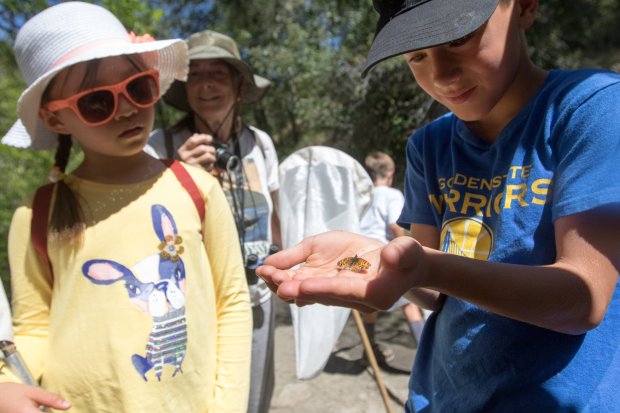 Adam Gurrola, 9, holds a California tortoiseshell while Ariel Zeng, 8, looks on during the annual North American Butterfly Association count at the Cascade Canyon Open Space Preserve in Fairfax, Calif., on June 3, 2018. (Douglas Zimmerman/Special to Marin Independent Journal)