
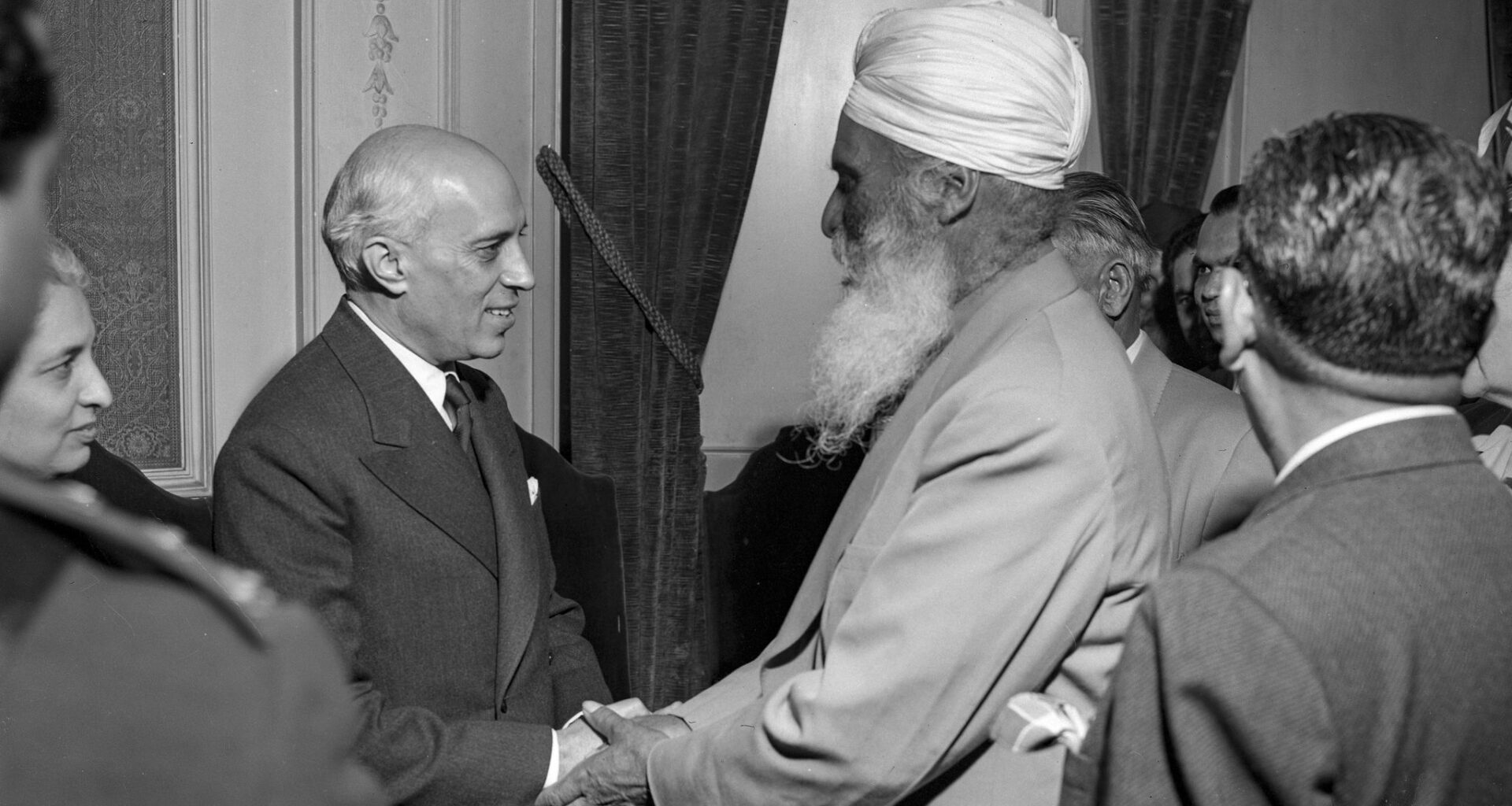
India’s Prime Minister Jawaharlal Nehru in attendance at reception in his honor, greeting the Indian American community at the Scottish Rite Masonic Center in San Francisco on Oct. 31, 1949. The Indian leader is visiting the United States on a goodwill tour at the express invitation of President Harry Truman.
Bob Campbell/S.F. Chronicle
India’s Prime Minister Jawaharlal Nehru is greeted by officials and hundreds Indian Americans as he disembarks an Air Force Constellation plane at San Francisco Municipal Airport on October 30, 1949. California Governor Earl Warren and San Francisco mayor Elmer E. Robinson greeted the Indian leader as he tours the United States on a goodwill tour at the express invitation of President Harry Truman.
Bob Campbell/S.F. Chronicle
In 1949, the Chronicle covered the arrival of a “fascinating visitor” to the City by the Bay: India’s first prime minister, Jawaharlal Nehru. With palpable bemusement, reporter Alvin Hyman noted that perhaps a thousand local Indians had assembled to greet him — “numbers far beyond the average man’s estimate of this region’s Indian population.”
Fast forward to 2015, when nobody in the Bay Area was particularly surprised that some 18 times that number turned out to greet India’s latest larger-than-life leader, Narendra Modi, at San Jose’s SAP Center.
The decades in between had seen the meteoric rise of the Bay Area’s Indian American community, our region’s wealthiest ethnic group, on average, and the one that more than any other is synonymous with our most quintessential industry: tech.
Article continues below this ad
India’s Prime Minister Jawaharlal Nehru is greeted by officials and hundreds Indian Americans as he disembarks an Air Force Constellation plane at San Francisco Municipal Airport on October 30, 1949. California Governor Earl Warren and San Francisco mayor Elmer E. Robinson greeted the Indian leader as he tours the United States on a goodwill tour at the express invitation of President Harry Truman. Filed in: Film. Nehru, A-Z. Note: Negative sleeve reads photographer Bill Young but inscription on negatives read Campbell.
Bob Campbell/S.F. Chronicle
People wait in line to see Indian Prime Minister Narendra Modi during an appearance at the SAP Center in San Jose, Calif., on Sunday, Sept. 27, 2015. (Jose Carlos Fajardo/The Contra Costa Times via AP) MANDATORY CREDIT
Jose Carlos Fajardo/Associated Press
But that is not nearly the whole story. Northern California Indian Americans have become Congressmen, culinary pioneers and even comedy stars. One fell a couple of points shy of becoming President. Something is happening now that will touch everyone in our region and the nation.
Serendipity launched the Indian American story: Schools in India furnished large amounts of the technical talent that U.S. industry desperately needed. The immigration system, however imperfectly, made room for many of those workers to come here, build careers and raise families on the sun-blessed shores of the Pacific.
San Francisco Chronicle Logo
Make us a Preferred Source to get more of our news when you search.
Add Preferred Source
Both sides of that bargain are now in doubt. First, there’s the question of supply: The Trump administration has become hostile to immigration, including legal immigration, and has taken steps to curtail programs that have long brought Indian workers here, most notably H-1B. It has also floated onerous restrictions on green cards. As our reporting shows, talented Indians who might once have imagined that the Bay Area was the only place to build their dreams are looking to greener pastures.
Article continues below this ad
Then there’s the question of demand. Even as the federal government is signaling that immigrants aren’t welcome, advances in artificial intelligence have called into question the future of the very profession that a third of Bay Area Indian Americans practice: software engineering.
If the Indian American story hits a wall, it will tell us something profound about the Bay Area’s future.
But consider the legacy that already stands. Between 2010 and 2024, the Indian population of our region doubled, after having already increased fivefold in the previous two decades. It now stands at some 480,000, nearly 7% of the region.
Clockwise from top left: Shanaya Singh, Maheen Malhotra and Samreen Malhotra, left to right, on the last day of school at the Tri Valley Sikh Center; Visitors come in through the main entrance of the Sri Siddhi Vinayaka Center in Fremont; The Legends cricket team huddle up before playing the Dazzlers in Newark; Yoga during the senior program at the India Cultural Center in Milpitas.
Juliana Yamada/For the S.F. Chronicle and Santiago Mejia/S.F. Chronicle
Top to bottom: Shanaya Singh, Maheen Malhotra and Samreen Malhotra, left to right, on the last day of school at the Tri Valley Sikh Center; Visitors come in through the main entrance of the Sri Siddhi Vinayaka Center in Fremont; The Legends cricket team huddle up before playing the Dazzlers in Newark; Yoga during the senior program at the India Cultural Center in Milpitas.
Juliana Yamada/For the S.F. Chronicle and Santiago Mejia/S.F. Chronicle
Our five-part series opens with a story about the richness of the Indian diaspora and how it’s powered the Bay Area’s economic ascension. Our second story will look at the Tri-Valley region of the East Bay, where Indian families have created language schools and other gathering places and rituals to carry on and pass down their culture.
Article continues below this ad
Next, we will turn to the rise of Indian politicians in the Bay Area, followed by a look at why the next generation of Indian tech talent may not stay in our region. Lastly, we’ll tell the story of how high-end regional Indian cuisine grew out of the abundance and diversity of the Bay Area’s community.
Through these five stories, we look at how Indian Americans built lives here, how the Bay Area shaped them — and how they changed who we all are. We would love to hear your feedback on the series.
Later this summer, we’ll hold an event to celebrate these stories. We hope you can join us.