
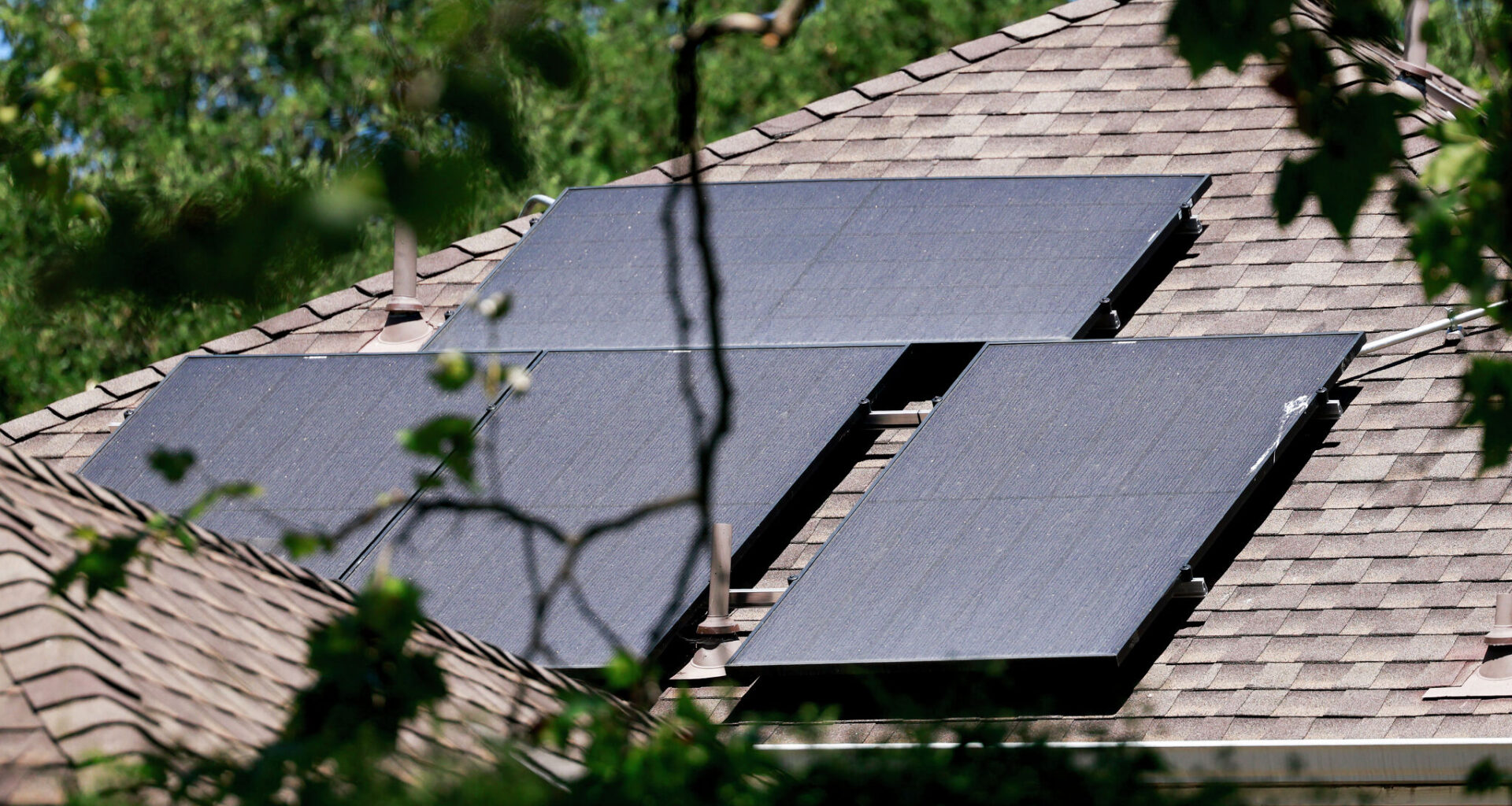
Solar panels on a home in San Anselmo in 2024. A state program links more than 200,000 solar-powered homes to supply electricity to the grid when there is peak demand, lowering costs for all users.
Jessica Christian/S.F. Chronicle
At my home in Southern California, I have solar panels and a battery backup. When a heat wave hits and the grid is strained, I generate power for my neighborhood. It’s the cheapest, cleanest power available, and it helps keep the lights on.
I’m proud to participate, alongside more than 200,000 other California households, in the state’s Demand Side Grid Support Program. It links us together in a vast web — a network of batteries, smart thermostats and other home devices that cut demand and supply electricity to the grid just like a traditional power plant. We’re sharing our infrastructure with our neighbors when they need it most.
As a result, California now has the largest distributed power plant in the world. Together, our homes can deliver a gigawatt of clean electricity, enough to power all of San Francisco at peak demand times. And because we kick in during the most expensive hours — automatically, whenever wholesale prices spike above $200 per megawatt-hour — we lower electricity bills for every Californian.
Article continues below this ad
A recent analysis found that continuing the demand side program through 2028 could save Californians up to $206 million on their electricity bills. We also keep the dirtiest fossil-fuel power plants from turning on, protecting our neighbors from pollution. Those aging fossil-fuel peaker plants operate only when demand spikes, so this program helps avoid their use. And it’s all been done on a shoestring, with just one-third of the funding the program was meant to receive.
The demand side program also uplifts lower-income families. It reaches every California Senate and Assembly district. In a study I recently published, the places with the lowest-income solar customers also had the highest participation rates in this program. In the Inland Empire and the Central Valley, lots of families are using the program. Many of these areas are also among California’s most pollution-burdened districts. The program is delivering bill savings and cleaner air to the communities that have long lived in the shadow of California’s dirtiest power plants. And with temperatures steadily rising each year, so does the need to continue to utilize it.
San Francisco Chronicle Logo
Make us a Preferred Source to get more of our news when you search.
Add Preferred Source
Climate change is making California’s grid harder to manage every year. Heat waves are hotter, and peak demand is higher. Climate scientists have forecast a super El Niño this year and next, which means we’re likely to shatter heat records. That will put the entire grid on the brink. Programs that help households reduce their demand and share clean power during those crises are exactly what we should be prioritizing.
The state is also poised to shut down several old, dirty gas plants at the end of the year that are poisoning communities in Los Alamitos and Huntington Beach (Orange County), and Ormond Beach in Oxnard (Ventura County). The closures are the right decision, and they’re long overdue, but it will also take almost 3 gigawatts of power offline. We should be using this successful Demand Side Grid Support Program to fill that gap.
Article continues below this ad
Even with these potential shortages, California is at risk of shutting down the program. Gov. Gavin Newsom’s proposed budget would stop funding after 2026, redirecting taxpayer dollars to an investor-owned utility program that costs more and delivers far less. The governor’s office argued the goal is to streamline the state’s demand response programs. But in practice, the proposal would hand the program to investor-owned utilities that have already failed to deliver.
From 2022 through 2025, the successful demand side program spent just $13 million on administration costs while paying $66 million to participating households. Compare that to a similar failed utility program: Since 2023, utilities have spent a whopping $39 million on administration fees while delivering a measly $700,000 in benefits. For every dollar that reached the public, the utilities pocketed $55. To say that’s embarrassing is too kind. Meanwhile, Pacific Gas and Electric Co. posted a third consecutive record year of profits in 2025: $2.6 billion; Sempra, the parent company of San Diego Gas & Electric, cleared $1.8 billion; and Southern California Edison’s parent company tripled its profits to $4.9 billion. The utilities do not need another handout.
Newsom’s budget would also gut the state’s school electrification fund, which installs air conditioning in classrooms, again to benefit the failed utility program. Roughly $200 million has been sitting unspent in the school electrification fund for years while thousands of schools wait for upgrades they urgently need. In that time, the fund generated $70 million in interest. Newsom’s proposal would send that $70 million to the failed utility program and let the $200 million return to utility coffers.
Guest opinions in Open Forum and Insight are produced by writers with expertise, personal experience or original insights on a subject of interest to our readers. Their views do not necessarily reflect the opinion of The Chronicle editorial board, which is committed to providing a diversity of ideas to our readership.
Read more about our transparency and ethics policies
A group of California legislators has proposed a better path. Lawmakers sent letters urging the Legislature to release the $200 million principal to the schools it was meant for, and use the $70 million additional interest to fund the successful Demand Side Grid Support Program through 2028. That money would make schools safer for kids and bolster the grid through the Super El Niño years ahead.
Article continues below this ad
My family’s home, and 200,000 households like ours, are already making the grid cleaner, cheaper and more reliable. The Legislature should not kill that progress to hand more money to the utilities right before record summer heat tests our grid like never before.
Leah C. Stokes is an associate professor at UC Santa Barbara, author of the forthcoming book “The Carbon Wave,” policy director of the 2035 Initiative and host of the podcast “A Matter of Degrees.”