
Voters within California’s 8th Congressional District will head to the polls for the primary election on June 2.The 8th Congressional District covers areas in and around the Bay Area with portions of Contra Costa and Solano Counties. It includes cities such as Fairfield, Vallejo, Richmond, Antioch, and Suisun City, to name a few.There are four candidates on the ballot for voters to choose from, and the top two candidates will then move on to the November general election regardless of party affiliation.KCRA 3 contacted every leading candidate who qualified to be on the ballot; they’re listed in alphabetical order.Democrat Nicolas Carjuzaa is a former international financial regulatory analyst who focused on the intersection between finance and regulation.Democratic incumbent John Garamendi is seeking his 9th term in Congress. The former California lieutenant governor is currently the top Democrat on the House Armed Services Subcommittee on Readiness.Republican Rudy Recile is a small business owner and retired U.S. Army Major.Democrat Aaron Rowden has worked as a policy analyst for a Bay Area public health nonprofit.Recile did not return KCRA’s request for an interview.On the issue of access to affordable housing:Aaron Rowden, Democrat:”If I’m elected to Congress, my number one policy in this area would be to curtail the sale of single-family homes as investment properties. I think that we need to see more ability by ordinary people to make an investment in their future. By owning a home, and we don’t need to boost the bottom line of private equity and large property management companies that are profiting from pricing out everyday people. So, I think that’s an area that we need to look at is really regulating to a certain degree, who can buy in favor of individuals. Another thing is even renting is expensive in our area. Buying a home is great, but there’s lots of people who that is going to be a very long-term goal, because we have structural problems in our economy that go beyond home pricing.”John Garamendi, Democrat:”About four to five years ago now, I introduced a bill called the Home Act, which is an update of the federal low-income and moderate-income housing program, which has not been updated since 1994. And these are grants to build the houses to build the low-income houses. Also, rent payment assistance and other kinds of programs to assist in the construction of new housing, and also the rehabilitation of existing housing.”This year, the HOME Act was incorporated into a broader bipartisan housing package, and Garamendi wants to continue working to push this piece of legislation through Congress.Nick Carjuzaa, Democrat:”We need to subsidize affordable housing that can be done through public investment. It can be done, through a bill, to channel billions and actually trillions of dollars are needed to close the housing gap in America. But we need the financial system to play a part in that, too. If the financial system is built to securitize housing to make sure that investors get their share of the profit in terms of housing development, in terms of the values of homes, then we’re putting good money after bad money to fix the housing crisis in America. We need to treat it like a public infrastructure problem. The federal government has to play a role in funding it, and the tax code and our financial system have to support it.”On the issue of clean air and climate concerns:Nick Carjuzaa, Democrat:”Look at Richmond, for decades, children there have suffered with higher rates of asthma than in other places. That’s a direct result of being closer to the refinery. Now, the issue is making sure that we also allow those refineries to make the investments that we expect of them. More importantly, I think we do need to get off of fossil fuels. We just get rid of the entire problem when we invest in renewable sources. I don’t think the market can respond to it on its own. It’ll take a federal hand in helping it.”Aaron Rowden, Democrat:”I strongly support a completely renewed approach to energy generation. I simply don’t think that passing the buck generation after generation, with rising temperatures, rising pollution, rising levels of PFAs, forever chemicals, microplastics, etc. that are all a product of this method of production that fundamentally is aimed at extracting and then destroying resources, is sustainable.”John Garamendi, Democrat:”I’ll do what I’ve done for 52 years. In 1974, I introduced the very first tax credit for solar, wind and conservation. (In) 1976, Jerry Brown signed that bill. I’ve been at this a long, long time on renewable energy. We’ve continued to push that. In fact, one of the renewable energy plants, a solar program, is still operating in the California desert. It is 50 years old now. So, what do we do now? We just hunker down, hang on as best we can to what we have put in place.”On the issue of gas and grocery prices: John Garamendi, Democrat:”We’ve got a very, very serious problem, it’s called Donald Trump. Donald Trump, in his trade wars, when he went after the tariff issues, put in place extraordinary increases in the cost of everything, and now the Iran war on top of that, it is an intolerable situation that Trump has created all by himself. “”(Food) You’ve got to grow it, you’ve got to fertilize it, you’ve got to then package it and get it to the store. All of those costs are driven up by the Iran War. We see gasoline. I just bought a tank of gasoline here. It was $6.05 a gallon for gasoline. Now, on my truck at the ranch, diesel. I don’t even think about it, we’re just not going to use that truck, it’s horribly expensive. All of those costs are going to land right in the consumer’s pocket…So what to do about it? Fight fiercely in Congress to end this war.”Nick Carjuzaa, Democrat:”(District 8) it’s largely a commuter population. A lot of people spend almost an hour every day commuting, paying tolls, paying for gas. It’s how people get to work. It’s how they make their livelihoods. And it’s just added a huge cost to them. So, the way we need to fix that is by ending the war in Iran.””I think it’s important to make sure that people can live closer to their work. We can add public transportation; we can build infrastructure to support that. But to get gas prices down, we need to end the war in Iran, and we need to start investing in renewable energy.”Aaron Rowden, Democrat:”We have to end this patently illegal military operation in Iran. The president of the United States does not have the authority to unilaterally declare war and sustain that war without congressional authority. The Strait of Hormuz is the choke point for energy. It’s the choke point for fertilizer, which goes to the price of food. Currently, the executive branch is tying up vital resources in Iran.””I think we need to go line by line through our agricultural policies and really see why are we incentivizing higher prices and price shocks as opposed to price stability? Are we incentivizing people to grow? Are we incentivizing people to collect subsidy? I am very much in favor of the government creating the ability to bring food to market, not just to create something, but to also bring it to the marketplace so that people can actually buy it.”You can learn more about the candidates on their campaign websitesNick CarjuzaaJohn Garamendi Rudy Recile Aaron RowdenSee our full voter guide for the June 2 primary here.See more coverage of top California stories here | Download our app | Subscribe to our morning newsletter | Find us on YouTube here and subscribe to our channel | Make KCRA a preferred news source in Google
Voters within California’s 8th Congressional District will head to the polls for the primary election on June 2.
The 8th Congressional District covers areas in and around the Bay Area with portions of Contra Costa and Solano Counties. It includes cities such as Fairfield, Vallejo, Richmond, Antioch, and Suisun City, to name a few.
There are four candidates on the ballot for voters to choose from, and the top two candidates will then move on to the November general election regardless of party affiliation.
KCRA 3 contacted every leading candidate who qualified to be on the ballot; they’re listed in alphabetical order.
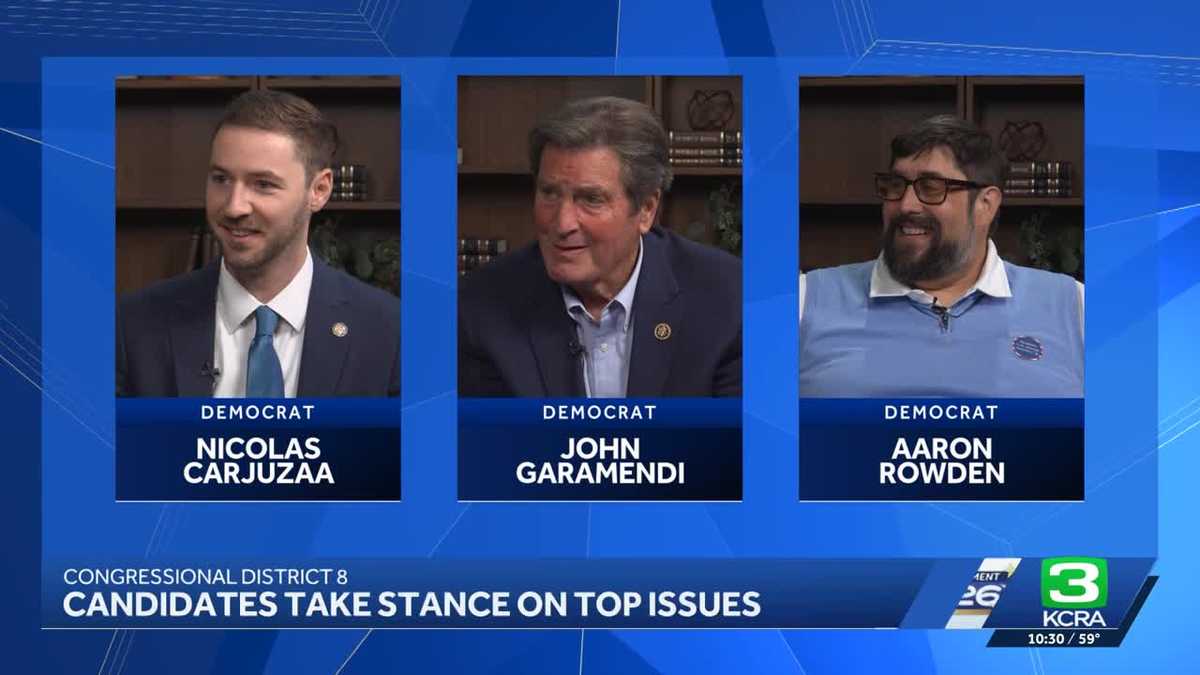
Democrat Nicolas Carjuzaa is a former international financial regulatory analyst who focused on the intersection between finance and regulation.
Democratic incumbent John Garamendi is seeking his 9th term in Congress. The former California lieutenant governor is currently the top Democrat on the House Armed Services Subcommittee on Readiness.
Republican Rudy Recile is a small business owner and retired U.S. Army Major.
Democrat Aaron Rowden has worked as a policy analyst for a Bay Area public health nonprofit.
Recile did not return KCRA’s request for an interview.
On the issue of access to affordable housing:
Aaron Rowden, Democrat:
“If I’m elected to Congress, my number one policy in this area would be to curtail the sale of single-family homes as investment properties. I think that we need to see more ability by ordinary people to make an investment in their future. By owning a home, and we don’t need to boost the bottom line of private equity and large property management companies that are profiting from pricing out everyday people. So, I think that’s an area that we need to look at is really regulating to a certain degree, who can buy in favor of individuals. Another thing is even renting is expensive in our area. Buying a home is great, but there’s lots of people who that is going to be a very long-term goal, because we have structural problems in our economy that go beyond home pricing.”
John Garamendi, Democrat:
“About four to five years ago now, I introduced a bill called the Home Act, which is an update of the federal low-income and moderate-income housing program, which has not been updated since 1994. And these are grants to build the houses to build the low-income houses. Also, rent payment assistance and other kinds of programs to assist in the construction of new housing, and also the rehabilitation of existing housing.”
This year, the HOME Act was incorporated into a broader bipartisan housing package, and Garamendi wants to continue working to push this piece of legislation through Congress.
Nick Carjuzaa, Democrat:
“We need to subsidize affordable housing that can be done through public investment. It can be done, through a bill, to channel billions and actually trillions of dollars are needed to close the housing gap in America. But we need the financial system to play a part in that, too. If the financial system is built to securitize housing to make sure that investors get their share of the profit in terms of housing development, in terms of the values of homes, then we’re putting good money after bad money to fix the housing crisis in America. We need to treat it like a public infrastructure problem. The federal government has to play a role in funding it, and the tax code and our financial system have to support it.”
On the issue of clean air and climate concerns:
Nick Carjuzaa, Democrat:
“Look at Richmond, for decades, children there have suffered with higher rates of asthma than in other places. That’s a direct result of being closer to the refinery. Now, the issue is making sure that we also allow those refineries to make the investments that we expect of them. More importantly, I think we do need to get off of fossil fuels. We just get rid of the entire problem when we invest in renewable sources. I don’t think the market can respond to it on its own. It’ll take a federal hand in helping it.”
Aaron Rowden, Democrat:
“I strongly support a completely renewed approach to energy generation. I simply don’t think that passing the buck generation after generation, with rising temperatures, rising pollution, rising levels of PFAs, forever chemicals, microplastics, etc. that are all a product of this method of production that fundamentally is aimed at extracting and then destroying resources, is sustainable.”
John Garamendi, Democrat:
“I’ll do what I’ve done for 52 years. In 1974, I introduced the very first tax credit for solar, wind and conservation. (In) 1976, Jerry Brown signed that bill. I’ve been at this a long, long time on renewable energy. We’ve continued to push that. In fact, one of the renewable energy plants, a solar program, is still operating in the California desert. It is 50 years old now. So, what do we do now? We just hunker down, hang on as best we can to what we have put in place.”
On the issue of gas and grocery prices:
John Garamendi, Democrat:
“We’ve got a very, very serious problem, it’s called Donald Trump. Donald Trump, in his trade wars, when he went after the tariff issues, put in place extraordinary increases in the cost of everything, and now the Iran war on top of that, it is an intolerable situation that Trump has created all by himself. “
“(Food) You’ve got to grow it, you’ve got to fertilize it, you’ve got to then package it and get it to the store. All of those costs are driven up by the Iran War. We see gasoline. I just bought a tank of gasoline here. It was $6.05 a gallon for gasoline. Now, on my truck at the ranch, diesel. I don’t even think about it, we’re just not going to use that truck, it’s horribly expensive. All of those costs are going to land right in the consumer’s pocket…So what to do about it? Fight fiercely in Congress to end this war.”
Nick Carjuzaa, Democrat:
“(District 8) it’s largely a commuter population. A lot of people spend almost an hour every day commuting, paying tolls, paying for gas. It’s how people get to work. It’s how they make their livelihoods. And it’s just added a huge cost to them. So, the way we need to fix that is by ending the war in Iran.”
“I think it’s important to make sure that people can live closer to their work. We can add public transportation; we can build infrastructure to support that. But to get gas prices down, we need to end the war in Iran, and we need to start investing in renewable energy.”
Aaron Rowden, Democrat:
“We have to end this patently illegal military operation in Iran. The president of the United States does not have the authority to unilaterally declare war and sustain that war without congressional authority. The Strait of Hormuz is the choke point for energy. It’s the choke point for fertilizer, which goes to the price of food. Currently, the executive branch is tying up vital resources in Iran.”
“I think we need to go line by line through our agricultural policies and really see why are we incentivizing higher prices and price shocks as opposed to price stability? Are we incentivizing people to grow? Are we incentivizing people to collect subsidy? I am very much in favor of the government creating the ability to bring food to market, not just to create something, but to also bring it to the marketplace so that people can actually buy it.”
You can learn more about the candidates on their campaign websites
See our full voter guide for the June 2 primary here.
See more coverage of top California stories here | Download our app | Subscribe to our morning newsletter | Find us on YouTube here and subscribe to our channel | Make KCRA a preferred news source in Google