
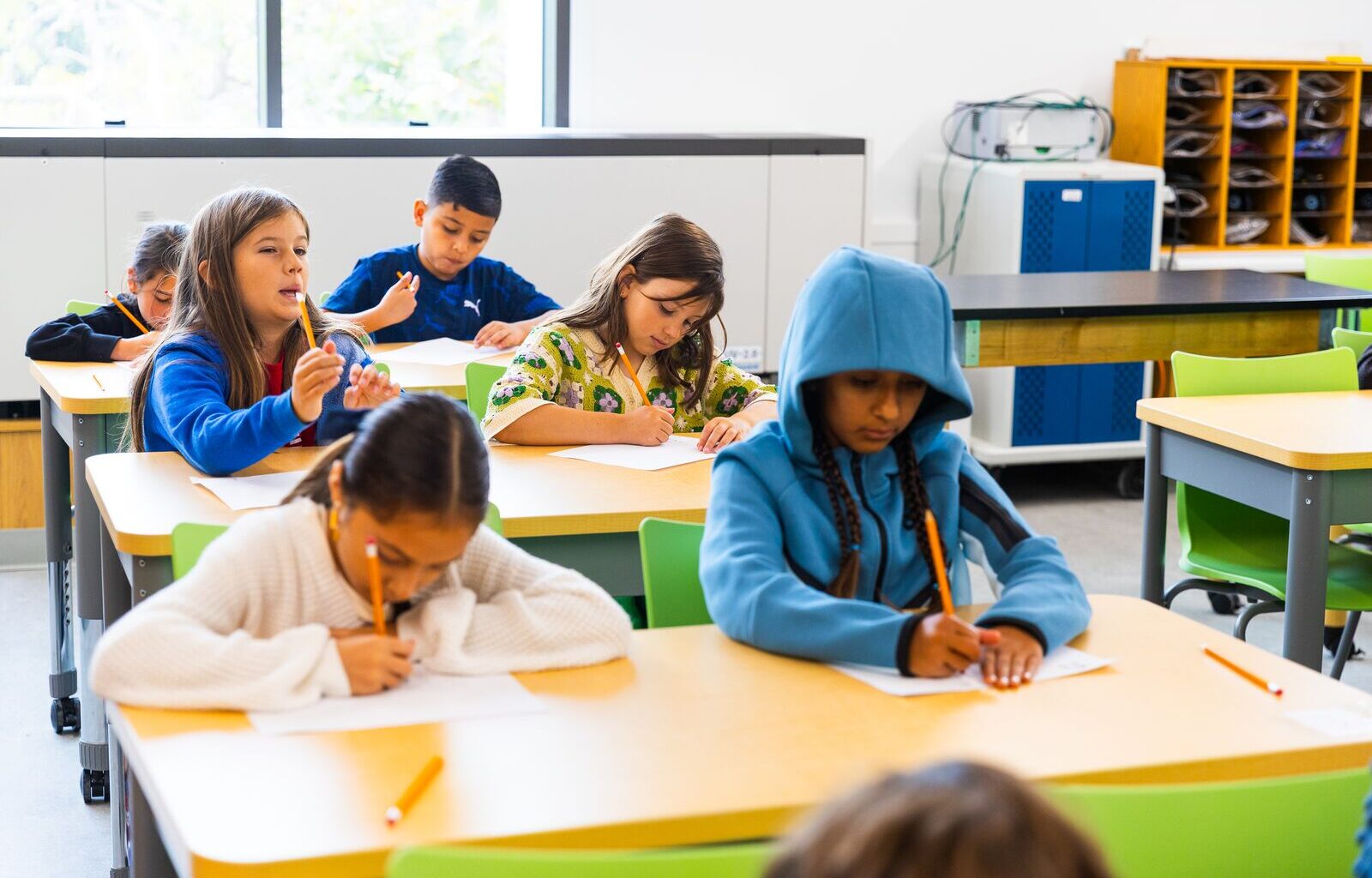
 Sylvia Mendez Elementary students work on a writing assignment in August 2025. Credit: Estefany Gonzalez for Berkeleyside
Overview:
BUSD isn’t alone in facing budget pressure, even with strong local tax support.
Schools have far less control over their finances than most people realize.
We explain BUSD’s funding and what it’s doing to improve its cash flow.
The Berkeley school district has made budget cuts year after year, with a round of layoffs and new fees likely needed to make ends meet next school year. So it’s not surprising that our readers often ask: Is there anything the district can do about this problem?
The short answer: School districts don’t have as much control over their revenue or spending as people might think. Most funding comes from the state (plus a small amount from the federal government) and a fair portion of it is earmarked for specific programs, such as special education. And the tools districts do have to raise money are limited.
The Berkeley Unified School District (BUSD) uses the same funding system as virtually all public school districts in California: The Local Control Funding Formula (LCFF), which determines how much money it gets based primarily on attendance and enrollment.
The state provides a base amount per student per grade level plus supplemental funding for “high-need” students, such as foster youths, low-income students and English language learners.
All of that adds up to roughly $13,000 each year per student, or over $80 per pupil, for a district like BUSD, depending on the grade level and needs of the student. But that funding is tied to attendance, so if a student doesn’t show up, the district doesn’t receive those dollars.
Those dollars make up the bulk of the district’s budget. About half of BUSD’s funding comes through the LCFF, with 9% from other state funds, according to district documents. Federal funding accounts for about 2%, with about 38% generated locally — primarily through parcel taxes and facility rentals. (PTA funds and other donations are also used to fund programs and services at BUSD.)
That doesn’t mean districts are completely stuck, but it indicates that BUSD’s funding problems are likely more structural than related to how the district’s funds are being managed locally.
Even so, said Travis Bristol, associate professor of teacher education and education policy at UC Berkeley, “one can’t just throw up their hands.”
Here are a few ideas about how to get more involved in your local school district:
The reality is the state and federal funding isn’t enough, he said, and California school districts — even wealthier ones, like BUSD — have only a handful of ways to increase revenue: Increase attendance, stabilize enrollment, ask voters to pass local parcel taxes or bonds or pursue grants.
But those options have strings attached: Parcel taxes depend on voter approval; bonds can only pay for buildings and repairs (not salaries); and grants are usually short-term and tied to specific programs.
School districts can also fundraise for specific programs, create partnerships with other agencies or rent out facilities like fields or multi-purpose rooms for profit.
Enrollment and attendance are the most promising revenue sources
Some school districts are grappling with declining birth rates. While other districts are facing declining enrollment due to losing kids to neighboring districts, charter schools or private schools.
Births have declined every year since 2015, with an accelerated decline of 6% between 2019 and 2020 statewide. And since 2019, BUSD has lost about 8% of its students, or nearly 800 pupils, according to state data, coinciding with pandemic enrollment declines across the country, though unlike many districts, enrollment has ticked up a little over the last couple of years at BUSD, and next year is projected to again rise slightly.
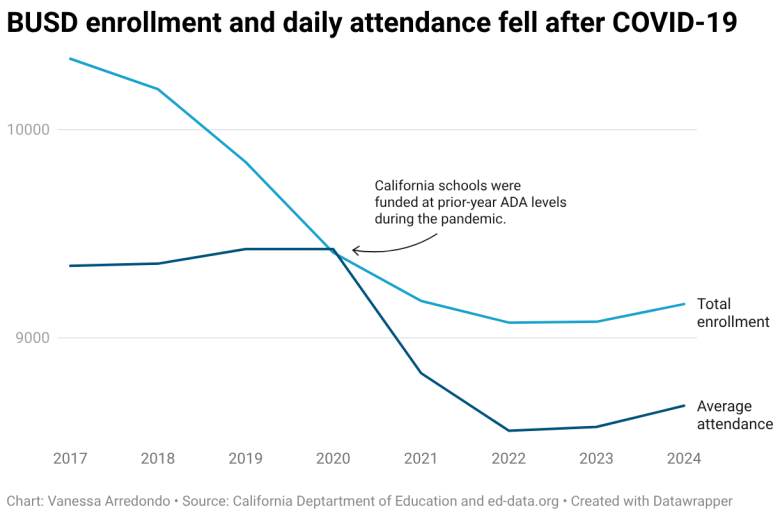
BUSD’s average daily attendance — meaning the percentage of enrolled students who attend school on a typical day — is also well below pre-pandemic levels, and the district is facing reduced revenue from the expiration of one‑time COVID-19 relief funds.
“Our expenses are outpacing the revenue that we would get from the increased enrollment,” Assistant Superintendent of Business Services Pauline Follansbee told Berkeleyside. “We are at least trending in the right direction, but it’s still not enough to account for increases in expenses.”
BUSD officials have maintained that enrollment and attendance are some of the few areas the district can still influence to improve its budget outlook. In fact, enrollment is projected to increase by about 15 students to 9,427 next school year, generating an estimated $13,860 more in revenue based on average attendance, according to district budget documents.
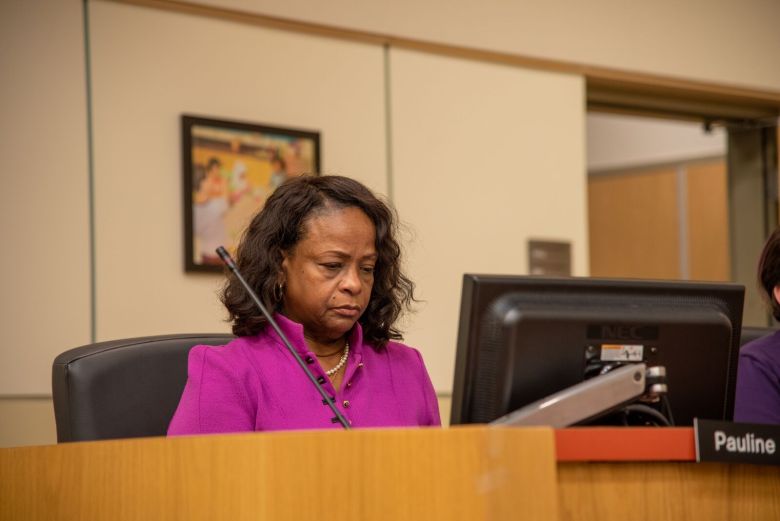 BUSD Assistant Superintendent of Business Services Pauline Follansbee during a school board meeting in June 2023. Credit: Ximena Natera, Berkeleyside/CatchLight
But increasing enrollment to pre-pandemic levels may seem like a pipe dream for many school districts, especially as birth rates decline.
BUSD has been able to offset declines with rising enrollment at the high school level and by operating a transitional kindergarten program that has brought in hundreds of students, keeping the district’s total enrollment numbers above 9,000 over the past seven years.
BUSD’s average daily attendance has remained between 94% to 96% since the 2017-18 school year. The most recent data, available for 2024-25, shows a 95% ADA, albeit with about 1,000 fewer students.
The district has floated a number of ideas to increase attendance, including a “March Madness” style competition between BUSD schools. It has also expanded targeted interventions for higher-risk youth, including text messages to parents, outreach from family engagement specialists, and home visits.
Future BUSD cuts tied to average daily attendance
Attendance is by far the most impactful lever a district has to increase attendance. Just a 1% increase in average daily attendance can generate $1 million in additional state funding at BUSD. Each regularly attending BUSD student brings in about $11,000 each year.
This budget year, BUSD plugged a $10.4 million deficit, leaving a nearly $1 million cushion. A large portion of these savings and revenue is tied to one-time block grants, potentially leaving BUSD’s finances unstable in future years. BUSD has already made at least $12.6 million in cuts in the last two years.
The depth of the future will be determined by average daily attendance.
“We can try to control that money because every time we have a student who’s actually seated in a chair, we get funded,” Follansbee said in a board meeting in February. “It’s a balancing game.”
Staffing costs add another layer of pressure. A new contract between Berkeley teachers and BUSD secured a 3% raise this year and another 3% next year, which district officials said reflects their commitment to fair compensation while protecting the district’s long‑term budget stability. The union said the deal stretches BUSD to its limit without causing a “fiscal emergency.”
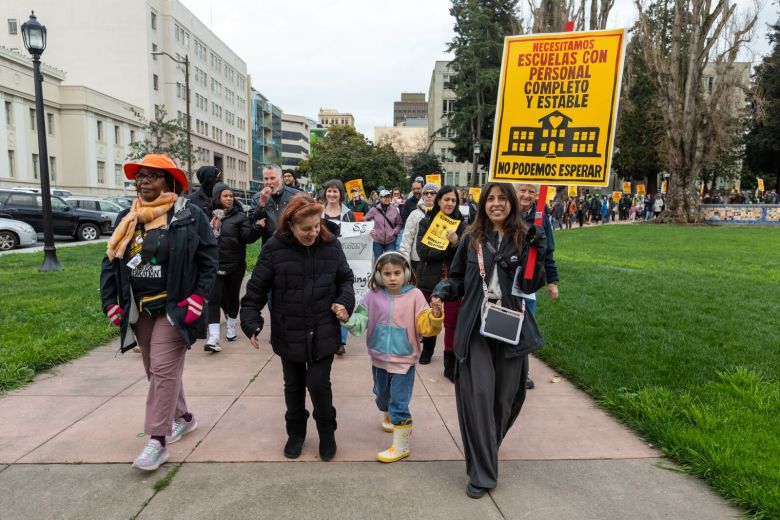 Berkeley teachers, parents, students, and supporters participate in a march from Civic Center Park to BUSD headquarters on Feb. 18, 2026, demanding higher wages and school funding. Credit: Kelly Sullivan for Berkeleyside
It’s a song and dance that many districts are seeing across the state. And while enrollment decreases and salaries increase to match cost-of-living increases, average daily attendance is what districts will focus on most.
Leveraging grants and offering students more support
Bristol agreed that increasing attendance is a major lever for school districts, but doing so is not simple. There are a myriad of reasons outside of school that impact attendance.
Students who lack access to basic needs, such as food, stable housing or even hygiene products, are less likely to attend and engage in school on a regular basis. Another formidable barrier is reliable transportation, and California ranks last in the nation for school bus accessibility for students.
About one‑third of BUSD students are considered high‑need, and the district provides them with extra transportation and basic‑needs support. But transportation has not been easy for some families. The district last year cut bus stops to optimize resources amid a driver shortage, causing some parents to opt out of the service and scramble to get their kids to school.
Solving those major barriers, in part, also means major investment from the state or federal government, he said.
There are, however, easier lifts for school districts to leverage state dollars to offset district costs, but it also won’t generate as much revenue as an average daily attendance increase.
One major example Bristol pointed to was the state’s national board incentive program, where the state pays a teacher an additional $5,000 per year if they receive a national board certification at the state and teach at a high-priority school.
“Teachers can make $25,000 (more) over five years, which increases a teacher’s capacity to teach all students and increases their pay,” Bristol said.
Of BUSD’s 20 schools, only Berkeley Technology Academy qualifies as a ‘high priority’ school, meaning 55% or more of the student population is either low-income, an English language learner or in foster care.
Parcels and bonds add millions in revenue, especially in wealthy cities like Berkeley, but it’s still not enough
School districts can also ask constituents to help increase revenue through parcel taxes and bonds. Parcel taxes can be used for programming, salaries or any other day-to-day school needs. Bonds are only used for facility upgrades and projects.
BUSD benefits from stronger local funding than other East Bay districts. Voter‑approved parcel taxes like the Berkeley Schools Excellence Program (BSEP) and the Berkeley Educator Recruitment and Retention Act (BERRA), along with recurring school bonds, generate tens of millions in revenue each year. Berkeley residents show they are invested in public education, passing these measures with overwhelming support — most recently, 88% voted in 2024 to renew BSEP and extend it for 8 years.
This level of investment is possible because Berkeley’s wealthier tax base brings in many times more local revenue per pupil than nearby districts such as those serving students in Oakland or Richmond.
Former Chief Economist at the U.S. Department of Labor Jesse Rothstein said it’s not a particularly equitable way to fund schools because the revenue generated or number of parcel taxes approved is often dependent on the socioeconomic status of the constituents.
“That tends to be something that you can get voters to support in wealthy areas,” Rothstein said, noting a super-majority vote (two-thirds) is a high bar to clear.
But even for wealthier districts like Berkeley, the money is still not enough to make a big dent with such large budget deficits.
Rothstein, who is now a public policy and economics professor at UC Berkeley, squarely attributes the state’s public school budget problems to the passing of Proposition 13 because it restricted districts’ ability to meaningfully increase revenue.
Before it passed in 1978, local officials, like a school board, could adjust property tax rates to meet budget needs, and that money flowed directly into local school funding.
“Effectively, it took California from being one of the highest spending states in the country to one of the lowest spending states in the country in education,” Rothstein said. “There’s very little [school districts] can do now.”
That also means that the responsibility to fix those problems falls squarely on the state. He said, aside from school districts jointly advocating at the state level for additional funding, “I don’t think they have many other options” to avoid impending cuts.
Is it on the state, federal government or the district?
Rothstein said the issue goes beyond local control. His research shows that better-funded schools lead to better outcomes and that even higher taxes can increase property values when they result in stronger schools.
“You can always point to some decisions or there’s always going to be some ways more could be squeezed out of the rock,” he said. No district is perfectly managed, but I also think that most districts are not terribly managed. [Ultimately,] if we choose not to spend money on schools, we’re not going to get schools that have the resources they need,” he said.
Bristol echoed that sentiment, saying the real solution lies beyond individual districts.
“Maybe at some point, [teachers and parents] may come together and realize that their fight is not one against the [school districts],” Bristol said. “Until then, we are really tinkering at the edges here.”
He added that the limited role of federal funding is a policy choice, not a constraint, and pressure should be added there.
For example, the Individuals with Disabilities Education Act is chronically underfunded, with the federal government only providing 13% to 15% of the promised 40% per-student cost — a roughly $38.6 billion shortfall that states and districts are then forced to cover, diverting resources locally.
“Look at the war in Iran — we can quickly spend billions of dollars, so it’s not a question about [federal] resources,” Bristol said. “The way that we fund schools in the United States keeps students who are at the margins at the margins, and rarely brings them to the center.”
“*” indicates required fields