
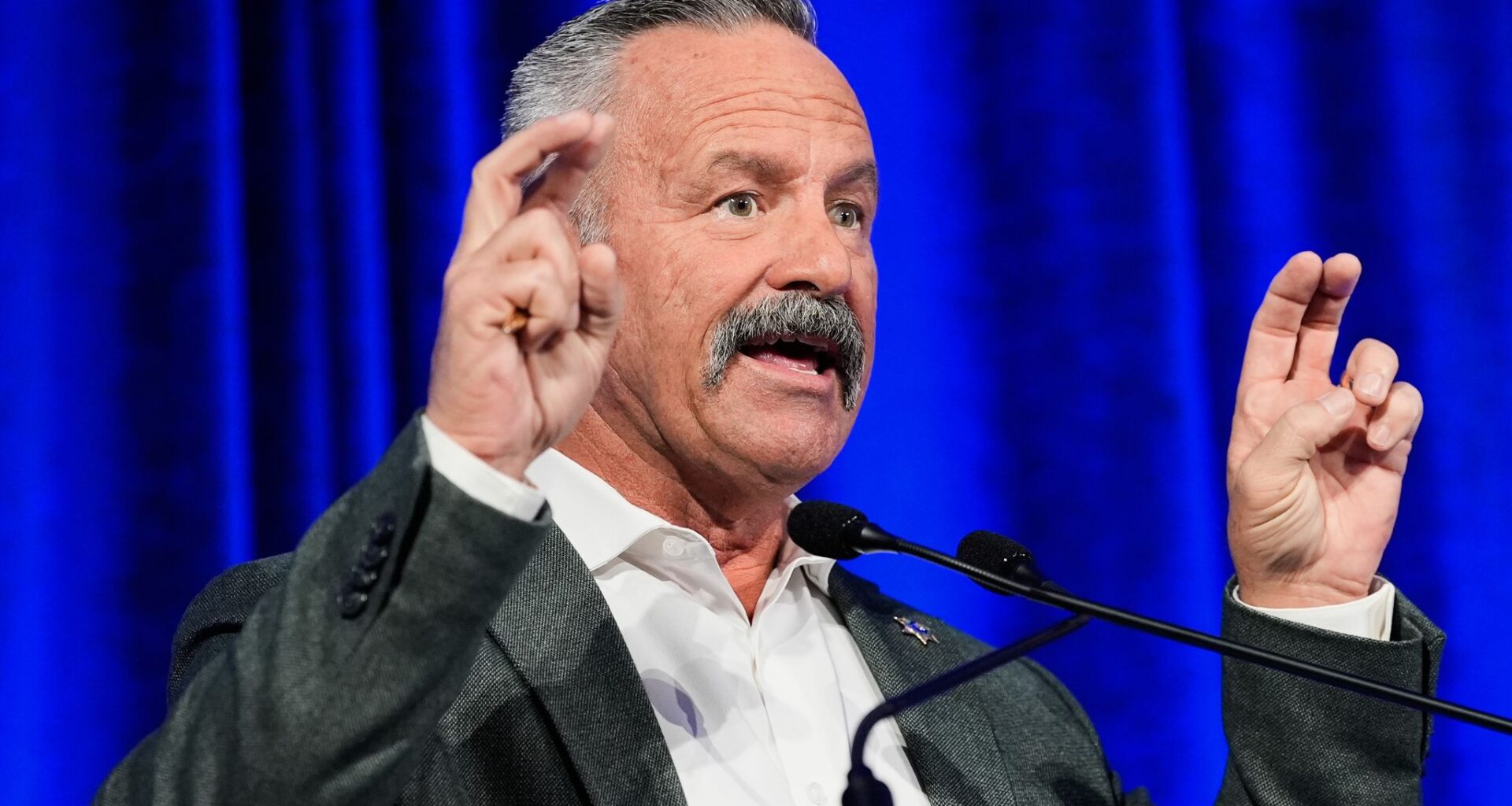
Gov. Gavin Newsom signed SB73 on Wednesday, a measure inspired by Riverside County Sheriff Chad Bianco’s move to seize thousands of ballots. Bianco’s investigation has been temporarily blocked by the California Supreme Court.
Godofredo A. Vásquez/Associated Press
Riverside County Sheriff Chad Bianco’s unprecedented seizure of 650,000 local voters’ ballots earlier this year just inspired a new law to stop him from doing it again.
Gov. Gavin Newsom signed the Bianco-inspired legislation on Wednesday, during a news conference his office billed as an act to safeguard California’s elections from threats both inside and outside the state. The emergency legislation takes effect immediately, six days before millions of California voters decide whether they want Bianco, a Republican who is also running for governor, or another candidate to succeed Newsom.
The governor refused to mention Bianco by name, referring to him as “a former member of the Oath Keepers,” the far-right militia that Bianco recently said he was proud to have been a dues-paying member of.
Article continues below this ad
“This is not the final word on election integrity,” Newsom said, flanked by the bill’s authors.
The law, Senate Bill 73, makes it a felony for anyone, including law enforcement officials, to seize ballots from a county elections office, punishable by up to three years in prison and a $1,000 fine and subject to civil injunctions and penalties. It also makes it illegal for law enforcement agencies to search or take custody of voter rolls or voting machines without a signed warrant or agreement with the election official overseeing the election, and clarifies the attorney general’s authority to advise county election officials on how to respond to law enforcement requests.
San Francisco Chronicle Logo
Make us a Preferred Source to get more of our news when you search.
Add Preferred Source
It was introduced in April by Sen. Sabrina Cervantes, D-Riverside, whose office said in a release at the time that the legislation was inspired by Bianco’s seizure of ballots as part of “a sham investigation driven by conservative extremist groups.”
Bianco’s office obtained a search warrant to seize more than 650,000 ballots from the Riverside County Registrar of Voters office in February, citing a local group’s claims that the November 2025 election, in which California voters approved the redistricting measure Proposition 50, was marred by a 45,000-vote overcount.
Article continues below this ad
Prop 50 won in Riverside County by more than 82,000 votes and in California by more than 3.3 million votes. Local and state elections officials said the group’s claims were based on a bad reading of raw ballot data. Election scholars expressed alarm over the investigation, saying that there are established procedures to challenge an election result and that the sheriff’s office broke the chain of custody when it seized the ballots.
Search warrant affidavits reviewed by the Chronicle show that the sheriff’s office based its investigation entirely on the complaint from the Riverside Election Integrity Group, which has made similar claims in previous elections. The sheriff’s office has conducted at least two prior investigations into alleged voting irregularities since 2022, and found nothing.
Bianco, who also has ties to the extremist constitutional sheriffs movement that claims supreme authority over the law, has embraced President Donald Trump’s views about elections and opponents. Bianco has attacked Attorney General Rob Bonta, Secretary of State Shirley Weber and Riverside County Registrar of Voters Art Tinoco, claimed without evidence that undocumented immigrants regularly vote in elections and said he is in favor of federal immigration authorities patrolling polling places, which would be against the law.
He also supports Trump’s efforts to drastically restrict mail voting and to force every American voter to re-register with proof-of-citizenship documents that could disenfranchise millions of eligible voters.
SB73 also expands an earlier state prohibition against military or law enforcement personnel at polling places, also written by Cervantes, by empowering the attorney general and secretary of state to overrule a local election official who requested it.
Article continues below this ad
In framing the need for election safeguards, Newsom ticked off an array of flashpoints that he characterized as brazen threats and previews of what’s to come. They included the president’s relentless push for the SAVE Act, his attempts to seize voter rolls in California and other states, FBI ballot seizures in Georgia and Arizona, the Trump-appeasing redistricting effort by Texas Gov. Greg Abbott, Louisiana Gov. Jeff Landry’s suspension of a primary election that was already underway, right-wing commentator Steve Bannon’s calls for ICE at polling places and a “preening” Greg Bovino’s appearance alongside masked border agents outside Prop 50’s kickoff event in Los Angeles.
“These guys are not screwing around. They’re ruthless,” Newsom said. “I absolutely expect the worst.”
Cervantes is also the driver behind the California Voting Rights Act of 2026, made up of two bills that essentially create a version of the Supreme Court-decimated Voting Rights Act in the state, with components to prohibit voter suppression and vote dilution, and to require jurisdictions with histories of voter discrimination to get state approval before making any changes to voting requirements.
“Democracy in California is under attack, not only by the Trump Administration but also by some officials in our state, including Riverside County Sheriff Chad Bianco,” Cervantes said in a statement when her legislation cleared two Assembly committees earlier this month. “We have a responsibility to protect the voices of California voters, and we will not stand by as outside forces seek to undermine our electoral process.”
Article continues below this ad
With less than a month before the June election, Emerson College Polling showed the sheriff in fourth place for governor, just ahead of former Rep. Katie Porter. In California’s open primary system, the two top vote-getters on Tuesday will advance to the November general election.