
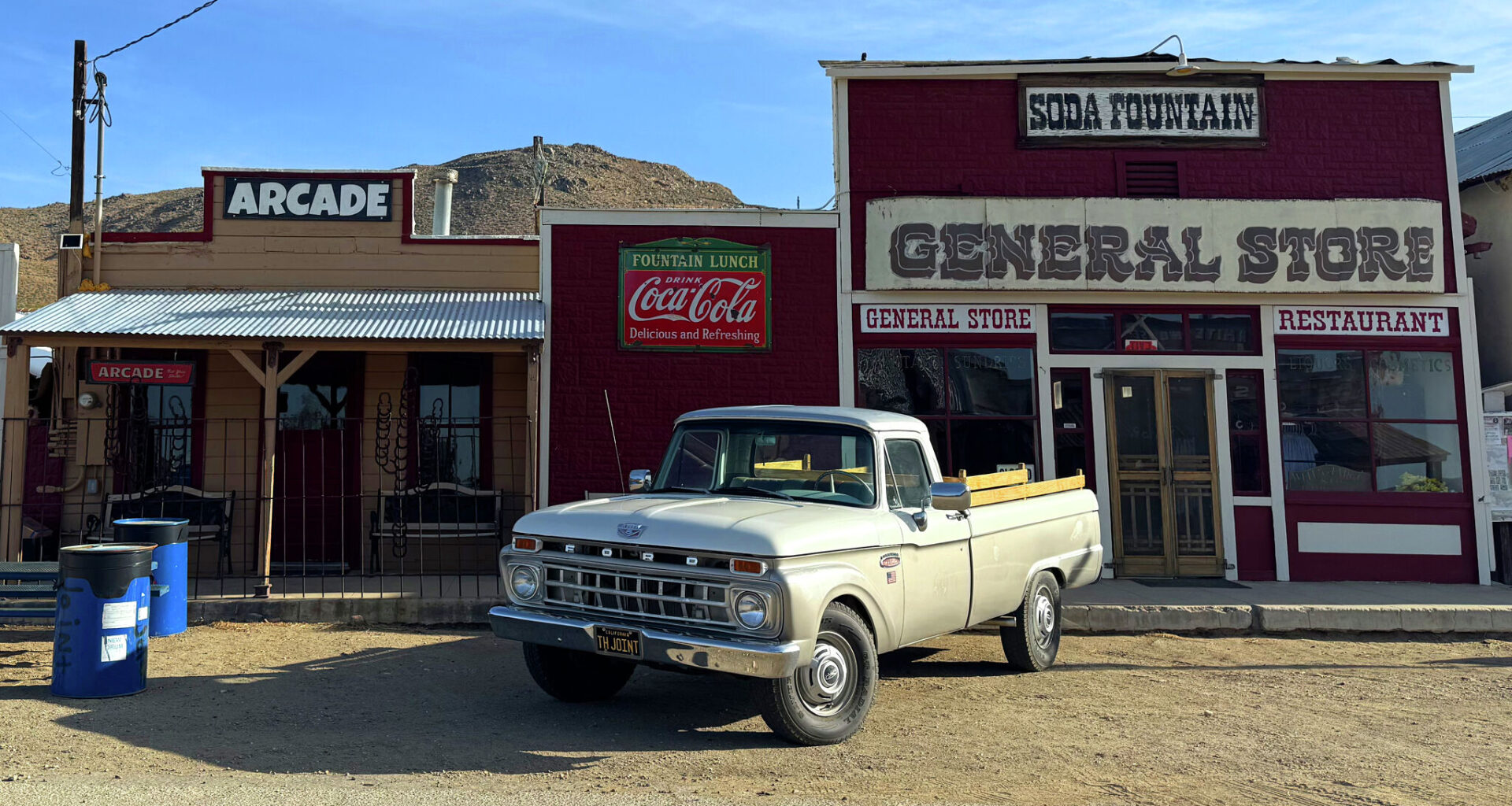
A wide blue arrow points toward Randsburg, California, from the side of a winding stretch of the desert artery that is Highway 395, an illustrated bearded miner coaxing a reluctant donkey toward the town. The yellowing billboard promises a “living ghost town” just a mile away, but on a Thursday afternoon, there’s no sign of the living — the only sound a creaking metal sign swinging gently from a pole. Butte Avenue, the town’s main street, is desolate, its old-timey, one-story buildings appearing more like an old Western movie set than an actual town.

By mid-morning Friday, the town bustles by comparison. A handful of off-roaders park their vehicles in front of the only bar, and curious day-trippers wander in and out of the antique store, the gift shop and the town’s one restaurant — the few businesses operating in those buildings that largely date back to 1905, their wooden facades still ornamented with painted lettering. These visitors will spend at least a few hours funneling modest amounts of cash toward Randsburg T-shirts, burgers and beers, but that modest spending pipeline may soon dwindle so much, the businesses warn they could shutter.
A view of Randsburg, Calif., on April 17, 2026.
Tessa McLean
Inside the Joint on Butte Avenue in Randsburg, Calif., on April 17, 2026.
Tessa McLean
A view of Butte Avenue in Randsburg, Calif., on April 17, 2026.
Tessa McLean
Some residents of a town like this may not like the influx of tourists on weekends, but in Randsburg, they say it’s their lifeline, with most locals agreeing that the town would disappear altogether without it. Randsburg’s population of full-time residents has already steadily shrunk — from 77 in 2000 to 69 in 2010 to 45 by 2020 — as the town lost most nearby mining operations and its local school and post office. Morphing from mining boomtown to historic landmark to off-roading haven, the desert community has always found a way to stay alive, weathering each obstacle with the same grit characteristic of the miners that built the place. But with a recent devastating flood coupled with new California legislation that could seriously limit off-roaders’ ability to travel in and around the town, this time everything seems to be working against Randsburg.
Article continues below this ad
From boomtown to desert playground
In 1895, a trio of inexperienced prospectors struck gold on Rand Mountain, setting off a mining boom that would establish Randsburg about 150 miles northeast of Los Angeles. By 1897, several mines operated in the area, with each one raking in millions. The new town soon swelled with saloons, boarding houses and shops, and would peak at about 3,500 residents in 1899.
So much gold and silver lined the surrounding hills that the adjacent towns of Johannesburg and Red Mountain also took root, forming a mining region that even necessitated the construction of its own railway.
View of the mining town of Randsburg, Calif., 1897.
USC Library/Calisphere
Living in the Old West was harsh and dangerous, though, and fires plagued Randsburg’s early years, with one particularly disastrous blaze burning down about half its structures in 1898. The residents always rebuilt, and a subsequent discovery of tungsten, a naturally occurring metal that became integral for machinery making during Word War I, continued the town’s mining interests through the early 1900s.
Article continues below this ad
A massive statewide mining decline hit California post-WWII, but Randsburg never emptied out, even as its population decreased dramatically. Remaining residents’ dedication to preserving its historic buildings and mining town history kept the town from completely disappearing. In 1981, the Rand Mining District became California Historical Landmark No. 938.
Around the same time, off-highway vehicles — ATVs, dirt bikes, side-by-sides and 4x4s — were creating a whole new culture in Southern California, and Randsburg sat perfectly situated in the middle of prime land for off-road driving. Riders from all over the state began to discover the Old West town on weekend rides, exploring about 50,000 acres of Bureau of Land Management trails while also patronizing local businesses. De Wallace, whose family has lived in Randburg for 108 years, said she noticed a sharp increase in off-roaders visiting town about 15 years ago.
Off-road vehicles parked outside the Joint in Randsburg, Calif., on April 17, 2026.
Tessa McLean
The walls inside the Vault in Randsburg, Calif., on April 17, 2026.
Tessa McLean
When asked if she’s happy there’s a new generation of people that love Randsburg, she said, “Yes and no, I’ll be honest about that.”
Article continues below this ad
Wallace said she’s had problems with the off-roaders over the years trespassing and damaging her property. She lives on a dirt road, and she said some apologize if they find out it is private property, but others don’t care.
“A lot of times they’re really rude to us,” Wallace said.
But, she acknowledges, “they bring a lot of money for the Joint and for the Vault,” the bar and restaurant in town, which she doesn’t want to see close. They’re some of the few institutions left.
The Randsburg of today looks little like what Wallace grew up with. The elementary school she went to has closed, the post office relocated a town over, the movie theater where her parents met shuttered years ago, and the mine her son worked at is no longer operating. Most everyone makes a weekly pilgrimage to Ridgecrest, about 20 miles away, for medical appointments, grocery shopping and whatever else they need from a bigger city.
Article continues below this ad
That’s nothing unusual for a small desert town, but as SFGATE previously reported, a ruling from a federal judge in January ordered the closure of 2,000 miles of BLM trails nearby in an effort to protect the endangered Mojave desert tortoise, an essential desert species whose numbers have shrunk around 90% since the 1970s. If enforced, that would cut off access to Randsburg for visitors riding in from all over the state, and decimate the local businesses that boom on weekends and holidays.
Like closing a ski mountain in a ski town
Lorene and Travis Frankel bought a home in Randsburg in 2018, having fallen in love with the surrounding desert they explored on weekend trips away from their apartment in Los Angeles. They imagined it as a vacation getaway, but when COVID-19 hit, they moved into the small house full-time, now able to do their jobs remotely. Both architects searching for a project, they soon bought another property on Butte Avenue that was formerly the Rand Motor Co., kept the name, and fixed up the 1929 automotive repair shop and gas station with a loose plan to rent it out for photo shoots and events. They then converted an additional building in the back into two vacation rentals.
Travis Frankel outside the Rand Motor Co. in Randsburg, Calif., on April 17, 2026.
Tessa McLean
Inside the Rand Motor Co. in Randsburg, Calif., on April 17, 2026.
Tessa McLean
In 2024, they bought the town’s old high school — its last class graduated in 1960, and it briefly operated as an antique shop — hoping to fix it up to use for large events like weddings and retreats. When the trail closures were announced in January, “it blindsided us,” Travis, himself an avid off-roader, said, likening the ruling to closing down the ski mountain in a ski town. “If we don’t continue to get the off-roaders here, I’m not sure that our business plan even pencils out.”
Article continues below this ad
The couple, who still work full-time jobs as architects, try to maintain their optimism that the ruling may get repealed, or at the very least the restricted acreage reduced. In the meantime, they’re thinking about other untapped markets of people who may be attracted to Randsburg, like people traveling from LA to Mammoth or between California’s national parks. Still, “nobody wants this place to become a tourist trap,” Travis said, as he showed off the work they did to restore the Rand Motor Co., including finding historically accurate furniture and decor and placing historic gas pumps out front.
Travis and Lorene, who at 44 and 42, respectively, are some of the youngest residents, said they’ve had to grapple with what gentrification looks like in a small town. They’re mindful that their own businesses could attract newcomers who aren’t what Randsburg is used to. “It would be hard to replace that [off-roader] community and still have this place feel the way that it feels,” Travis said.
A view of the Rand Desert Museum in Randsburg, Calif., on April 17, 2026.
Tessa McLean
A change in tourism is the biggest fear of most longtime residents and business owners. The off-road community treats the town like a second home, said resident Tim Powers, since most riders visit at least a few times a year. “I just don’t want it to turn into a Knott’s Berry Farm,” said Powers, 63, who has lived in town since 1983.
Article continues below this ad
Powers had visited the area on camping and off-roading trips growing up and, on one visit in his 20s, offered to help open a bar in town. He never left. For him, the BLM closures are concerning because much of the surrounding open space could be fenced off, an eyesore that would fundamentally change the feeling of the place. “I don’t even think I’d stay living here if I didn’t have access to it. It would kill the spirit of why I’m here,” Powers said.
The BLM and the U.S. Department of Justice are appealing the January ruling, though the closures remain in effect until a new ruling is made.
As much about community as business
Neil Shotwell, owner of the local dive bar the Joint, never stops moving. He’s in and out from behind the bar, pouring beers, restocking napkins or touting town history to visitors. His enterprising grandmother, who helped transform the space from a bakery in 1955, instilled in him a strong dedication to hospitality and work ethic. As a kid, he emptied ashtrays and tossed out empty bottles that collected around the bar’s old stone fireplace. When he officially inherited the Joint a little more than a decade ago, it didn’t matter that he didn’t live in town or that he had a full-time job. He dedicates almost all his spare time to the business when it’s open, Thursday through Sunday, commuting up from Ridgecrest where he lives and works during the week at a power plant in Trona.
Article continues below this ad
A view of the shuttered White House Saloon on Butte Avenue in Randsburg, Calif., on April 17, 2026.
Tessa McLean
Given his family’s legacy in town (his grandmother tended bar until she was 98) and the Joint’s more than 70-year history, it essentially functions as an unofficial town hall. Locals relax and catch up alongside visiting tourists most nights it’s open, operating on a loose schedule of hours that no one seems to mind. The place has charmed most people who have walked through its front door, including actors Billy Bob Thornton and Channing Tatum. Enough signed pictures, historical artifacts and neon signs cover the bar’s wood paneling that there’s barely an empty space on any wall.
Shotwell said the Joint gets a lot of European tourists passing through on Death Valley road trips — one wall of the bar is papered with foreign currency — but California off-roaders provide the bulk of the revenue. Shotwell also owns a few vacation rentals in town, and recently bought the town’s historic soda fountain and general store just down the street, which have been closed since 2022. He had big plans to renovate them and maybe even reopen this summer, but when the trail closure ruling was announced at the beginning of the year, Shotwell started to rethink his plans.
“Without off-roaders, this town is done,” he said, though he noted the town has survived every obstacle that’s come its way so far.
Article continues below this ad
They’ve muscled through major earthquakes and COVID, but perhaps the biggest blow to Randsburg was a catastrophic flood that hit town in September 2025. “This was the worst I’ve seen,” Shotwell said, explaining that it left the only other road into town aside from Highway 395 indefinitely closed, blocking off all traffic from the other side of town.
Owner Kristen Bell outside of her gift shop Bells & Whistles on Butte Avenue in Randsburg, Calif., on April 17, 2026.
Tessa McLean
A view inside an antique shop in Randsburg, Calif., on April 17, 2026.
Tessa McLean
Particularly bad timing intensified the disaster, as it occurred just days before the town’s annual Old West Days, its biggest event of the year and an integral fundraiser for the town museum. It was the first year Kristen Bell, the owner of local gift shop Bells & Whistles, had taken charge of running the event. She ended up rescheduling the event to November, but it was one of the hardest times Bell has gone through, watching the town she loves so much suffer, she said.
Article continues below this ad
Bell doesn’t live in Randsburg, either — she’s also in nearby Ridgecrest — but she’s visited since she was 15. Her mom loved off-roading. Growing up, they’d come to visit the small town while exploring the surrounding areas in her mom’s Jeep Cherokee. “I’ve always been fascinated with [Randsburg],” Bell said. “The history here is so thick, and it’s kind of hard not to love it if you’re a history lover.”
She opened her store in 2021, operating only Friday through Sunday, as she and her husband run their construction company during the week. “I’m part of the younger group that’s coming in now to try and carry Randsburg through the next, as this other generation is starting to dwindle away,” Bell said.
She’s also worried about the trail closures, but she said Randsburg was entering a transition period even before they happened. Bell had tourists come in from Santa Barbara and Lone Pine the morning SFGATE visited her shop, and most weeks have people popping by from all over the world, “but they’re not enough to sustain us,” emphasizing how important the off-road community is now to Randsburg. Bell hopes they’d at least consider keeping one trail open, “so you don’t completely die off a whole entire town.”
A view of Randsburg, Calif., on April 17, 2026.
Tessa McLean
A view of Randsburg, Calif., on April 17, 2026.
Tessa McLean
“Mining towns in the desert are hard, no matter what generation you live in. Back when they founded it in 1895, it was a hard life. And even to this day, it’s not easy,” Bell said.
Article continues below this ad
She “hasn’t made a dime” in five years, she said, as the building was “in terrible shape” when she bought it. She’s pumped “plenty of money, time, sweat and tears, and probably a little bit of blood” into it, she says with a laugh.
Still, she loves it, and she even hopes to open a cafe next door, once she can finish fixing that building up. There’s nowhere in town to get an early morning coffee.
And even though she doesn’t live there full-time, she doesn’t take having a business in Randsburg lightly. “I didn’t want to just be a business owner here. I wanted to be part of the community,” Bell said.
What’s next for Randsburg
At the Cottage Hotel, a five-room bed-and-breakfast built in 1930 at one end of the main drag, Aaron Mattson and friends gathered on the back porch on a spring Friday, drinking coffee and planning their day. The group had traveled down from the San Jose area for an annual off-roading trip, most having frequented the area for around 35 years running.
Article continues below this ad
A view of Randsburg, Calif., on April 17, 2026.
Tessa McLean
Inside the Vault, a restaurant in Randsburg, Calif., on April 17, 2026.
Tessa McLean
A view of Randsburg, Calif., on April 17, 2026.
Tessa McLean
Mattson’s worried about the trail closures, and recently he’s seen more fences in the desert where they ride. He thinks the concern about the tortoises is mostly overblown, but he’s not quite sure how to help the fight against the new restrictions, since he doesn’t live nearby. He’s also not sure they’d come back to Randsburg if they couldn’t ride here.
Article continues below this ad

Stay informed, and entertained.
By signing up, you agree to our Terms Of Use and acknowledge that your information will be used as described in our Privacy Policy.
Brad Myers, owner of the Vault, the town’s only restaurant, has already given up. “Without the dirt bike riders, I’ll be closed by this time next month,” he told SFGATE in April. When contacted again in late May, Meyers said the Vault was still open, but he wasn’t going to order any more food. He planned to sell through what he had, estimating he’d close permanently by mid-June. This July would have marked 10 years in business.
Myers said between the road that’s still closed because of the flood, the impending trail closures and rising food costs, “there’s just not enough people coming into town to sustain the businesses. I don’t see unless a miracle happens how we’re going to make it,” Myers said.
He plans to sell his home in Los Angeles and move out of California altogether.
Article continues below this ad