
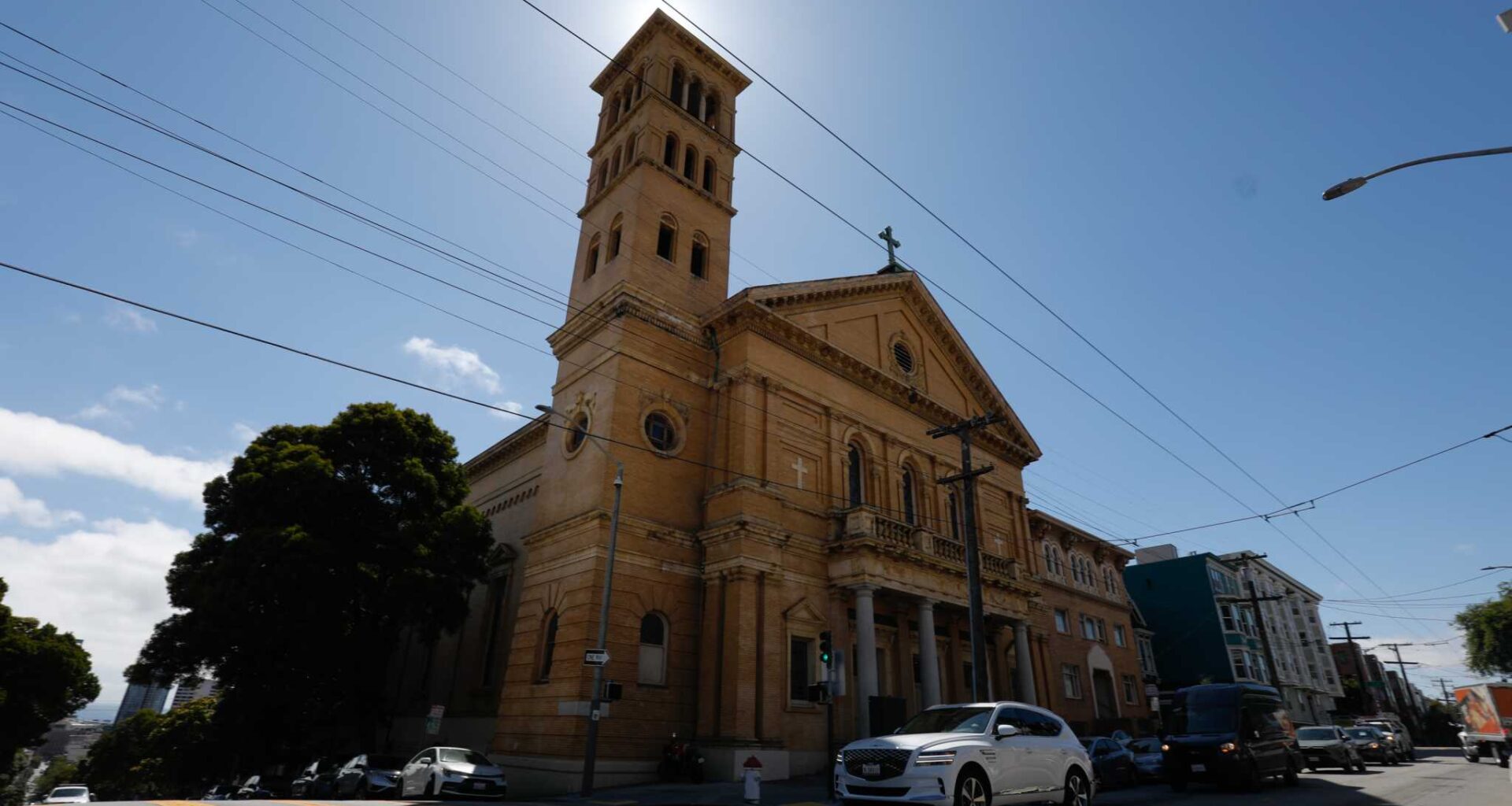
The Sacred Hearts church and home to Church of 8 Wheels at 554 Fillmore St. is one of San Francisco’s appointed landmarks. More could join its company as the city wants to double the list of landmarks.
Lea Suzuki/The Chronicle
San Francisco is going on a historic landmarking spree.
With a slew of new pro-housing state laws giving developers broad powers to get projects approved with with little to no public review process, Supervisor Rafael Mandelman and Mayor Daniel Lurie on Thursday announced a plan to assign an additional seven planners to undertake a citywide survey of historic properties, along with $700,000 to augment contracts with preservation consultants.
The goal would be to double the number of buildings that are either protected landmarks or part of historic districts over the next five years from the current 2,800 to about 5,600, according to the city.
Article continues below this ad
The announcement is facing blowback from pro-housing YIMBY factions who argue that landmarking thousands of new structures will undermine all the state and local laws that make it easier to build housing and to prevent opponents from filing appeals or lawsuits that, for decades, have slowed down and killed new units. Meanwhile, some preservationists questioned Lurie’s commitment to protecting historic assets given his past efforts to delay state approval of a historic district in North Beach.
The building that used to be Compton’s Cafeteria, the site of the Compton’s riots, is a San Francisco landmark.
Gabrielle Lurie/The Chronicle
Mandelman said both residents and developers would benefit from a citywide survey because it will give them a clear sense of which structures can be demolished to make way for housing and which cannot. San Francisco has about 228,000 parcels, so even if the number of landmarked properties is doubled, that would only represent about 2% of city lots. With 70,000 approved units languishing in the pipeline lack of financing, it’s unlikely that clamoring to redevelop many of the landmarked properties.
San Francisco Chronicle Logo
Make us a Preferred Source to get more of our news when you search.
Add Preferred Source
“I think it makes sense to identify landmarks on the front end before a development project comes forward,” Mandelman said. “For a long time people have felt that like a problem with San Francisco’s project approval process has been only assessing things after a project is proposed so there is no certainty for the developer and no certainty for the community about which properties are likely to be preserved and which might be subject to demolition or significant alteration.”
Article continues below this ad
Already the landmarking push has produced results. In 2025 the city approved just one new landmark. Less than halfway through this year, 66 landmark designations are in the works, with 14 set to be approved next week and another 52 in the next few months. The number of new landmarkings is notable considering the city has designated just 321 landmarks in the 50 years since the program began, along with 16 historic districts.
Structures currently in the process of being landmarked include the city’s oldest firehouse on Valencia Street in the Mission, a 1922 Bank of Italy branch at Castro and Market streets, and St. Matthews Lutheran Church on 16th Street.
“A lot of this work is already in flight,” said Planning Department Chief of Staff Dan Sider. “At the end of the day the effort turbocharges our ability to preserve the buildings that matter the most.”
By the end of 2027 the city hopes to complete a historic survey of the districts that were upzoned as part of the recent “Family Zoning Plan”: commercial corridors in districts that have produced little housing in recent decades, districts including the Marina, the Sunset, the Richmond, West Portal, Noe Valley and Fisherman’s Wharf. The goal is to complete a citywide survey by the end of 2028.
St. James Presbyterian Church, which was designed by architect of merit Julia Morgan, is on the San Francisco landmarks list.
Yalonda M. James/The Chronicle
The family zoning plan was an attempt to meet state housing goals by adding the city’s capacity for new housing by 36,000 units, although, so far, it has not resulted in any new projects.
Article continues below this ad
YIMBY Action Executive Director Laura Foote called the focus on historic preservation “baffling.” Rather than “using these state laws as powerful tools to help the city achieve its housing goals,” the city is “playing games and seeking every opportunity to get less housing built,” she said.
“Rents are now the highest they have ever been,” Foote said. “The economy is back and the only focus right now should be making sure we are building sufficient housing so we don’t head right back into the crisis we have been in where every boom in the economy comes with incredible pain for working people as they are pushed out of the city.”
San Francisco Heritage President Woody LaBounty acknowledged that the landmarking drive is, in part, a response to “a lot of new state legislation that bypasses local control for housing production projects.”
“We are left scrambling to figure out when we have special places that are protected and when they are not,” he said. “Part of this is to patch the holes in all the legislation. Right now the best way to protect something is with a landmark designation so we are trying to do everything we can to speed up that process.”
San Francisco Historic Preservation Commission President Diane Matsuda said her board is “extremely happy this is happening.” She said the city has been “stagnant in terms of landmark designations for years and we know there are a lot more out there.”
Article continues below this ad
She said the citywide survey would give planners a chance to thoroughly study neighborhoods from the Bayview to Visitacion Valley to the Portola that have rich social and cultural histories even though they may lack the sort of high-profile architecture or stately mansions and churches that are more typically associated with historic preservation.
“We tend to look at a very tight, very small, very wealthy constituency that had tangible buildings to brag about,” she said. “This will allow us to look at things with a broader lens, to help us acknowledge heritage that hasn’t been highlighted before.”
The former Casa Sanchez building along 24th Street in the Mission District of San Francisco became the first property to receive historical landmark status for its contribution to San Francisco’s Latino community.
Jessica Christian/The Chronicle
Former Supervisor Aaron Peskin, who has been a leading proponent of preservation, expressed skepticism that the landmarking initiative would produce results. He said that he and Mandelman successfully pushed to add preservation planners and money in the past in order to do a citywide survey, but that the results were lackluster at best
“We teamed up years ago to give the planning department tons of extra money to do tons of historic surveys which they pissed away, and we have nothing to show for it,” Peskin said. “It’s an embarrassment.”
Article continues below this ad
He also said Lurie’s track record on preservation has been less than stellar, pointing to the mayor’s request that the state delay designation of a 728-building historic district in North Beach.
“It’s all ironic given the mayor has assured that the long sought, well-documented North Beach historic district has come to a standstill — something that enjoys overwhelming support in every corner of the city,” he said. “We have a historic survey of North Beach that the planning department staff reviewed and approved, that the historic preservation commission reviewed and approved, and that the mayor wrote a letter to the state and said please take this off your agenda.”
In addition to beefing up the staff and budget, the announcement by Lurie and Mandelman includes legislation to streamline the landmark designation process, making it easier and faster to add landmark protection status. It will cut redundant Historic Preservation Commission hearings and simply review, potentially removing months of delays from the process.
Lurie and Mandelman also announced that they had written a letter to the California Office of Historic Preservation, requesting that the state office recognize San Francisco landmarks designated for inclusion in the California Register of Historic Resources. This request is especially reasonable as San Francisco has a rigorous process for evaluating the historic merit for proposed landmarks that is in many ways more stringent than the process for inclusion in the State Register.
Lurie has also faced criticism from preservationists for supporting a mixed-used development at 530 Sansome St, which will include the demolition of a historic coffee warehouse. The project, which will include an office building and new firehouse, required that the warehouse’s landmark status be “removed.”
LaBounty said he raised that project when convincing Lurie to double down on the landmarking program.
“I said, ‘You need to make this a priority because you are the first administration that has had a landmark delisted,’” he said. “I think Mayor Lurie took that to heart. That was helpful to our case that more work and resources had to be put toward preservation.”
Rich Sucre, who heads up preservation for the planning department, said much of the work his team has been doing in recent years has been setting the stage for the aggressive landmarking: historic context statements that “provide a clear understanding of what are the important themes in the history of San Francisco.”
A historic context statement on the African-American community in the city, for example, took 10 years to complete and one on the Latino communities has taken six years.
Lurie said “whether it’s the Painted Ladies or Harvey Milk’s camera store in the Castro, San Francisco’s historic landmarks tell the story of our city.”
“San Francisco doesn’t have to choose between growth and preservation, and as our city evolves, we are protecting what makes San Francisco special and gives our neighborhoods their character,” he said.
Mandelman acknowledged that “historic preservation can be subject to abuse” but said “our “planning department is rigorous and sophisticated in its evaluation of potential landmarks.”
“Most reasonable people believe that San Francisco needs to add a whole lot of housing, that cities do change, but that it’s OK and good to identify particular buildings and collections of buildings that you want to make sure are preserved as they are or adaptively reused,” he said.