
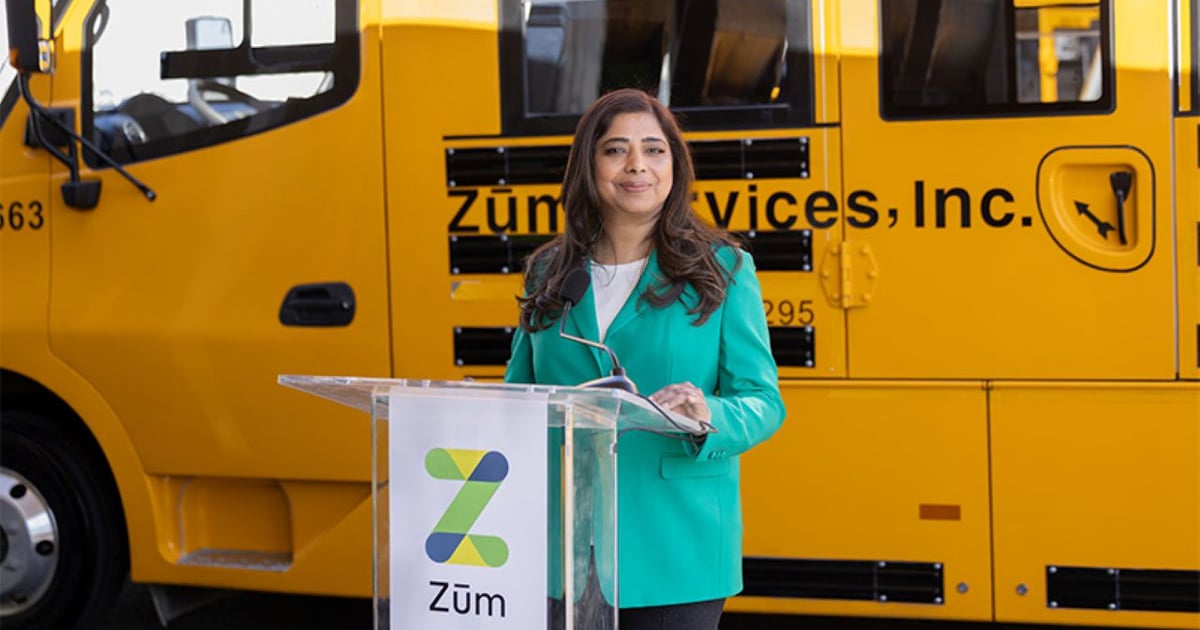
California-headquartered school fleet electrification company Zūm has announced it will deploy a fleet of 104 all-electric buses to San Francisco Unified School District (SFUSD).
The US company will provide the vehicles and charging infrastructure necessary, as well as its Connected Mobility Experience (CMX) solution, which provides routing intelligence and real-time operations visibility into a single system.
The charging infrastructure will have in-built bidirectional charging capability, enabling vehicle-to-grid (V2G) charging. Zūm said this will make it the largest bidirectional electric school bus fleet in the US.
The electric buses will have the combined capacity to provide up to 3GWh of power back to the local electricity grid annually. School buses in the US have been described as “perfectly aligned” with the V2G use case, particularly during school holidays when they are out of use and can stand in as “the perfect stationary batteries”.
Zūm CEO Ritu Narayan said: “This state-of-the-art electric fleet, combined with Zūm’s CMX technology, will improve the mobility experience for students, families, and drivers while strengthening grid reliability and resiliency for the entire community.”
Phase One of the project has been completed with a ground breaking ceremony for the infrastructure, and in August Zūm will deploy 104 ebuses, with plans to increase the size of the fleet up to 238 in the 2027-28 school year.
The student transport company is credited with deploying the first fully electric school bus fleet in the US, in the Oakland Unified School District in California, for the 2024-25 school year. In April, Zūm announced the deployment of a fully electric school bus fleet for Branford Public Schools.
According to Zūm, the US school bus fleet is double the size of all other mass transit in the country combined, including buses, trains and airlines. Other companies have offered to support similar electrification initiatives; at the beginning of this year, Highland Electric Fleets signed on as contractor for several New Jersey schools’ transitions, supported by nearly US$32 million in grants from the New Jersey Department of Environmental Protection.
Elsewhere, Massachusetts saw Zenobē deploy 35 new electric school buses through partnerships with local districts, while the global electric bus fleet continues expanding as municipalities prioritise emission reductions and air quality improvements around schools.