
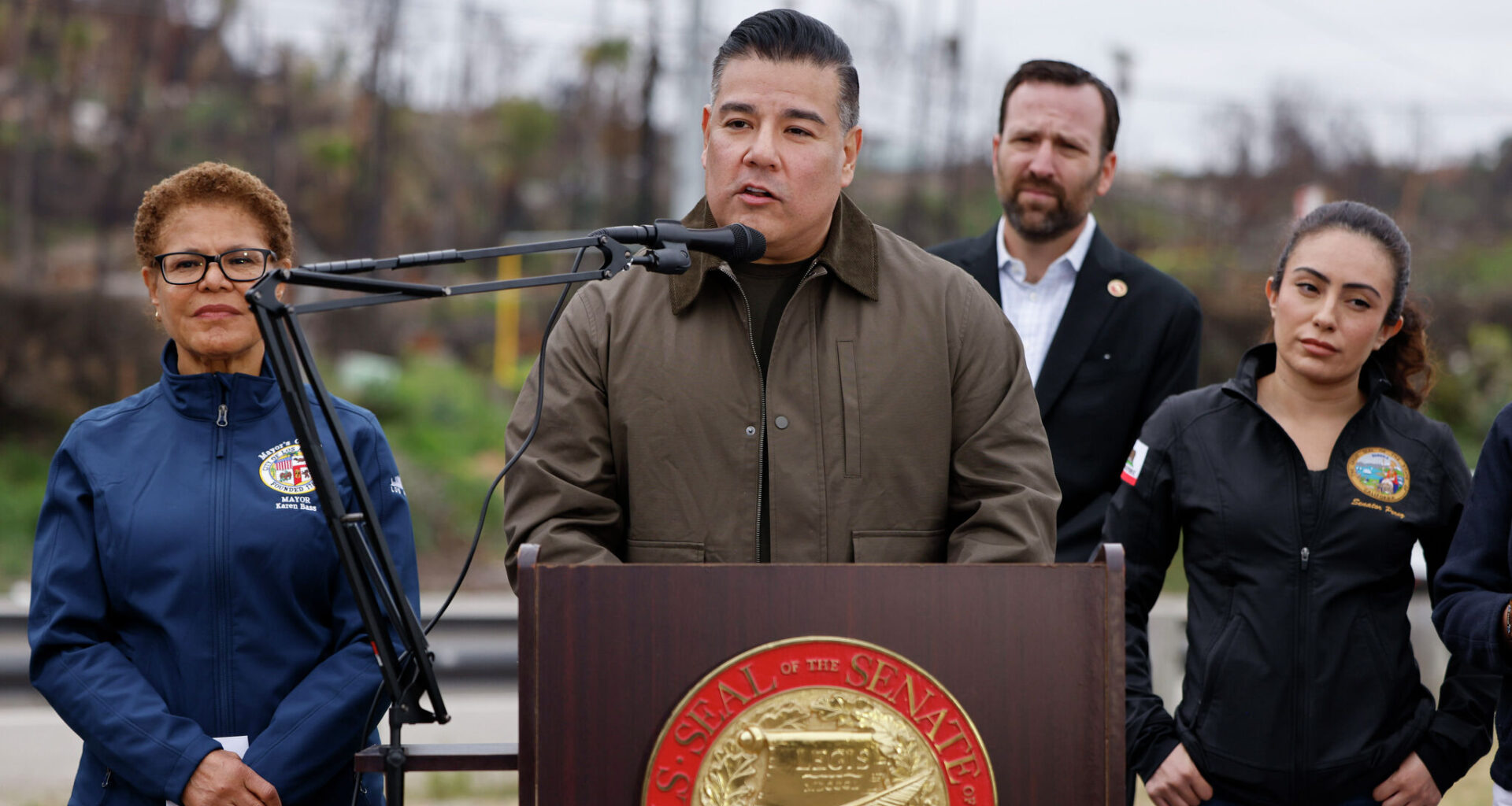
California Insurance Commissioner Ricardo Lara, shown in Los Angeles in April 2025 after the deadly wildfires, will be termed out of the position in January. Some candidates for the job don’t think insurance commissioner should be an elected position.
Los Angeles Times
Every four years, Californians elect an insurance commissioner — one of just a dozen states nationwide to use that method to choose the top insurance regulator.
Some current candidates for the job think the position, charged with safeguarding the health of one of the largest insurance markets in the world, should not be left in the hands of voters.
Article continues below this ad
The insurance commissioner is just one of eight statewide elected positions in California. In non-wildfire years, it runs under the radar in comparison with roles further up the ballot. Traditionally it has been filled by a state legislator who’s hit the term limit or is seeking a change of pace.
This year, a statewide insurance crisis, punctuated by devastating wildfires in Los Angeles County, has attracted a diverse and competitive field of candidates promising to deliver change. For some, that change would be taking the position they’re running for — currently held by Ricardo Lara, who is termed out — off the ballot.
San Francisco Chronicle Logo
Make us a Preferred Source to get more of our news when you search.
Add Preferred Source
Before voters passed a proposition that overhauled insurance regulations in 1988, the insurance commissioner was appointed by the governor. Harvey Rosenfield, the proposition’s author and founder of the advocacy group Consumer Watchdog, said that left the office open to the sway of governors seeking to pay back the industry for campaign contributions.
“The whole point of Prop 103 was to give the insurance commissioner power to protect the public against pillaging by the insurance industry and to make sure that the commissioner was more likely to be disposed to protect voters and consumers, not the insurance companies,” Rosenfield said. “The voters made it an elected person, accountable not to the government, but to them.”
Article continues below this ad
Some fear the opposite — insurance commissioners who could make choices based on political popularity, rather than what would be best for the market.
Over the past 36 years, just five people have been elected for the job. Four came directly from the Legislature; none had direct experience working in the insurance industry. Two others were appointed by the governor to hold the position briefly after their predecessor resigned.
This year’s field of 11 candidates contains two contenders with experience in the Legislature — current state Sen. Ben Allen, a Democrat representing part of the Palisades Fire burn zone, and former fellow Los Angeles County state Sen. Steven Bradford, also a Democrat.
Bradford said he “would strongly suggest that we consider” the idea of having the governor once again appoint the insurance commissioner, though he stopped short of full-throated advocacy.
“I think this should be an appointed position, I really do,” Bradford said. “You have folks afraid to make a decision because they put their fingers up in the political winds saying, ‘How does this affect my next election? How does it affect my office?’”
Article continues below this ad
But both Bradford and Allen touted their experience in Sacramento and their relationships with fellow legislators as a reason they would make for effective commissioners.
The insurance commissioner enjoys broad authority over insurance companies’ rates and regulating their claims practices, but not their underwriting practices. Issues such as how insurance companies use drone imagery to determine insurability or efforts to require insurers to cover wildfire-safe homes require partnerships with the Legislature.
Allen, who has spent the past decade serving in Sacramento, noted there are both advantages and disadvantages to being one of few states to elect their insurance commissioner. But he said coming into the job with experience working in the political process and making good on campaign promises could only be a benefit.
The only other candidate who’s spent time in elected office is Jane Kim, a progressive former San Francisco supervisor who supports continuing to allow voters to choose, due to the importance of public accountability. Kim noted that appointed officials can also be swayed by political demands.
“Now you’re dependent on another elected office, which is the governor,” she said. “There’s really no way to delete political dynamics from this office.”
Article continues below this ad
Stacy Korsgaden, a former insurance broker from San Luis Obispo County, was the only candidate who spoke to the Chronicle and voiced unabashed support for removing the insurance commissioner position from the ballot.
If not, Korsgaden said she would work toward establishing a requirement that candidates for the job possess an active insurance license of at least six months. Fellow candidate Patrick Wolff, a San Francisco financial analyst, obtained a license in preparation for his campaign.
“It has to be someone that knows what they’re doing, that has had experience and knows what the whole ramification is,” Korsgaden said, citing her firsthand experience working with homeowners who have become priced out of their insurance policies due to the crisis.
Wolff echoed the stance that the insurance commissioner position is more technical than it is political, arguing it takes expertise in understanding financial markets. But it’s still possible for such a person to occupy the office even if it’s elected, he said.
“What you need is politics that gets the right people in the right positions. That can be done through appointment, that could be done through election, but it’s not a magic bullet one way or the other,” Wolff said.
Article continues below this ad
What’s not conducive to success, Wolff argued, is a candidate viewing the position simply as a launchpad for higher office. Wolff himself, along with Bradford, have both pledged to not run for any elected position besides insurance commissioner.
But Allen said the stepping stone concept, though oft repeated, is not well founded. Though previous commissioners have gone on to run for governor or other offices, only one — current Rep. John Garamendi, D-Fairfield — has succeeded in holding a higher office.
“It certainly is not a good stepping stone office,” Kim said. “History has not shown it to be one. But I do think that this office is tackling some of the most interesting issues today and could be a powerful ally for working Californians.”