

It seems fitting, at the start of a deep dive on the June 2 primary election for California’s 1st Congressional District, to acknowledge Doug LaMalfa, the House member whose sudden death in January saddened many — including President Donald Trump — while complicating and raising the stakes in the already fraught race to replace him.
Plainspoken and passionate about certain issues — water rights and storage, forest management and wildfire mitigation foremost among them — the Butte County rice farmer had a gift for connecting with colleagues on both sides of the aisle, and a knack for nicknaming them. His former House colleague Karen Bass, now mayor of Los Angeles, was “Bass-O-Matic.” Rep. Vince Fong, R-Bakersfield, was “The Fongressman.” Rep. Russ Fulcher, an Idaho Republican, was “Mr. Potato Head.”
LaMalfa, 65, was also a “car guy” — an avid classic car mechanic known to tinker with, and sometimes change the oil in his vehicles in the garage of the Cannon House Office Building in Washington, D.C.
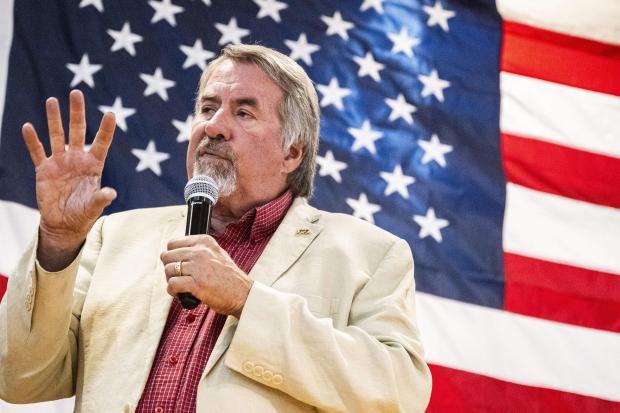 Doug LaMalfa, R- Calif., answers a question during a town hall meeting on Aug. 11, 2025, in Chico, California. (HECTOR AMEZCUA/The Sacramento Bee/TNS)
His death, during emergency surgery after suffering a tear in his aorta, has served to modify, or “soup up” the District 1 race.
Make that “races.”
Up for grabs this year are two different versions of District 1.
The current, existing district, a reliably Republican swathe of rural counties covering 26,000 square miles in northern and northeastern California, had been LaMalfa’s seat since 2013.
Following the November passage of Proposition 50, however, the 1st District was reconfigured into a “Solid Democratic” seat, according to the Cook Political Report. The shift added Santa Rosa as its main population base while subtracting ruby red Shasta, Modoc and Siskiyou counties.
Those new boundaries don’t take effect until the start of 2026.
That means on June 2, voters in the new district, which favors Democrats, will choose between a field of five, including three high-profile candidates — state Sen. Mike McGuire of Healdsburg and Chico educator Audrey Denney, both Democrats, and Assembly member James Gallagher, a Sutter County Republican — to decide who makes it through to the November runoff.
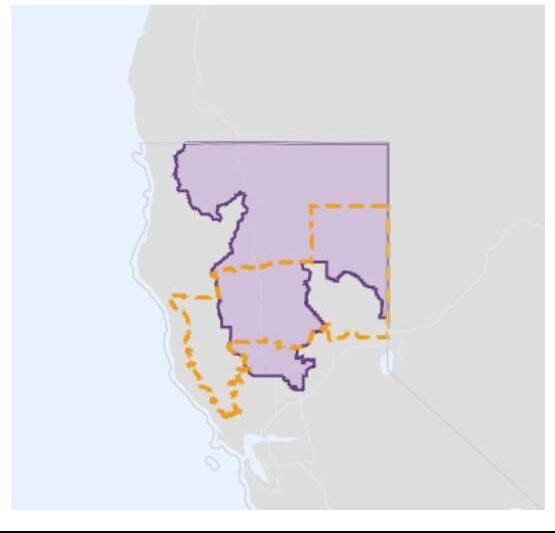 The purple section above shows the current 1st Congressional District in Northern California, vacated upon the January 2026 death of Republican Rep. Doug LaMalfa. The gold dotted lines show the redrawn 1st District, approved by the California Legislature after passage of Prop. 50 in November 2025. It will include all of Democratic-leaning Santa Rosa. The redrawn district will be 41% Democrat, 31% Republican and 27% ‘no party preference’ according to redistricting effort documents obtained by The Press Democrat, making it one of five districts Democrats hope to turn blue in 2026. (Map courtesy CalMatters)
Meanwhile, voters in the existing, Republican-friendly 1st District will cast ballots featuring the same three frontrunners to choose who serves out the remaining months of LaMalfa’s term a race that could have immediate, national implications.
Hoping to win outright
The favorite in the race for the interim seat is Gallagher, a Yuba City lawyer and LaMalfa protegee whose many conservative endorsements include one from Trump, a trophy his Democratic opponents are intent on using as a cudgel against him.
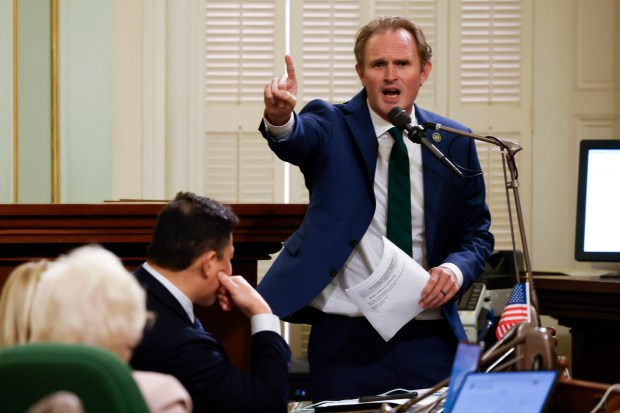 Republican Assembly member James Gallagher — here shown in the Capitol on August 21, 2025 — has announced he will run for the U.S. House seat formerly held by Doug LaMalfa. (Photo by Justin Sullivan/Getty Images)
In that contest, should Gallagher get more than 50% of the vote on June 2, he will proceed directly to Congress – where he would be warmly welcomed and swiftly seated by House Speaker Mike Johnson, whose current 217-212 margin leaves scant room for error.
If no candidate gets more than half the votes, the top two will proceed to a runoff scheduled for Aug. 4 – the last day possible, chosen by Gov. Gavin Newsom to deprive Johnson of that seat, should Gallagher prevail, for as long as legally possible.
Residents living in the post-Prop. 50 District 1 — the safely blue one stretching north from Santa Rosa into Mendocino County and east across Lake County and the Sacramento Valley, to the Nevada border — will cast their votes for a congressperson to serve a full, two-year term. The top two finishers will proceed to the November runoff.
The favorite in that contest is McGuire, the erstwhile political wunderkind from Healdsburg who went on to serve as president of the state Senate, from February 2024 to November 2025, and who, as it happens, did much of the heavy lifting to get Prop. 50 on last year’s ballot in a compressed time frame.
 California State Senator Mike McGuire is photographed for a headshot. (Jackson Boaz/Contributed)
In Denney, a Butte County nonprofit leader, he faces a rival progressive Democrat. Like Gallagher, she enjoys strong name recognition in the existing district, where she’s already run twice for Congress. In 2018, she lost to LaMalfa by less than 10 points in a district Trump carried by 20. Two years later, she lost to him by 14.
Endorsed early in her campaign by Emily’s List, she has proudly reminded voters of her refusal to accept corporate PAC money.
Speaking to an enthusiastic crowd in Old Courthouse Square in January, she said, “You cannot change the systems of exploitation if you are funded by them.”
That was a swipe at McGuire, subject of a Jan. 12 Sacramento Bee story detailing how the former Senate president had taken $40,000 from his Progress for California committee — devoted, ostensibly, to supporting ballot measures — and spent it on a 2024 Super Bowl trip in Las Vegas.
 Audrey Denney, a candidate for U.S. House California District 1, talks with voters during the Wednesday Night Market May 20, 2026 in Santa Rosa’s Old Courthouse Square. (John Burgess/The Press Democrat)
That trip, McGuire later told The Press Democrat, was for a fundraiser that brought in “hundreds of thousands” to “advance progressive causes” and elect Democrats in every corner of California and flip seats red to blue. And I’m proud of it.”
At an April candidate forum hosted by the grassroots political group Indivisible Sonoma County and attended by Denney and McGuire, along with Rep. Mike Thompson, D-St. Helena, and his 4th District opponent, Eric Jones, she was the only panel member to directly answer the question: Is Israel committing genocide in Gaza?
Yes, Denney said.
She was also the only candidate willing to say that Democrats need a better leader than Hakeem Jefferies, the New York congressman now serving as House Minority Leader.
Asked why she thought McGuire got into the special election, where his odds are underwhelming at best, she said there are two possible reasons.
“One of them was to make his double-max donors” — those who contribute the maximum amount allowed in a candidate’s primary and general election campaigns – “double-max again.”
The other reason, she said, “Was to make sure I didn’t win” — dividing the Democratic vote and thus depriving Denney of any momentum she might then carry, either as the incumbent or party’s standard bearer in the August special election, into November’s runoff.
“They are concerned about Audrey Denney,” David McCuan, Sonoma State political science professor, said of McGuire’s campaign. “And they didn’t want her to get a leg up.”
“Establishment” candidates should be “scared s—less,” said Denney, who believes that a wide bloc of new youth and women voters, outraged by Trump, will turn out and cast ballots for progressives like her.
Asked Wednesday why he entered the “special,” despite his underdog status, McGuire did not answer directly. He spoke of the 40-plus town halls his campaign has hosted, “in small and large communities all throughout Northern California.”
Taking a pass on the special election, he implied, would go against the grain of his work ethic.
“It’s about hitting the streets, and burning the shoe leather. I won’t be outworked,” he said.
Asked how he was being received on LaMalfa’s old turf, he replied, “There’s more that unites us than divides us.
“No matter if you are a Democrat in Santa Rosa or a Republican in Susanville, you want to send your kid to a good public school. You want to keep your local hospital open. You want to afford a home in the community that you love. You want to have a more wildfire-safe hometown.
“That’s what I delivered in the state Legislature, and that’s what the vast majority of Northern Californians want.”
Dismissing the notion that he only sought to bigfoot Denney, McGuire said, “We are fighting tooth and nail, neighborhood by neighborhood, to win this seat” — the only seat in the country, he noted, that could be flipped red-to-blue “prior to the end of the year.”
‘Mike is not going to flip the 1st’
Gallagher was quick to dump cold water on that dream.
“I can say pretty confidently that Mike is not going to flip the 1st” District, he said — “at least not the existing 1st, the 1st that wasn’t rigged by Prop. 50.”
The former Sutter County supervisor welcomed McGuire’s entry in the race, he said, “because I wanted to have this debate about the issues.
“If you’re proposing to represent these people, they need to know what your positions are, and how you’ve operated, especially if you were part of the effort to deprive them of their ability to elect someone of their choice” — a reference to McGuire’s reported role in the the legislative maneuvering that reshaped District 1 and other red districts statewide to favor Democrats.
“The biggest contrast” between him and McGuire, said Gallagher, is that “Mike has supported essentially every policy that’s raised our electricity prices, that’s raised our gas prices, and I was the no-vote on those policies.”
Gallagher was referring to the suite of climate friendly policies and clean energy mandates that are anathema to today’s Republican Party, but were originally spearheaded in California by then-Gov. Arnold Schwarzenegger — one of last two GOP officials 20 years ago to win statewide office, and now an ardent Trump critic.
Without acknowledging his support for those initiatives and legislative packages, or Gallagher’s claim they resulted in higher electricity rates, McGuire responded to that line of attack by pointing to legislation he helped pass last year, part of a sweeping climate and energy package that will fund up to $60 billion in utility bill refunds and ratepayer relief.
He then pivoted to the subject of Trump’s tariffs, which, he said, have increased the cost of living for the average family in California by $2,400.
“Fertilizer is up 100%. Cars are up 15%. Coffee is up 10%.” Because of the war in Iran, he said, “Gas is up a buck-fifty.”
Most of the costs of those tariffs — “a policy choice by Donald Trump and the MAGA Congress enabling this fascist president,” McGuire said — end up being passed on “to all of us, small businesses and working families.”
Pointing to deep Republican cuts to Obamacare subsidies and Medicaid, he said, “Donald Trump and James Gallagher supported that.”
Not in lockstep with GOP
On that topic, Gallagher put some distance between himself and Trump, saying the sweeping cuts to California’s Medicaid program in last year’s HR 1, Republicans’ so-called “Big Beautiful Bill,” were “too severe, and I think we do need to restore those cuts, because they do hurt. They hurt our local hospitals.”
Gallagher also believes the government “should continue to cover Obamacare plans. And I think we can find a way to do that.”
At the same time, he said, “we have to make some reforms, because fraud is rampant in Medicaid, and i think everyone should want to make sure that money gets to the right place, and not to fraudsters.”
Recalling his undergraduate years at UC Berkeley, Gallagher said he’s always been able to work productively with those of opposing viewpoints.
He worked across party lines with Assembly member Buffy Wicks, D-Oakland, on reforming the California Environmental Quality Act, “to streamline the process of building more housing.”
More recently, he and Assembly member Jesse Gabriel, D-Encino, co-authored a bill that bans ultra-processed foods from school lunch programs.
He has collaborated with Democrats “many times over the years,” said Gallagher, who described himself as politician not in lockstep with his party’s leaders in the nation’s capital.
“Certainly I believe in the values of my party, and think that our philosophy on government is the better way.
“But I’ve always done what I think is the right thing for my district, and my constituents.
“I’m my own man.”
Begging to differ is McGuire, who refers to his opponent as “lapdog” who “won’t hold this fascist administration accountable.”
What’s needed, he continued, “are bold leaders who know how to fight, and how to win. And that’s what I’ve done in the state Senate.”
Still, while McGuire has been favored to win the open seat for the new District 1 since he announced last November, Gallagher likes his own chances in the special election.
Citing strong momentum, he said, “I feel very confident that on June 2nd, we’re not going to a run-off.”
Come to think of it, he added, “Mike may very well not even come in second.”
That, for McGuire, would be a first.
You can reach Staff Writer Austin Murphy at austin.murphy@pressdemocrat.com.