
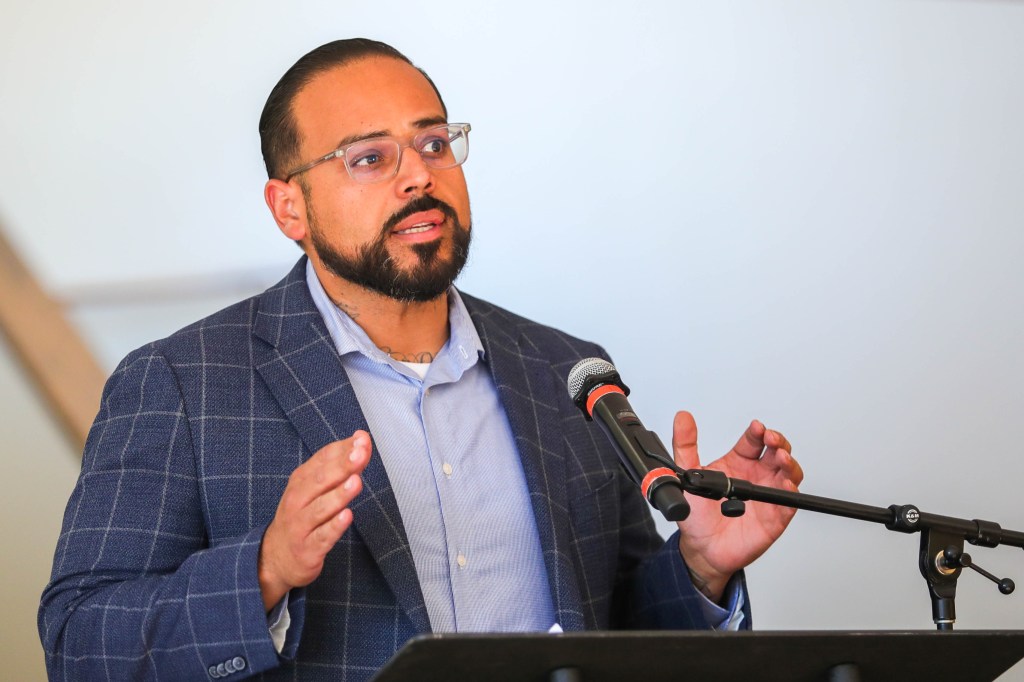
Ahead of the June primary election, the Bay Area News Group compiled a list of questions to pose to the candidates for San Jose City Council District 5. You can find the full questionnaire below. Questionnaires may have been edited for spelling, grammar, length and clarity.
To read our endorsements for other important Bay Area races click here.
Name: Peter Ortiz
Current job title: San Jose City Councilmember for District 5
Date of birth: October 10, 1989
Other political positions held: Mt. Pleasant School Board. Santa Clara County Board of Education – Trustee Area 6. San Jose City Council – District 5
District where you reside: East Hills Lyndale area
If you’ve held elective office before, how has your work directly improved the quality of your constituents’ lives?
In my time in office, I’ve focused on delivering tangible improvements that residents can feel in their daily lives, especially around public safety, affordability, and neighborhood quality.
On public safety, I supported efforts to hire more police officers, improve emergency response, and invest in infrastructure like better street lighting in neighborhoods impacted by crime. I also backed the installation of Automated License Plate Readers (ALPRs) to help deter and solve crimes, contributing to San José maintaining its reputation as one of the safest large cities in the country.
I’ve worked to expand access to essential services by supporting increased library hours and resources, ensuring families, students, and seniors have greater access to safe and enriching community spaces.
For our local economy, I’ve helped support struggling small businesses through targeted investments, corridor improvements, and initiatives that bring more foot traffic and activity to our neighborhoods.
Affordability has also been a key priority. I’ve advocated for anti-displacement strategies to help renters stay in their homes and supported policies that protect working families from rising costs.
Finally, I’ve pushed for increased beautification efforts across District 5, addressing illegal dumping, graffiti, and blight so that residents can take pride in cleaner, safer neighborhoods.
Together, these efforts reflect my commitment to improving quality of life in ways that are visible, meaningful, and rooted in what our community has asked for.
What are the top three problems you’re seeking to solve if elected to represent this district?
I’m committed to delivering safer and cleaner neighborhoods, lowering the cost of living, and expanding economic opportunity so every family in our community can succeed and stay here.
Why are you uniquely qualified to address the three problems you’ve identified above?
I bring a combination of lived experience, community leadership, and a proven track record of delivering results in District 5. As someone who grew up in East San José, I understand firsthand the challenges families face, from housing affordability to public safety and access to opportunity. That lived experience shapes how I lead and ensures that the solutions I fight for are grounded in the real needs of our community.
In my current role, I’ve worked closely with residents, small businesses, and city departments to move beyond conversation and deliver results. My background in public service has focused on practical, people centered solutions that improve quality of life while addressing root causes.
That includes advancing public safety efforts by co-authoring policies to address catalytic converter theft, supporting stronger enforcement tools for chronic problem properties, and taking action to prevent the overconcentration of liquor stores in high-risk areas. I’ve also introduced legislation to regulate smoke shops engaging in illegal activity and supported efforts to improve neighborhood cleanliness through targeted beautification and cleanup initiatives across District 5.
What sets me apart is not just understanding the problems, but having already taken action to solve them. I’ve built strong working relationships across labor, community organizations, and city leadership to get things done.
I’m ready to continue that work with urgency and focus, because our community deserves leadership that delivers real results, not just promises.
How do this district’s challenges differ, in degree or kind, from the rest of the city’s, if at all?
District 5 faces many of the same challenges as the rest of San José: housing affordability, homelessness, and public safety, but often at a greater intensity and with deeper historical context. East San José has experienced decades of underinvestment tied to redlining and inequitable planning decisions, which continue to shape outcomes for our residents today.
Our district is one of the most diverse and densely populated in the city, with a higher proportion of working class and immigrant families who are disproportionately impacted by rising costs and economic instability. Many households are navigating multiple barriers at once, including language access, limited access to services, and fewer economic opportunities.
Because of this, solutions that may work in other parts of the city often need to be adapted to meet the unique needs of our community. Addressing these challenges requires intentional, place-based investment and a community-informed approach that prioritizes equity, cultural competency, and accessibility.
Ultimately, the difference is not just in the type of challenges we face, but in the scale and urgency. District 5 requires focused attention and sustained investment to ensure that no family is left behind.
What differentiates you from your most serious competitors for this seat?
What sets me apart is both my deep connection to District 5 and a proven record of delivering results. I’m not new to this work; I’ve been on the ground, showing up in our neighborhoods, listening to residents, and turning their concerns into real action at City Hall.
I’ve built strong, trusted relationships across the district, with community organizations, small business owners, labor partners, and neighborhood leaders, and I’ve demonstrated the ability to bring those voices together to get things done. Whether it’s advancing public safety solutions, supporting our small business corridors, or securing investments for East San José, my work is rooted in collaboration and follow-through.
Voters often hear about what candidates hope to do. What differentiates me is that I’ve already been doing the work and delivering results. I understand the challenges our community faces because I’ve lived them, and I bring both urgency and experience to addressing them.
What committee or board would you most like to lead, if given the opportunity? And how would that position serve your constituents?
I would be most interested in serving in a leadership role on the VTA Board, because transportation is one of the most critical issues impacting East San José residents every day.
Our community has some of the highest transit ridership in Santa Clara County, yet historically we have faced disproportionate challenges when it comes to infrastructure impacts, service reliability, and project implementation, particularly with major efforts like the Alum Rock-Santa Clara Bus Rapid Transit (BRT) project and the Eastridge to BART Regional Connector Project (EBRC). Too often, East Side residents and small businesses bear the burden of construction and disruption without seeing timely support or benefits. Even as a non-member, I’ve been actively engaged in advocating for our community, pushing for stronger mitigation for small businesses, better communication with residents, and a more balanced approach that considers both the importance of transportation and resident needs.
As a board member, I would work to ensure that East San José is not just included, but prioritized in transportation planning and investment. That means improving service reliability, accelerating project delivery, and ensuring that infrastructure investments support, not harm, our local businesses and neighborhoods.
Ultimately, this role would allow me to better advocate for a transportation system that is equitable, reliable, and truly serves the working families who depend on it every day.
San Jose is now close to finalizing its third four-year review of its Envision 2040 General Plan, the details of which will shape the city’s future development path. What priorities would you like to see in this revised general plan?
As San José finalizes its third four-year review of the Envision 2040 General Plan, it’s critical that we center equity, stability, and opportunity in how our city grows.
First, equitable development must remain a priority; ensuring we are advancing all levels of affordability throughout our priority planning areas so that growth benefits residents at every income level.
Second, we need stronger small business protections. If we are going to streamline development, we must also ensure we are supporting, not replacing, existing small businesses along our major corridors that have long served our communities.
Third, labor standards must be part of this growth. New development should create quality jobs, and we should require strong labor standards, including union labor, for projects in areas eligible for increased development.
Finally, we must prioritize anti-displacement protections. As we plan for growth, we cannot support policies that push out the very families who have built these communities. Protections for tenants and existing residents must be central to any development strategy.
Growth must be intentional, inclusive, and rooted in community stability.
What solutions do you support to reduce housing costs in San Jose? How are they any different than ones that have already been tried?
To reduce housing costs in San José, I support a focused strategy that increases supply at all income levels while making it faster and more predictable to build. That includes streamlining permitting and approvals, expanding by right zoning near transit and job centers, and accelerating office to residential conversions downtown. I would prioritize partnerships that deliver mixed income and workforce housing, including using public land more effectively and leveraging state and federal funding, while also supporting accessory dwelling units and missing middle housing in existing neighborhoods. Where this approach differs is in execution and accountability. We have talked for years about building more housing, but projects still take too long, cost too much, and face uncertainty at every step. I would focus on clear timelines, standardized processes, and measurable outcomes so housing actually gets built, while balancing growth with infrastructure and community needs to ensure long term affordability.
San Jose has placed a 2% hotel tax increase on the June ballot. Do you support that tax? Why or why not?
Yes, I support the proposed hotel tax increase because it allows the City to generate needed revenue without placing additional financial burden on our residents or small businesses.
San José families are already facing a high cost of living, and small businesses are still recovering from economic challenges. The Transient Occupancy Tax is primarily paid by visitors traveling to our city for business or leisure, making it a more equitable way to raise revenue for essential services.
This approach helps ensure we can continue investing in public safety, neighborhood services, and infrastructure improvements while protecting local residents and business owners from new taxes.
Ultimately, this measure is about balancing our city’s financial needs with fairness, and I believe this is a responsible way to do that.
Why should renters in your district vote for you?
Renters in District 5 should vote for me because I not only understand their reality, I live it. As one of the few renters on the City Council, I bring a perspective that is often missing in decision-making, and I know firsthand the challenges of rising rents, housing instability, and the fear of displacement.
In my first term, I’ve supported anti-displacement efforts and policies that protect tenants from unfair practices, while pushing for more affordable housing so working families can stay in the communities they call home.
I’m committed to continuing that work by strengthening tenant protections, expanding access to affordable housing, and making sure renters have a real voice at City Hall.
This is about stability, dignity, and fairness. Renters deserve someone who truly understands their experience and will fight every day to keep them housed, and that’s exactly what I will continue to do.
Is PG&E serving San Jose residents well? If not, explain what actions you would take to lower energy costs for San Jose ratepayers.
Many San José residents are feeling the strain of rising energy costs, and it’s clear that more needs to be done to ensure affordability, reliability, and transparency. While PG&E plays a critical role in delivering essential services, ratepayers deserve better accountability and cost control.
In my role, I have supported efforts to improve and modernize our electrical infrastructure, including advancing implementation agreements with PG&E to bring needed investments to East San José. These projects are important for long-term reliability and to support economic growth in underserved communities.
At the same time, we must be more proactive in advocating for residents. I would continue to push for stronger oversight at the state level, where utility rates are set, and work with regional partners to hold PG&E accountable for cost increases. I also support exploring alternative energy solutions, including local clean energy programs and community-based options that can provide more affordable and sustainable choices for ratepayers.
Ultimately, my focus is on ensuring that working families in San José, especially in District 5, are not disproportionately burdened by rising energy costs, while still investing in the infrastructure needed for a reliable and resilient energy system.
What actions do you support to tackle homelessness? How are your policy prescriptions different than what’s already been done?
I support a comprehensive approach that accelerates the production of housing at all levels, including emergency interim shelter, affordable housing, market-rate housing, and permanent supportive housing. We cannot address homelessness without significantly increasing supply across the board.
What sets my approach apart is a focus on accountability and results. I introduced and passed a policy to increase transparency around outcomes for nonprofit service providers working with the unhoused. This ensures the City can shift funding away from programs that are not delivering results and reinvest in those that are actually helping people transition out of homelessness.
Why should your district’s commuters vote for you?
Commuters in District 5 deserve safe, reliable, and accessible transportation that reflects the realities of their daily lives, and I’ve made that a priority.
I supported the $437 million light rail extension from Alum Rock to Eastridge, a long-overdue investment that will significantly improve transit access for our community.
I’ve also played a leadership role on the VTA Eastridge to BART Regional Connector Project, serving as Chair of the committee, where I’ve pushed for transparency, accountability, and real results throughout the process.
At the same time, I’ve worked to elevate the voices of District 5 residents, advocating for safer mobility options and ensuring that infrastructure projects reflect community needs. I’ve also fought to protect small businesses along construction corridors like Capitol Expressway by securing support and resources during periods of disruption.
My approach is simple: improve transit, protect our local economy, and make sure transportation investments actually serve the people who rely on them every day.
San Jose is facing a $56 million budget shortfall. With property and sales tax revenue growth slowing and labor costs rising, how should the city balance its budget? What specific programs or services would you cut? What contracts, if any, would you renegotiate?
San José should close its $56 million budget gap through disciplined cost control and reprioritization rather than broad cuts to core neighborhood services. As a moderate progressive, I would protect essential services like libraries, parks, public safety, and youth and homelessness prevention programs, while targeting savings in areas with lower direct impact on residents.
That means freezing or delaying nonessential program expansions, eliminating duplicative pilots and consultant-heavy projects, and sweeping long-vacant administrative positions. I would also reduce overtime costs through better scheduling and operational changes rather than cutting frontline staff. On the contract side, I would aggressively renegotiate homeless shelter operations to lower per-bed costs while maintaining capacity, rebid citywide service contracts like janitorial and facilities management, and pursue stronger cost-sharing with the county for health-related services. I would avoid reopening base wage agreements immediately but push for efficiencies in overtime and work rules. Finally, I would use limited one-time reserves only as a short-term bridge while implementing ongoing structural fixes, ensuring the city remains fiscally responsible without undermining the services residents rely on.
San Jose PD spent more than $71 million in overtime last year. This year, it is on track to surpass its personnel services budget once again. What financial cuts or reforms will you demand of SJPD, if any?
Fiscal responsibility and public safety must go hand in hand. While SJPD provides an essential service, we must ensure resources are being used efficiently and transparently. That includes reviewing overtime spending, improving staffing strategies, and identifying opportunities to reduce unnecessary costs without compromising safety.
At the same time, we must continue investing in prevention and targeted policy solutions that reduce crime before it happens. In District 5, we’ve demonstrated that approach by advancing policies to crack down on catalytic converter theft, limiting the overconcentration of liquor stores in vulnerable neighborhoods, and regulating smoke shops engaged in illegal activity. These efforts not only improve safety but can reduce long-term strain on police resources
San Jose PD has an exceptional record closing murder cases, and the city has a low violent crime rate relative to many other big U.S. cities. But in what ways could SJPD better serve your district?
SJPD plays a critical role in keeping our communities safe, and while the department has strong outcomes in key areas, there is always room to improve how it serves District 5. That starts with continued investment in community policing, faster response times, and stronger partnerships with residents and local organizations.
Improving public safety in East San José has been a top priority for my office. We’ve taken concrete steps to address the root causes of crime and improve neighborhood safety. I co-authored a policy establishing some of the strongest consequences in the state for catalytic converter theft, helping deter a crime that has deeply impacted our residents. We also prevented the expansion of problematic liquor stores near schools and gang-impacted neighborhoods, recognizing the link between over concentration and public safety concerns.
In addition, I introduced legislation to better regulate smoke shops and hold accountable those engaged in the illegal sale of cannabis to minors—an issue that disproportionately affects District 5, which has a higher concentration of these businesses than anywhere else in the county.
Moving forward, I will continue to support strategies that combine enforcement with prevention—ensuring that public safety efforts are both effective and community-centered.
Explain your position on San Jose’s policy to cite and arrest homeless residents who repeatedly refuse shelter.
I do not support policies that rely on arresting homeless individuals as a primary response to homelessness. I voted against the “Responsibility to Shelter” policy because I believe it is neither feasible nor effective.
Declining shelter is often not an act of defiance—it is frequently tied to trauma, mental health challenges, or concerns about safety and conditions within shelters. Criminalizing individuals under these circumstances does not address the root causes of homelessness and can further destabilize people who are already vulnerable.
I am also concerned about the strain this approach places on an already understaffed police department, as well as the risk of diverting resources away from long-term solutions like permanent affordable housing.
That said, public safety matters. I support balanced approaches, including reasonable restrictions such as limiting encampments near schools to protect students and neighborhoods.
We need solutions that prioritize housing, services, and prevention—not enforcement-first policies.
Explain your position on San Jose’s use of Flock license plate cameras.
I support the use of license plate reader technology as a tool to help law enforcement solve crimes and keep our communities safe. However, I have serious concerns about the city’s current vendor, Flock Safety, particularly around how sensitive data is handled.
My position has been clear: the issue is not the technology itself, but whether we are using it responsibly and with the right partners. That’s why I pushed for the city to explore alternative vendors and strengthen safeguards around data use, access, and privacy.
We must ensure this technology includes strong oversight, transparency, and protections for civil liberties. Public safety is critical—but so is maintaining the trust of our community. If we cannot guarantee both, then we must be willing to reevaluate how this technology is implemented.
Should San Jose have more data centers than those already approved? Why or why not?
I believe any additional data centers in San José should be evaluated on a case-by-case basis, with a strong focus on community benefit; especially quality job creation and local economic impact.
If a project brings real, accessible jobs for local residents, supports workforce development, and contributes to our local economy, then it’s worth serious consideration. But those benefits must be clear, measurable, and directly tied to our community.
At the same time, we need to fully understand the impacts on infrastructure, energy use, and ratepayers. Any project should be required to invest back into the community, whether through infrastructure improvements or local hiring commitments.
Ultimately, I support data centers only when they deliver meaningful economic opportunity for our residents while being responsible in how they impact our city.
San Jose office vacancy rate remains stubbornly high post-pandemic. In downtown, offices sit empty and countless retail storefronts are boarded up. What policies do you support to revitalize the city’s downtown core?
To revitalize downtown San José, I support a pragmatic mixed-use strategy that focuses on bringing people, not just offices, back into the core. That means accelerating office-to-housing conversions for underutilized buildings and streamlining permitting to make adaptive reuse faster and financially viable. I would pair that with targeted incentives for small businesses and local retailers to fill vacant storefronts, while prioritizing ground-floor uses like restaurants, arts, and entertainment that create consistent foot traffic. Public safety and cleanliness must be visibly improved through outreach, maintenance, and community policing so residents and visitors feel comfortable downtown. I also support investing in events, cultural programming, and partnerships with San José State and local employers to draw students, workers, and families into the area. Finally, I would focus economic development dollars on projects with clear near-term impact, such as housing, nightlife, and walkability, so downtown becomes a vibrant neighborhood rather than just a traditional office district.
San Jose is attracting a fraction of Bay Area venture capital. And the city, relative to San Francisco, is weak in attracting seed- and early-stage startups, per overwhelming VC data reports. What should San Jose be doing to attract more tech, if anything at all?
San José should take a focused, realistic approach to attracting more early stage tech by building on its strengths rather than trying to replicate San Francisco. I would prioritize creating a strong startup ecosystem anchored around San José State, local talent, and existing tech companies by supporting incubators, university partnerships, and pathways from research to commercialization. The city should streamline permitting and reduce barriers for startups, especially for flexible office, lab, and maker spaces, while encouraging more affordable and adaptable workspaces downtown. I would also support targeted incentives tied to clear outcomes like local hiring or staying in San José, rather than broad subsidies. Just as important is improving the quality of the place by investing in housing, transit, and a vibrant downtown so founders and employees want to live and build here. Finally, the city should actively engage with venture capital firms and regional partners to better connect San José startups to funding networks, recognizing that success comes from strengthening the ecosystem, not chasing headlines.
Have you been convicted of any felonies? If so, when and of what?
No.
Are you a plaintiff or a defendant in any current civil litigation? Please explain, if yes.
No.
What do the biggest contributors to your campaign expect from you?
Nothing beyond strong, principled leadership. I’ve been clear from the beginning that any support for my campaign is rooted in a shared belief in my vision for a stronger District 5, not an expectation of influence or special consideration.
My responsibility is to the residents of District 5, and every decision I make is guided by what is in the best interest of our community. I maintain a strict commitment to transparency, accountability, and ethical leadership, and I do not allow contributions to influence my policy positions.
What more should we know about you that might inform our board’s judgment of your capacity to serve this district’s constituents?
One of my greatest strengths is my humility and willingness to keep learning. I understand that I don’t have all the answers, and I believe strong leadership means listening, growing, and surrounding yourself with people who bring different perspectives and expertise.
Throughout my career, I’ve sought out mentorship from leaders who have a proven track record of bringing people together and delivering real results. That has helped shape my approach to leadership, one that prioritizes collaboration over ideology and focuses on outcomes for our community.
I’m also someone who reflects, learns from mistakes, and continuously works to improve. That mindset has allowed me to grow as a leader and better serve District 5.
I am committed to bridging divide, especially between business and labor, because the challenges facing our city are too complex for rigid thinking or division. Real progress requires trust, partnership, and a shared focus on results.
At the end of the day, I lead with humility, accountability, and a deep commitment to the people I serve.