
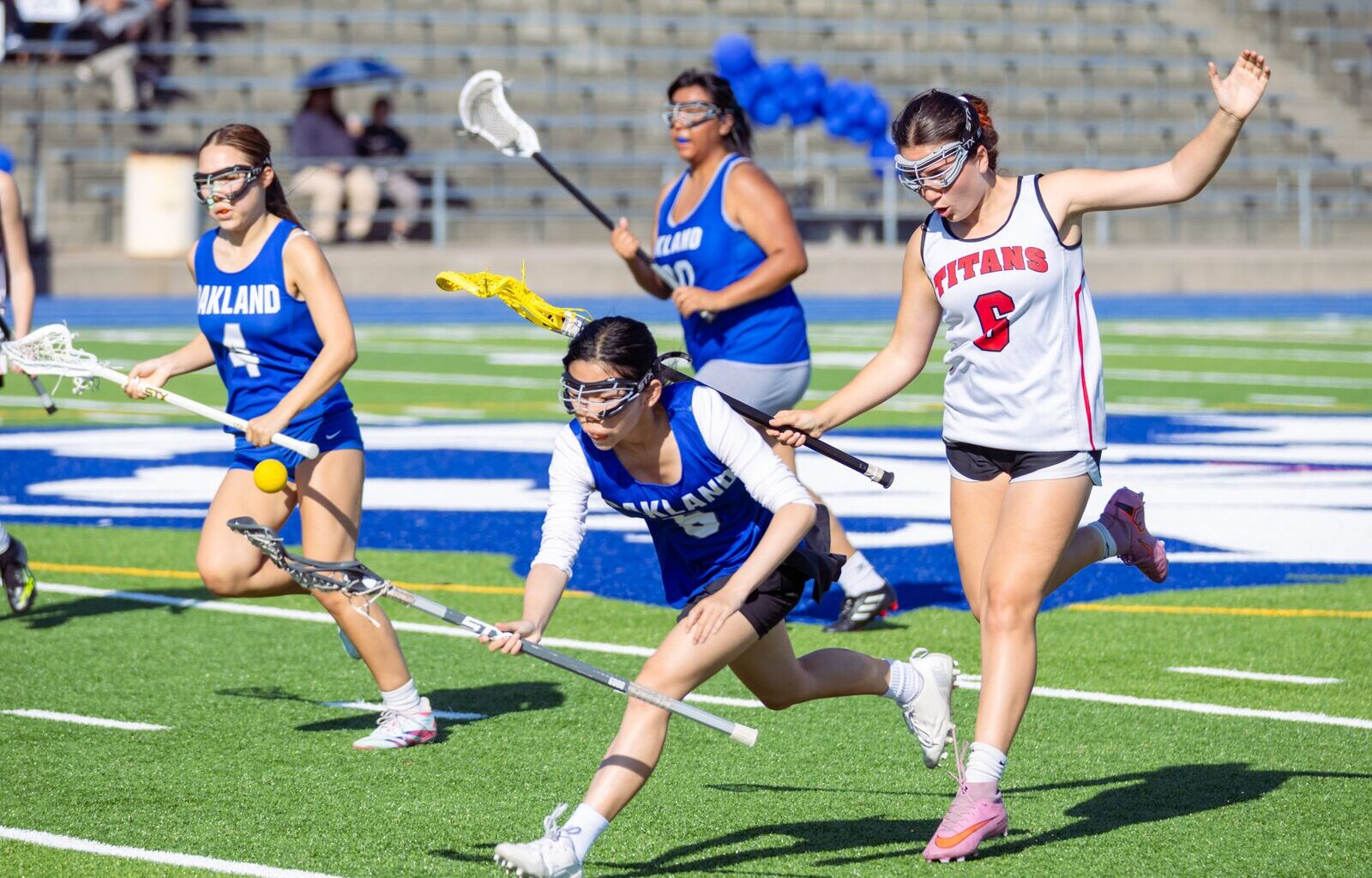
In 2023, the Oakland Tech girls’ basketball team celebrated their third consecutive state championship. The following year, the Oakland High girls’ basketball team took home the state basketball trophy. And this year, Oakland Tech wrestler Shayna Ward won Oakland’s first girls wrestling state championship.
It’s hard to imagine that just eight years ago, Oakland’s public schools were being accused of gender discrimination.
It all started in 2018, when, to help solve a $30 million deficit, the district reduced the budget of the Oakland Athletic League by $500,000 by shutting down 10 high school sports: bowling, wrestling, swimming, girls golf, girls tennis, boys tennis, boys golf, girls lacrosse, girls badminton, and boys volleyball.
The belt-tightening was tough all around, but it turned out the cuts disproportionately affected girl athletes: 347 girls lost their school sport compared to 183 boys. Students found out shortly after they returned from summer break, and a backlash ensued. The father of one Oakland Technical High School student called it “a complete and utter tragedy.”
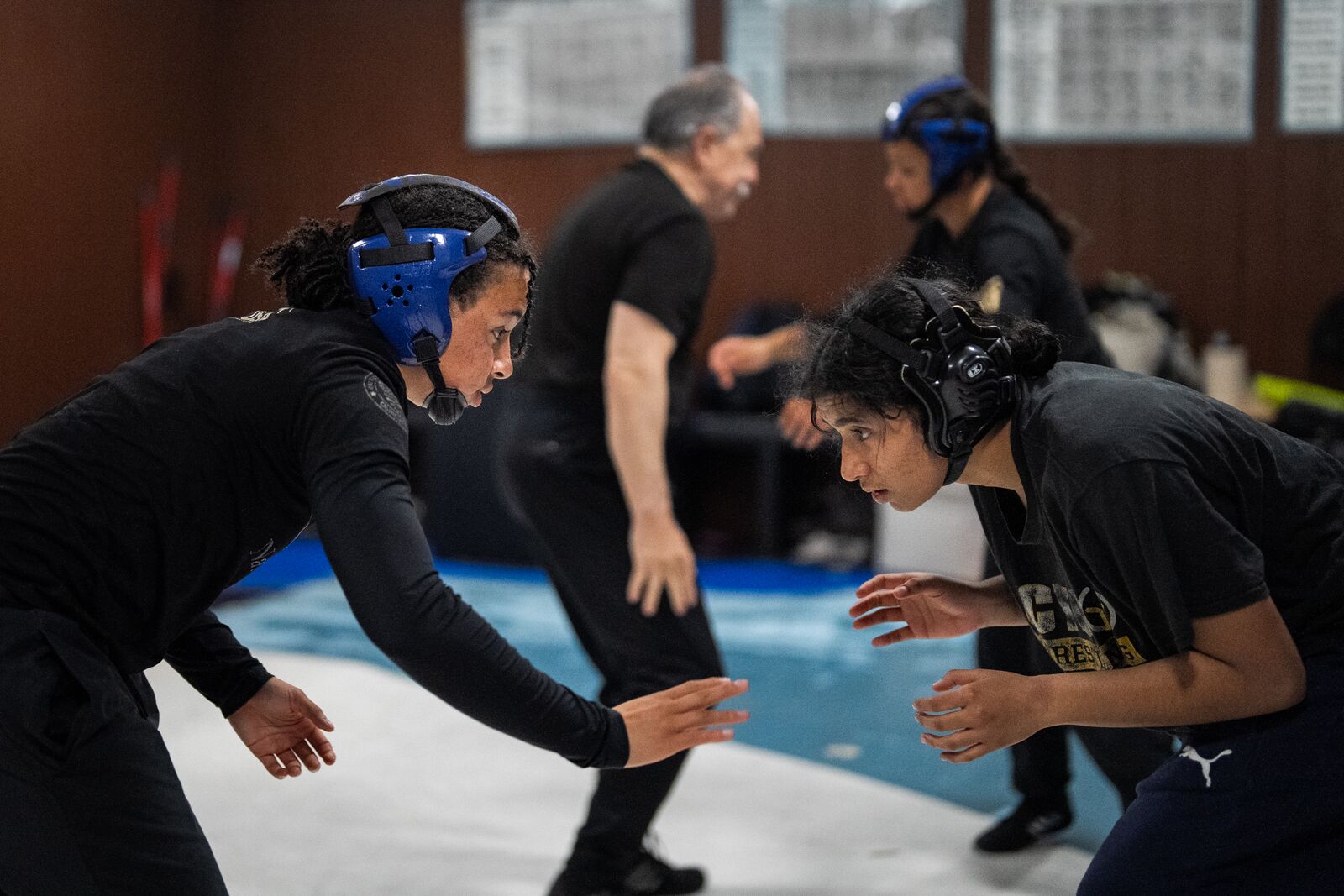 Shayna Ward, a senior at Oakland Technical High School, left, practices with Shiya Kachroo, a senior at Dougherty Valley High School, inside the wrestling room at Oakland Tech on Feb. 24, 2026. Credit: Sarahbeth Maney for The Oaklandside
“We all jumped into action,” District spokesperson John Sasaki said at the time. “We knew that this could not continue.” One anonymous donor stepped in to restore golf and tennis; another to restore lacrosse. The Oakland Raiders stepped up with $250,000.
But the inequities had set off a chain reaction, and the following month, a group of parents, represented by Legal Aid at Work, sent a letter claiming that Oakland Unified School District was in violation of Title IX, the landmark 1972 federal law — stipulating that “all persons, regardless of their gender, should enjoy freedom from discrimination of any kind in the educational institution of the state” — that set in motion the admission of women into all-male colleges and universities and mandated equal investment in girls’ sports. Participation in college sports, one long-term study found, is associated not only with physical health, but with social and financial well-being, self-motivation, and community engagement.
The legal claim has had profound effects across the Oakland Athletic League, The Oaklandside has found, setting in motion systems and protocols to achieve fairness not only in girls high school sports, but in growing a growing set of interscholastic middle school teams as well.
‘It tells girls they are second-class citizens’
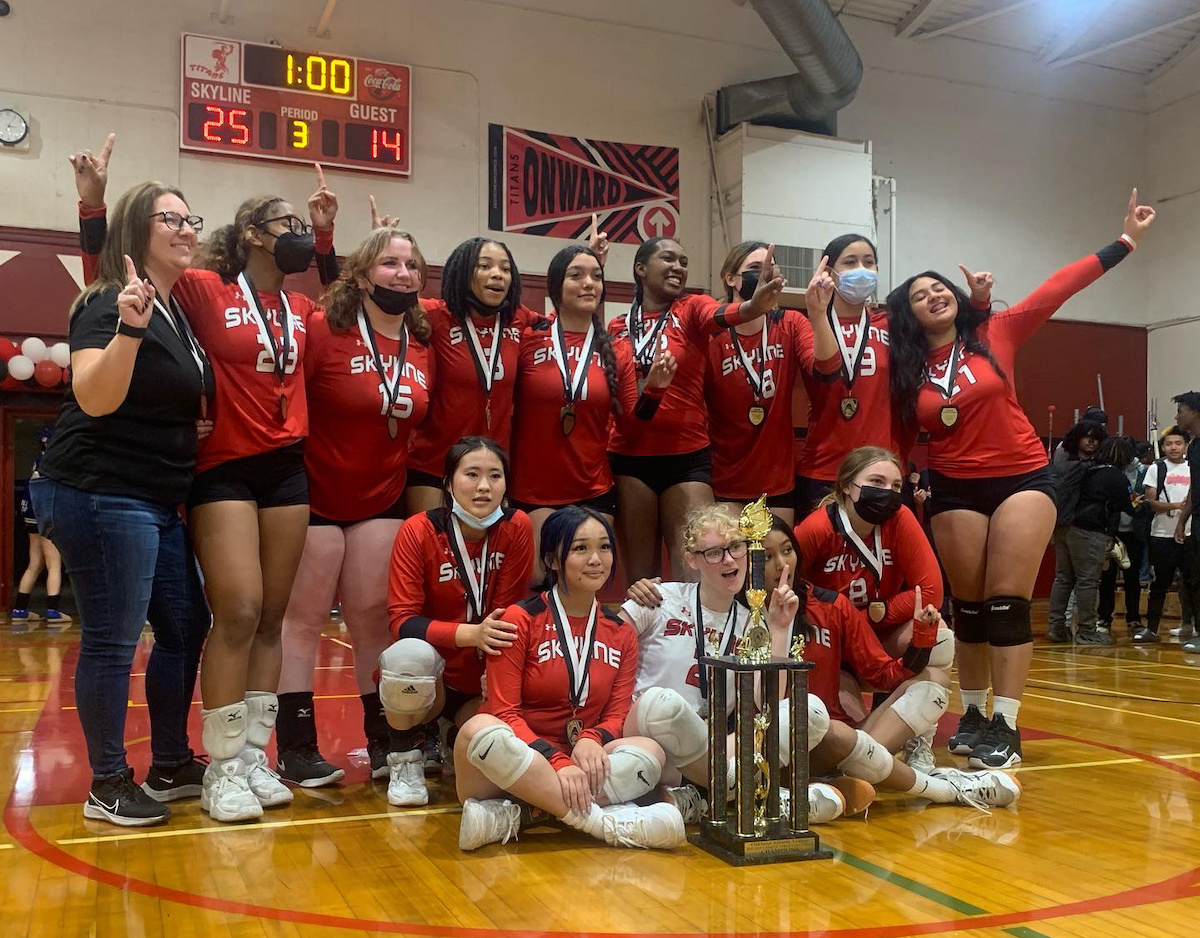 Skyline High School’s 2022 Oakland Athletic League championship volleyball team. Credit: Nick Lozito for The Oaklandside
Elizabeth Kristen, now legal director of the California Women’s Law Center, was part of the team who put together the case against the district. At the time, she was working for Legal Aid at Work, the San Francisco-based nonprofit law firm that drafted the legal demand letter.
“The organization I used to work at and the organization I’m at now have been focusing for decades on creating opportunities for girls and women to play sports,” she said, “both in equitable numbers, but also equitable facilities, uniforms, coaching and the right for girls to speak up about their rights without being retaliated against.”
Not long after the district’s budget cuts were announced, Kristen told The Oaklandside, an OUSD parent contacted Legal Aid. The Oaklandside reviewed a redacted version of the settlement agreement.
READ MORE from The Oaklandside’s high school reporting fellows
“This to me is a clean and clear and blatant violation of Title IX,” Kristen said at the time. “I realize they have this budget deficit, but balancing the budget on the backs of girls sends a terrible message. It tells girls they are second-class citizens.”
She said that the letter Legal Aid cited the district’s own numbers for the 2017-2018 school year, when girls represented around 48% of the student population, but only received around 44% of athletic opportunities — a roughly 4-point gap. The inequities, Kristen said, were in all aspects of sports, not just in participation opportunities, but also in terms of facilities, coaching and uniforms.
Kristen said the district’s in-house counsel was “cooperative” and “solution-oriented,” and documents show they quickly sat down to engage in negotiations. Within six months, a settlement was reached: OUSD would post the name and contact information of a Title IX coordinator at the district and instructions about how to file a complaint and hire a Title IX consultant for a year. The district would also file annual reports to the claimants’ counsel and submit to monitoring for three years. Most importantly, the district would commit to “equitable treatment and benefits” for male and female athletes, from equipment to facilities, coaching, travel, fundraising, and publicity.
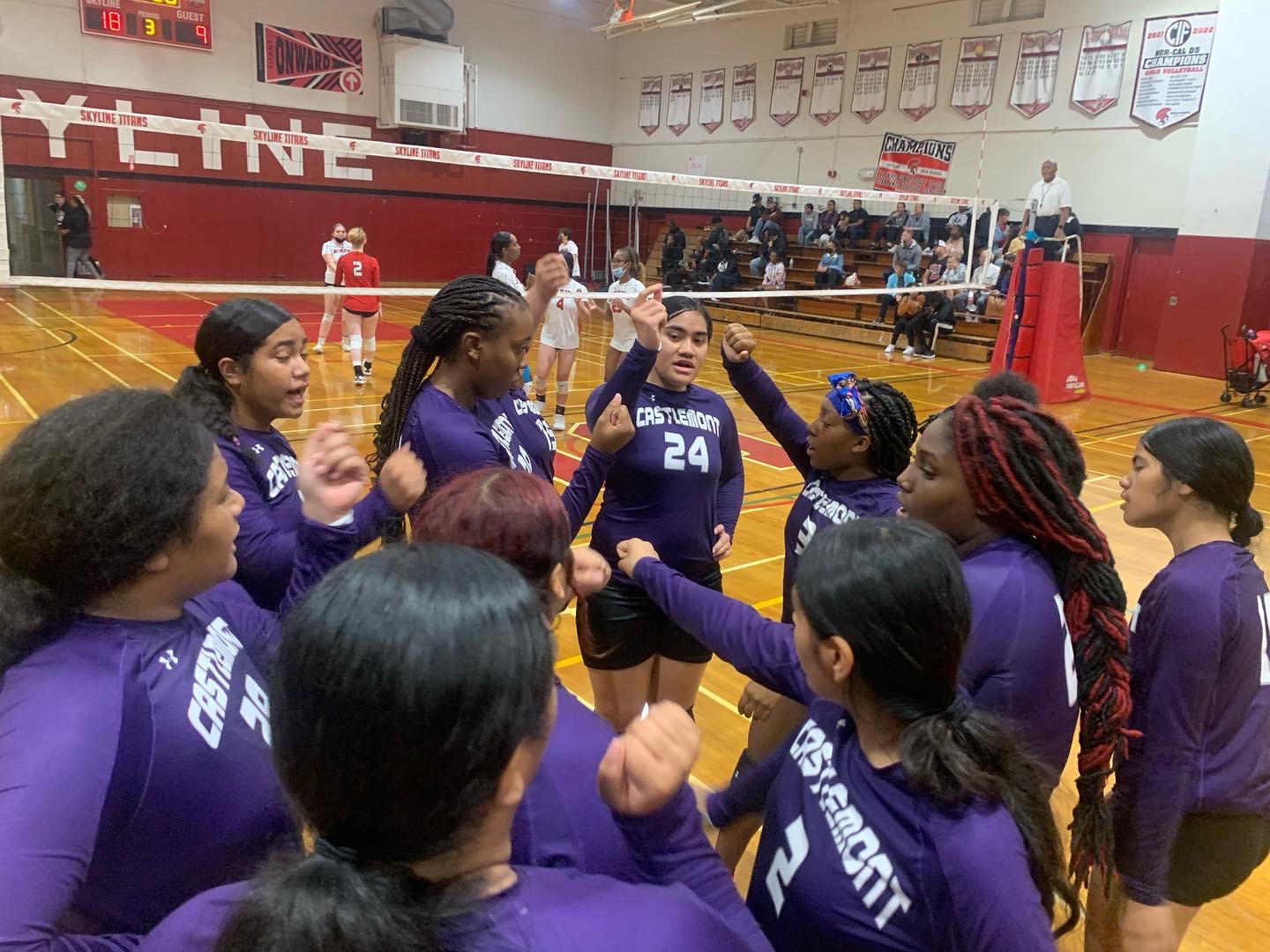 April Samate, number 24, rallies her Castlemont High volleyball teammates during their semifinal match against Skyline High in 2022. Credit: Nick Lozito
Five months after the deal was inked, Francisco “Franky” Navarro, a longtime coach and athletic director at Castlemont High took over as the new commissioner of the Oakland Athletic League. He was charged with ensuring compliance — and ushering in an age of gender equity in Oakland school sports.
“Franky was the person who, in this agreement, became the one that was trained by the outside Title IX consultant,” Kirsten said. “He became the Oakland expert on Title IX and what it requires.”
The monitoring was intended to last for three years, but Kirsten said that with sports suspended during pandemic remote learning, it was extended for another year. That oversight finally ended in 2024.
A tax measure marks a new era for high school sports
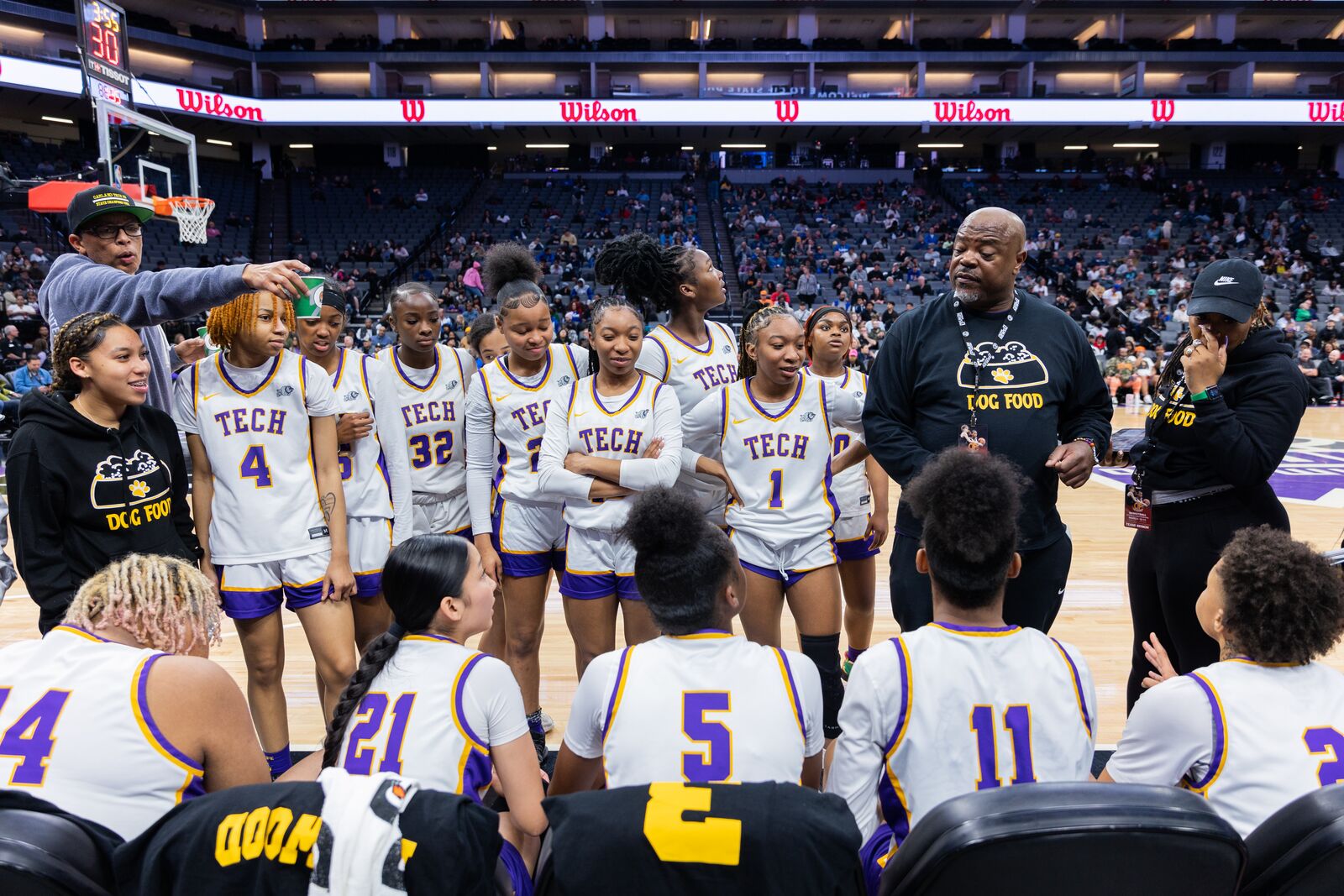 The Oakland Tech Lady Bulldogs have a team huddle on the sidelines of the CIF State Championship match in Sacramento, March 10, 2023. Credit: Amir Aziz/The Oaklandside
Under Navarro’s leadership, the Oakland Athletic League’s budget crept back up to where it had been before the budget cuts that set the Title IX complaint in motion. The budget finally crossed the $2 million mark in the 2022-2023 school year as Navarro began to build out sports in the district’s middle schools. That December, he made an even bigger play. He appeared before the independent committee that oversees Measure G spending to make an ask: commit money to OAL.
Measure G is a $195 annual parcel tax that was approved by voters in 2008 to bolster the city’s public schools by, among other things, attracting and retaining highly qualified teachers, keeping class sizes small and textbooks up to date, maintaining school libraries, and — what likely caught Navarro’s eye — providing “programs, including arts and music, that enhance student achievement.” His slide deck to the oversight committee, presented in December 2022, argues that more sports funding would boost student enrollment numbers, increase student attendance, and allow for equitable programming for boys and girls, maintaining Title IX compliance.
Navarro, who had himself been a student athlete in Oakland, playing baseball and soccer for Castlemont High, made his case, winning a major infusion from Measure G. By the 2024-2025 school year — the most recent year for which the committee has reviewed an annual spending report — OAL received $3.06 million for middle and high school sports.
According to Navarro, the current budget for OAL is $4.2 million, with roughly $3.7 million coming from the Measure G parcel tax to cover everything from coaching and refs to transportation, uniforms, and equipment. Money from the district’s general budget and ticket sales — around $200,000 last year, Navarro said — covers the rest.
“For me it’s an appreciation for the community and Oakland taxpayers,” Navarro said. “Everyone that pays this parcel tax on the properties in Oakland don’t know that the money goes to support OAL. And it really does.”
He said OAL has also forged partnerships with the city, which allows the league to use baseball fields for free; with private companies who offer sponsorships or discounts; and with professional athletes who want to give back to their alma maters.
Navarro said that since 2021, the district has had a partnership with Under Armour, the Baltimore-based sports apparel company, to purchase uniforms at a discounted rate. That discount, combined with Measure G funds, now allows OAL to provide uniforms to every high school team, junior varsity and varsity alike, on a three-year cycle. Stephen and Ayesha Curry’s foundation, Eat. Learn. Play., has also kicked in funds. Through these type of partnerships, he said, the league has also been able to buy uniforms at wholesale priced for girls flag football teams at Tech, Oakland High and Skyline through Marshawn Lynch’s brand Beast Mode.
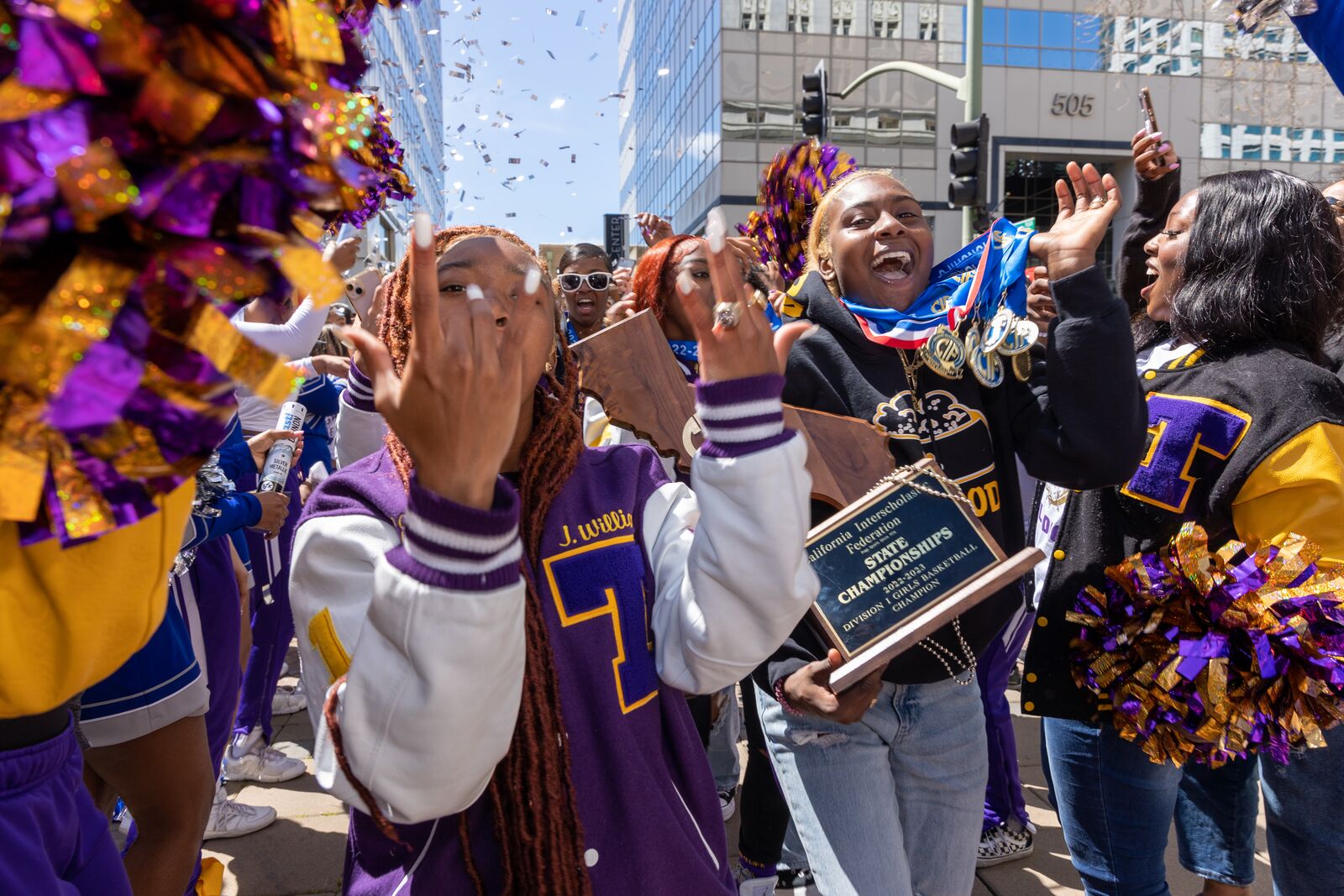 “City of Champions” parade and rally hosted by the City of Oakland celebrating the boys Oakland High School Wildcats Division III state title and the girls Oakland Tech Bulldogs Division I State title in Oakland on April 16, 2023. Credit: Amir Aziz/The Oaklandside
As head coach of the girls varsity basketball at Oakland High, Anita Simpson led her team to the California Interscholastic Federation state championship. She said that Oakland High alum Damian Lillard, the NBA player and gold-winning medal Olympian, has been giving back to his alma mater for years. In late 2016, Lillard joined with Adidas to revamp various parts of the school including the installation of a new weight room, a new sound studio, and a new scoreboard at the basketball court. Lillard, Simpson said, has also sponsored sneakers, balls, and uniforms for both the boys and girls basketball teams.
Navarro spends a lot of time making sure his $4.2 million budget gets distributed equitably — by gender, but also by school, and also among varsity and JV teams. Each team, he said, gets new uniforms every three years, and each team gets transportation to league games and up to five “nonleague” buses — for travel to matches an hour or more away. Each team also receives a budget of $450 per season, from the combined gate revenue, for items like uniform replacements and tournament fees.
Since 2018, Navarro said, the league has added girls flag football and girls lacrosse for high school, and increased participation in softball.
Navarro said that when professional athletes donate to school sports, the money is typically paid directly to the vendors involved, and neither the league nor Navarro are involved. In the case of Lillard, though, Navarro said the donation benefited the boys and girls basketball teams equally.
“There’s this notion that there’s a lack of funding, and that’s incorrect,” Navarro said. “There’s adequate funding. Can we do more? Of course.”
In a dream scenario, Navarro said he would like for the OAL budget to be $7.5 million a year, nearly double its current funding. That would allow the league to hire full-time athletic directors at each school like private schools have — currently, most do those duties on top of teaching PE or serving as a community school manager — increase coaching pay, and hire athletic trainers.
State champs with ‘ugly gold uniforms’
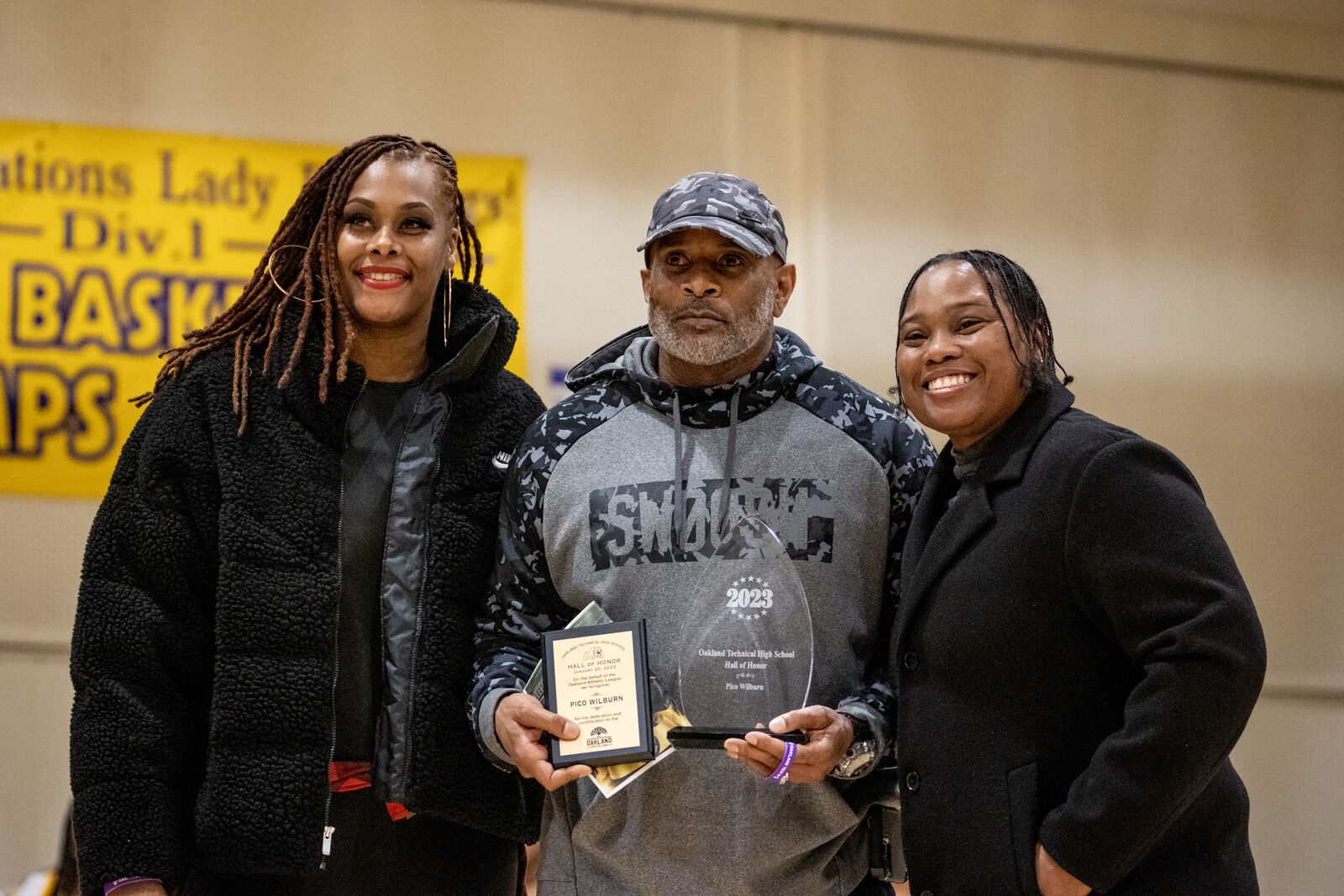 Former WNBA players Devanei Hampton and Alexis Gray-Lawson flank former Oakland Tech girls basketball coach Pico Wilburn at Oakland Tech’s inaugural Hall of Fame Class in 2023. Credit: Amir Aziz/The Oaklandside
Those kinds of resources have never flowed into OUSD’s sports programs before.
Alexis Gray-Lawson, the former WNBA player, graduated from Oakland Technical High School in 2005, when the sports program was at a low.
“When I first was at Tech, boys football had never won a silver bowl, and girls basketball had never won a championship before,” she said. “Tech had teams in the playoffs in the ‘80s, but by the ‘90s they were nonexistent.”
“We didn’t feel any inequities,” she recalled, “because both male and female athletes didn’t have access to facilities.”
Gray-Lawson said that a wave of Tech athletes who went on to have professional careers put Tech on the map — NFL players Marshawn Lynch and Josh Johnson (class of ‘04) and NBA player Leon Powe (class of ‘03), along with college stars like basketball players Quentin Thomas (class of ‘04), and Devanei Hampton, who was in the class of ‘05 with Gray-Lawson when they led the women’s basketball team to two state championships. “That’s when parents and other community members wanted to invest,” she said.
“We had these ugly gold uniforms my freshman through my junior year, and those uniforms had been worn by at least two or three more classes before me,” she said. “I remember us getting brand-new uniforms our senior year, but we had to go out and fundraise. There was a barbecue spot in East Oakland right off 80th Avenue that ended up donating money for us to get uniforms that year. And we had just won a state championship. The fact that we had these terrible uniforms on during the state championship, I think brought some awareness to it.”
“We were as good as Leon Powe,” she said, noting that she and Hampton were named McDonald’s All Americans, “and we still didn’t get the notoriety that the boys were getting,” even though more D1 athletes came out of girls basketball in OAL her year than boys basketball.
Many of OAL’s sports legends came up at a time when there weren’t women’s pro teams to feed into: McClymond High’s Bill Russell, who went on to win 11 NBA championships with the Boston Celtics in the 1950s and ‘60s; Hall of Famer Joe Morgan, a Castlemont High grad who went on to lead the Cincinnati Reds to back-to-back World Series wins in 1975 and 1976; running back MacArthur Lane, a Fremont High grad, who played for the NFL for 11 seasons in the 1960s and ‘70s; Skyline High’s Gary Payton, considered one of the one of the greatest point guards of all time, who was drafted into the NBA years before the WNBA launched.
 Gray-Lawson, an Oakland Tech grad (middle), played for the Phoenix Mercury during her two seasons in the WNBA. Credit: AP Photo/Ross D. Franklin
So far, only three women who started their basketball career at an Oakland public school have made it into the WNBA: Rehema Stephens, another Oakland Tech star, was drafted by the Monarchs in 1998 at the dawn of the league; Amisha Carter, out of McClymonds, joined the Liberty in 2004, and Gray-Lawson was drafted by the Mystic in 2010.
Seventeen years after Gray-Lawson graduated from Tech, she returned as the school’s athletic director, and she’s seen major changes. For one, the school finally has a weight room. And there’s another important one.
“When you look at Tech, we are evenly matched in sports participation by gender,” she said. “We have more female athletes now, especially with the addition of flag football.”
Simpson, the girls varsity basketball at Oakland High, said she thinks there’s still a long way to go in getting caught up after years of disenfranchising girls’ high school sports.
“To say that you can make up a deficit by just saying we’re going to be equal, that doesn’t work,” she told The Oaklandside. “Because, in essence, the program is already behind, which means you’re going to need more capital to bridge the gap.”
A balancing act
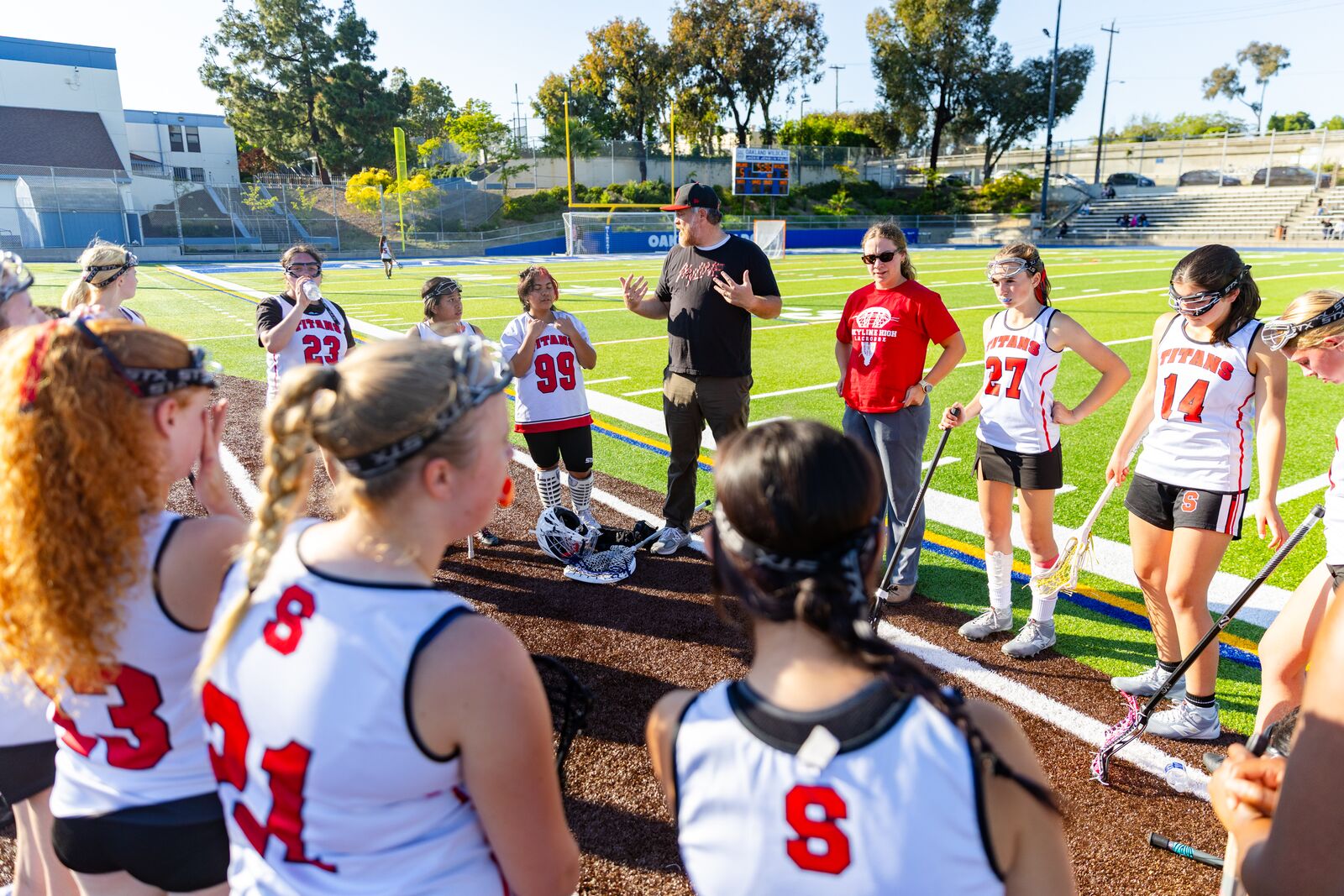 Skyline High School coaches Matt Clark, center, and Ivy Smith speak to lacrosse players during a match against Oakland High School on Wednesday, May 6, 2026. Credit: Estefany Gonalez for The Oaklandside
The challenge, Navarro said, is that coaches often want to turn to private fundraisers to get what they think their teams need. And that risks not only teams using vendors that aren’t district-approved, but creating spending imbalances that could throw the district out of compliance with Title IX.
“If the boys football team raises $20,000, how is it that an equal percentage of the girls team also gets a $20,000 benefit?” he said.
Last year, the Oakland High girls’ basketball team raised over $36,000 to cover costs for participating in the Nike Tournament of Champions tournament in Arizona, including flights, hotels and meals. In January, the Oakland High co-ed swim team launched a campaign to help pay for swimsuits, hoodies and snacks that raised more than $1,500.
Kirsten Mitchell, a spokesperson for GoFundMe, said more than 1,000 sports fundraisers have been created in Alameda County over the last five years, although she couldn’t break down how many of those were for public school teams in Oakland.
Navarro said sometimes teams fundraise at school sites and “we have no knowledge of it, no connection to it, but coaches still have to report it.” But when he’s made aware of a team that fundraises and their school can’t provide the equal benefit for the opposite gender, he said, “then we will use those gate revenues so that we can provide that same benefit.”
Many students we heard from said the private fundraising felt unfair on its face. “Asking for money from my parents just to be included in a high school soccer team is unjust,” Mariela Rubio, a ninth grader at Madison Park Academy, told us. “It should be funded directly from the school.” Navarro said he also tells teams that no student whose family can’t participate in those fundraisers, should ever be excluded from participating.
Navarro said gender equity questions also come up as he tries to build out middle school and junior varsity athletics, which are experiencing rapid growth, with 1,400 ninth graders participating on teams this year. He said he encourages school sites not to add a JV team for one gender unless they can add one for both, but student interest doesn’t always allow that. So in some cases there might be JV teams for boys in soccer or basketball that he’ll balance with a JV team in volleyball for the girls, or the recent addition of girls flag football.
It’s a constant balancing act, Navarro said.
When teams like those at Oakland Tech fundraise through their Parent Teacher Student Association or Associated Student Body accounts, it’s easier, Navarro said, as OAL has oversight over the funds and he can assure that the league is following Title IX rules. “We will work with the school to make sure that equal benefit is being provided,” he said.
Gray-Lawson said that at Tech, the athletic department tracks the funding they receive, which flows through the PTSA or ASB accounts, and how many athletes have played which sports — stats she sends along to OAL to assist with the league’s Title IX compliance.
Another equity-based fundraising option, Navarro said, is the Oakland Public Education Fund, a nonprofit that serves as a bridge between the community and the district, as a fiscal sponsor.
 Players face off during a lacrosse match between Skyline High and Oakland High at the Oakland High campus on Wednesday, May 6, 2026. Credit: Estefany Gonzalez for The Oaklandside
According to Ali Medina, the nonprofit’s chief executive officer, the organization’s efforts to mobilize resources for Oakland public schools and extracurricular programs are guided by two factors: compliance and equity. The goal is to ensure that “all fundraising efforts align with Title IX and other equity requirements, preventing imbalances within the league,” and that means the Ed Fund doesn’t sponsor fundraising for individual teams. Instead, they’ll develop campaigns to modernize a sports facility that will serve all genders or create a program to develop student-athlete leaders.
Mostly, the gender inequities that remain in OAL are subtle, students and coaches told us.
Simpson, the Oakland High girls’ basketball coach, said boys teams sometimes have more resources to tap into outside of school.
“Say the boys’ coach has access to other gyms from their own personal connections, that provides an advantage when, say, there’s usage conflicts in the school gym,” she said. “If that girls coach doesn’t have access to those resources, there’s still a gap there. People aren’t opening doors for each other.”
The sheer level of attention paid to boys’ versus girls’ teams can sting, students said.
“It’s better, but there’s a lot of things they can still do to fix it,” Jane Alexander, a triple threat at Skyline High School who played softball, flag football and basketball this school year. Alexander said she sees access to the gym and uniforms as equal. But the boys’ teams, in her view, just get more attention. Students show up for the men’s football games despite a losing season, but somehow when the girls basketball team made it to the state championships in 2025, they still couldn’t shake an old reputation as a “bad” team. The boys’ tackle football team, she said, will sometimes show up before flag football practice is over, forcing the girls onto a partial field. Or kids will speculate about whether a middle school boys’ soccer team could beat the Skyline women.
“The girls’ teams aren’t talked about with respect,” she told The Oaklandside. “I think if they acknowledged us,” she said of Skyline’s leaders, maybe with more attention at pep rallies, “more people would notice the girls teams have talent, and go to their games.”
A Skyline sophomore badminton player named Caden Holder also said that while facility access is equitable, he had experienced gender inequity in other ways. “I have seen male coaches treat women like they are inferior to men, or feel less than men,” he said. “I have witnessed students and other athletes making sexist jokes.”
Skyline’s athletic director, Koresh “K.C.” Adams, about the students’ claims, but he didn’t respond to our request for comment.
Navarro said that when it comes to OAL, the league roots for all teams equally.
“Everyone in the office is a girl’s dad,” he said.
This article was reported in collaboration with two Oakland high school student reporters, Alexis Kennedy and Brean Melgoza, who are participating in an Oaklandside high-school fellowship program made possible by a grant from the Stuart Foundation.
“*” indicates required fields