
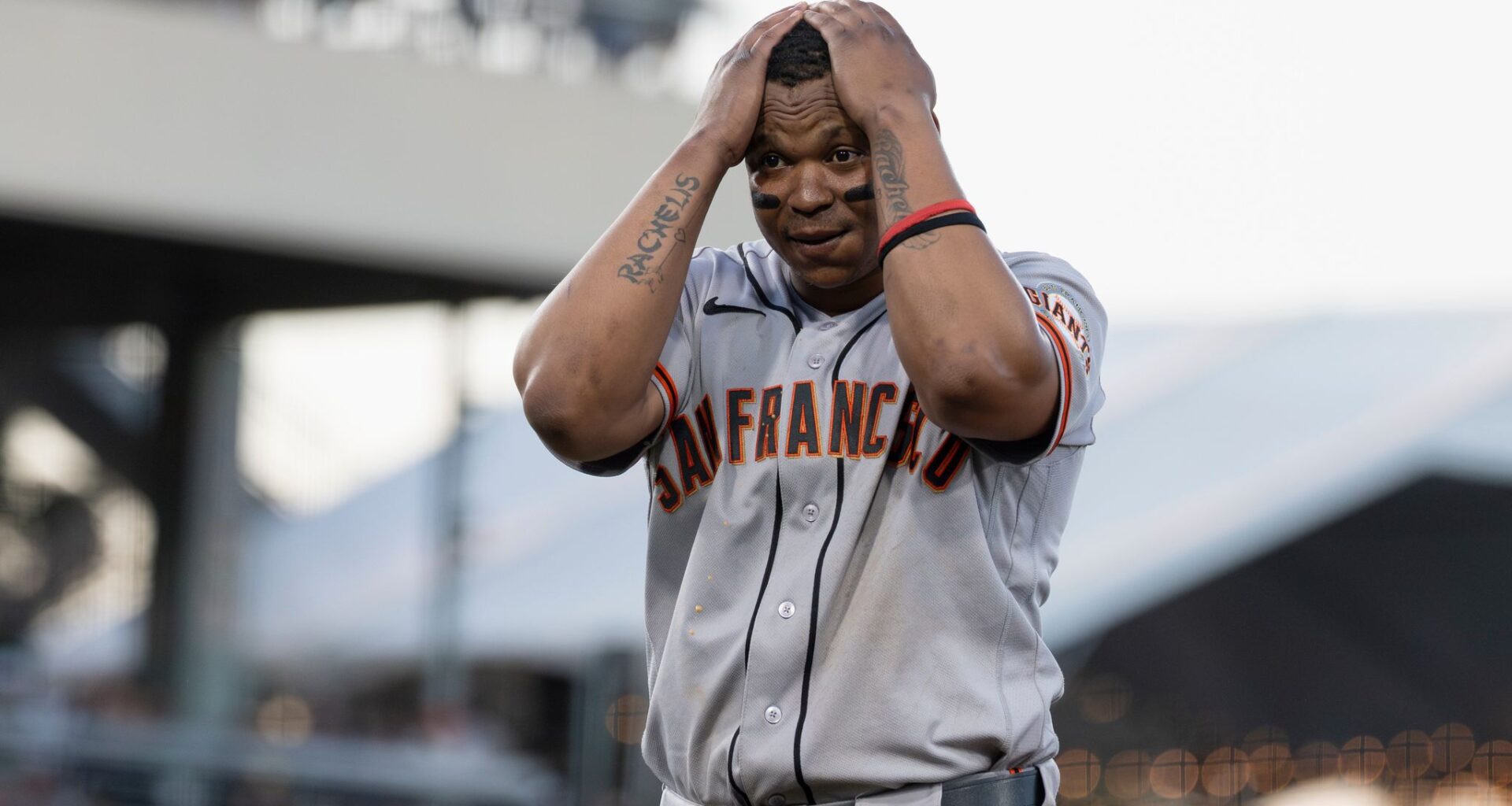
Giants slugger Rafael Devers reacts after striking out during the fifth inning against the Athletics on May 15 in West Sacramento.
Sara Nevis/Associated Press
After one of the San Francisco Giants’ recent losses to the Diamondbacks, manager Tony Vitello noted that the team needs to be better at throwing strikes — and hitting them.
That’s a pretty fundamental part of the game, and Vitello is correct: The Giants aren’t among the better teams when it comes to anything strike-zone related, including the ABS challenge system. They’re last in taking walks, by a large measure. They’re climbing the ranks in walks issued, while the expertise the Giants showed with the ABS system in the spring has diminished.
The strike zone is slightly smaller with the ABS format, which features a new elongated oval, meaning walks are up overall across MLB to 3.5 per nine innings compared to 3.2 last year. Yet the Giants entering Friday had drawn just 119, or 2.1 per game; the next worst teams, the Rockies and Mets, had 162.
Article continues below this ad
The Giants are seeing the fourth fewest pitches per plate appearance, 3.80, and seeing the most strikes (including pitches swung at out of the zone) at 65.9%. (The Yankees are last, seeing a strike just 61.2% of the time.) Teams will just keep throwing strikes until San Francisco starts doing more damage. Meanwhile, the Giants are helping their opponents by swinging at 33.1% of pitches outside the zone, the fourth worst mark in the majors.
Could the ABS system itself be playing some role in this? Catcher Eric Haase theorized that teams with older players who haven’t seen the ABS system before are at a slight disadvantage because they haven’t learned the ABS zone, which is calibrated to a player’s specific measurements, while younger players became accustomed to the system in the minors. The A’s, Marlins and Royals, all younger squads, are among the better teams challenging when in the batter’s box.
San Francisco Chronicle Logo
Make us a Preferred Source to get more of our news when you search.
Add Preferred Source
“I think part of it is that,” Giants third baseman Matt Chapman said of learning the ABS zone, “and part of it is that we’re not doing enough damage, so teams are coming after us. I think both are true.”
Article continues below this ad
Dodgers catcher Will Smith celebrates after Giants third baseman Matt Chapman struck out to end their game on May 13 in Los Angeles.
Mark J. Terrill/Associated Press
Giants assistant GM Paul Bien is the team official with the most ABS expertise, and he thinks there is something to having a lineup with fewer ABS-experienced hitters.
“I think the players’ intuition there probably makes a lot of sense,” he said. “It’s obviously been an adjustment for everyone, and it seems like the more reps you have at it, the more natural it’ll become. That’s a good hypothesis.”
The Giants’ two best hitters when it comes to challenges, Drew Gilbert and Bryce Eldridge, are both familiar with the system from the minors. Eldridge, by virtue of his height (6-foot-7) has a larger zone than most, but he knows the ABS zone well — for the most part.
“The high strike could go either way, especially with me,” Eldridge said, echoing the team’s catchers, who believe the high strike is harder to gauge. “It’s a little tricky sometimes.”
Article continues below this ad
Eldridge was 2-for-2 on challenges entering Friday, but he was kicking himself for not asking for one in Tuesday night’s loss to Arizona, a game in which Rafael Devers challenged in a great spot to do so — bases loaded, two outs — on a very close pitch and lost, only to then strike out on another low strike that looked out of the zone.
“You could probably tell from my face I definitely didn’t think it was a strike, but obviously if I was 1,000% sure, I would have done it right there,” Eldridge said of the 3-2 curveball that ended his at-bat. “I kind of just froze in that moment, we had one left, it was the sixth inning, I didn’t want to take the last one away before we got into the later innings.”
The older players might have nearly an inch of difference at the top or bottom of their zones, an adjustment for sure.
Umpire Chad Whitson announces that the Giants’ Heliot Ramos, left, challenged a strike, which was overturned, during the ninth inning against the New York Yankees at Oracle Park on March 28.
Jeff Chiu/AP
“Some guys have a pitch called a strike for the entirety of their careers and now it’s not,” catching coach Alex Burg said. “And you see a lot of guys’ heights have changed a ton. They were listed at 6-2, now they’re measured at 6-foot. For that guy, his zone is more than half an inch smaller than it would have been.”
Article continues below this ad
The Giants are in the middle of the pack when it comes to hitters’ challenges, with a 46% success rate. As with so much with this team after a bad start to the season, they believe they’ll improve with time.
“I think it’s something we can get better at, myself included,” said Chapman, who had been successful in three of eight challenges entering Friday. “You get emotional on one — you challenge it, and it doesn’t work out, then the next one is a ball that gets called a strike and I’m like, ‘Damn, I should have challenged,’ so I’ll be thinking about that one and then challenge another one.
“The ones that I’ve gotten screwed on, nobody’s been on base — I want it to be a meaningful challenge.”
If the challenge fizzles, that can get into a player’s head.
“There’s this weight that that carries,” hitting coach Hunter Mense said. “It’s like, if you get it wrong, you feel like you’re letting people down. There’s a real teammate aspect to it; you don’t want to just start throwing challenges out there. You don’t want to be selfish because some situations are much more high leverage than others.”
Article continues below this ad
Giants hitting coach Hunter Mense talks to the team during a spring training practice at Scottsdale Stadium in Arizona on Feb. 20.
Carlos Avila Gonzalez/S.F. Chronicle
During spring training games, the team’s catchers and pitchers were successful at a 60% clip; that has dipped to 51% during the regular season, 25th best.
“The toughest part of it is taking out emotion, and I think in spring training that’s easy,” catcher Daniel Susac said. “A lot of times emotion comes into it, so the tough part is balancing out when is the right time and wrong time.
“The top of the zone is a tough one. The bottom is so concrete, you can tell where it is, but the top is so just kind of hard to tell with each hitter. The bottom is pretty true, left and right is pretty true and the top really depends on the day.”
With the system based on individual player measurements, that shouldn’t be the case, and Berg has the Giants’ catchers — Susac, Haase and Jesus Rodriguez — working with the TrackMan radar technology to help make the ABS strike zone feel like second nature.
“You’re trying to figure out, ‘What is 27% of 5-foot-10?’ or ‘What is 53.5% of 6-foot-4?’” Berg said of how the bottom and top of the zone is measured for each batter. “That is always going to be a struggle until these guys get used to the system. It’s a work in progress, you do get a little gun-shy.
“Catchers have so many things going on, it’s ‘Catch this pitch as well as I can, what’s the next pitch, what have I thrown this guy before?’ The challenges are a little lower on the totem pole. There’s some strategy involved, and our guys are getting much better at it; we tell them, ‘Do be aggressive if you’re in a spot you know that’s going to change an at-bat — or maybe even change the complexion of a game.’”
Giants outfielder Harrison Bader flips his bat after striking out during the ninth inning against the Athletics on May 16 in West Sacramento.
Sara Nevis/Associated Press
Vitello likes to look at the challenge system as a nice opportunity, nothing to get too worked up over if it doesn’t work out.
“It’s a bonus if it goes your way,” he said. “If not, you’ve got to be prepared to deal with the circumstances, move on to the next thing and not let it affect the next pitch or the rest of your at-bat.”
For those in the stands, the ABS system has provided extra drama and highlighted the fact that the umpires do a very good job, as only a handful of calls in a game are reversed.
“I think it’s been a pretty well-done system,” Bien said. “It’s found a nice sweet spot of being entertaining to watch while also getting more calls correct. We’re all trying to adapt to how to best utilize it, but at the same time I think it’s been a positive from a game-play experience.”
“From a fan’s perspective, it’s one of the most exciting things,” Mense said. “Even when it’s in a low-leverage situation, it grabs your attention.”